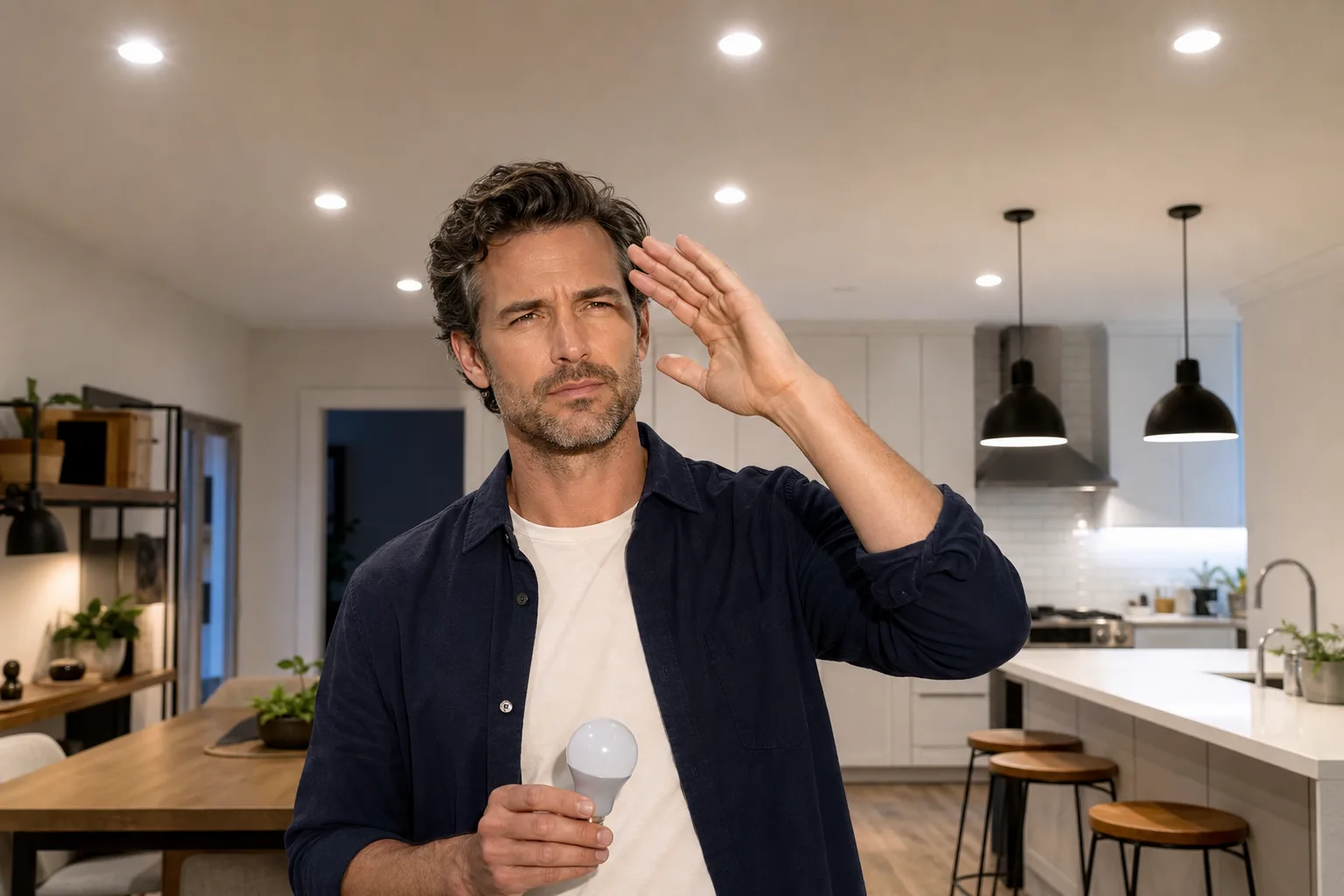
If your lights are too bright, start with the least disruptive fixes: reduce the lamp's lumen output, redirect exposed light away from your eyes, use fewer fixtures at once or lower the output with a compatible dimmer. Brightness is not the only possible problem. A visible LED source, narrow beam, cool color appearance or brightly lit room surrounded by darkness can feel harsh even when the total light output is reasonable.
Do not replace wiring or install a wall dimmer merely to diagnose the problem. First determine whether you are dealing with too many lumens, glare, poor distribution or a control issue. The tests below require no electrical disassembly.
Run a quick brightness diagnosis
Change one variable at a time and observe the room from the positions where discomfort occurs. Test at the same time of day because daylight can change both the measured level and your perception of contrast.
- Turn off some lights. If the room immediately becomes comfortable while work surfaces remain usable, the combined output is probably excessive.
- Shield the source from view with your hand. Do not touch the lamp or fixture. If discomfort falls while the room still looks adequately lit, glare or fixture placement is more likely than excessive total output.
- Move to another seat or viewing angle. A large improvement points to a directional beam, exposed lamp or reflection from a screen, countertop, glass table or glossy wall.
- Compare daytime and nighttime conditions. If the problem is worse at night, strong contrast between the lit area and its surroundings may be contributing.
- Check the packaging or product label. Record lumens, color temperature in kelvins, beam angle and whether the lamp is marked dimmable.
The Illuminating Engineering Society defines glare as a sensation caused by luminances in the field of view that are sufficiently greater than the level to which the eyes are adapted. Its severity depends on factors including source position, size and luminance.[2] In practical terms, a small exposed source can be uncomfortable without making the entire room objectively overlit.
Understand what the lighting numbers mean
Lumens describe output, not electricity use
A lumen measures emitted light, while a watt measures electrical power. Compare replacement lamps by lumens rather than choosing solely by their wattage or an old incandescent-equivalent label. The U.S. Department of Energy lists approximately 450 lumens as a conventional 40-watt incandescent replacement, 800 lumens for 60 watts, 1,100 lumens for 75 watts and 1,600 lumens for 100 watts. These are comparison points, not room-by-room requirements.[1]
If a six-lamp fixture contains six 800-lumen lamps, its nominal source output is 4,800 lumens:
Total source lumens = number of lamps × lumens per lamp
6 × 800 = 4,800 lumens
This calculation does not tell you how much light reaches a desk or floor. Shades, lenses, beam direction, mounting height, room dimensions and surface reflectance all affect the result.
Lux and foot-candles describe light reaching a surface
Illuminance is light falling on an area. One foot-candle equals one lumen per square foot.[3] Lux is the metric equivalent based on square meters. A handheld illuminance meter can help compare conditions before and after a change, but a phone app should be treated as a relative indicator unless its accuracy has been verified.
For a rough planning estimate:
Average foot-candles ≈ lumens reaching the work plane ÷ area in square feet
For example, if an estimated 2,000 lumens actually reach a 200-square-foot area, the simple average is 10 foot-candles. This assumes perfectly even distribution, which real rooms do not provide. Use the formula to compare options, not to promise a precise result.
Color temperature can change perceived harshness
Color temperature describes whether white light appears warmer or cooler; it does not measure lumen output. A 5,000 K lamp is not automatically brighter than a 2,700 K lamp, but cool light may feel more intense in a relaxing room, especially at night. If the output is otherwise suitable, moving to 2,700–3,000 K may produce a more comfortable appearance. For work areas, evaluate color and output separately rather than assuming a warmer lamp will solve excess illuminance.
Match the symptom to the likely cause
| What you notice | Likely cause | Safe test | Typical fix |
|---|---|---|---|
| The whole room looks washed out | Too many total lumens or too many fixtures operating together | Switch off one lighting group or remove one lamp only where the fixture permits it | Use lower-lumen lamps, separate controls or fewer active fixtures |
| Your eyes hurt when you can see the lamp | Direct glare from an exposed or shallow source | Block the source from view with your hand without touching it | Add a compatible diffuser or shade, use a frosted lamp, or choose a deeper fixture |
| A table or screen has a bright reflection | Reflected glare | Change your seat, screen angle or fixture aim | Reposition the light, use indirect lighting or reduce glossy reflections |
| One spot is intense while nearby areas are dim | Narrow beam or poor spacing | Observe the beam edge on the floor or wall | Choose a wider beam, diffuse the light or add lower-output layers |
| The room feels clinical at night | Cool color temperature combined with high contrast | Temporarily use a warmer lamp of similar lumens | Select a warmer color temperature and light adjacent surfaces softly |
| A dimmer barely lowers the light | Limited dimming range or lamp-control incompatibility | Check the lamp and dimmer compatibility documentation | Use a listed compatible combination or have the control replaced |
| Brightness changes unexpectedly | Scene settings, daylight response, smart controls or a fault | Review schedules and control settings without opening electrical boxes | Correct the settings; seek service if behavior continues |
Choose the fix that addresses the actual cause
Use lower-lumen lamps
For fixtures with replaceable bulbs, stepping down in lumens is usually the simplest permanent fix. If an 800-lumen lamp is plainly excessive, test a lower-output lamp with the same approved base, voltage, physical size and fixture-use rating. Do not exceed the fixture's maximum lamp wattage, and verify that an LED is approved for enclosed fixtures if it will operate behind a sealed globe. DOE notes that heat in fully enclosed fixtures can affect the performance and life of LEDs not designed for that application.[1]
Improve shielding and distribution
If blocking the source from sight solves the discomfort, reducing total lumens may unnecessarily darken the room. A frosted lamp, deeper shade, diffuser or fixture with better cutoff can soften the source while preserving useful light. Confirm that any added shade or diffuser is designed for the fixture and does not trap heat or contact the lamp.
For recessed lights, a wider beam can reduce bright pools and dark gaps. Adjustable fixtures should be aimed away from normal sight lines and reflective screens. In a low ceiling, broad indirect or surface-mounted light may be more comfortable than high-intensity downlights.
Use compatible controls
Dimming is useful when the same room supports cleaning, work, dining and relaxation, but the lamp, driver and dimmer must be compatible. A bulb marked dimmable is only one part of the system. ENERGY STAR advises checking the dimmer manufacturer's recommendations or the fixture's compatible-dimmer list because not every LED works well with every dimmer.[4]
Do not assume that a slider set halfway produces exactly half the light. Judge the useful range, low-end stability, noise and whether all lamps start together. Flicker, buzzing, sudden shutoff or a poor dimming range may indicate incompatibility rather than excess brightness alone. See the guides to choosing an LED dimmer, LED flickering and LED buzzing before replacing components.
Plan lighting in layers instead of relying on one bright source
A single high-output ceiling fixture has to illuminate every activity, so it is often brighter than necessary for resting and still poorly placed for reading or detailed work. Layered lighting separates three functions:
- Ambient lighting provides low-to-moderate general visibility.
- Task lighting places additional light where reading, cooking or close work occurs.
- Accent lighting highlights art, shelves or architectural features without carrying the room's full lighting load.
DOE lighting guidance emphasizes matching light quantity and quality to the task, using task lighting where needed and reducing ambient light elsewhere.[1] This approach can make a room feel calmer while improving visibility at the actual work surface.
Use a simple room-planning method
- List the activities performed in the room and their locations.
- Identify which existing fixture provides ambient, task or accent light.
- Operate only the ambient layer and note dark or uncomfortable areas.
- Add task lights individually rather than raising output across the entire room.
- Check the result from seated and standing eye levels.
- Repeat the assessment after dark, when windows become dark surfaces and contrast increases.
For a deeper plan, see layered lighting basics, the guide to glare and how to plan home lighting.
Know the electrical-safety boundary
Replacing a user-serviceable bulb is different from altering a fixture or wall control. Turn the light off, allow the lamp to cool and use a stable access method. Follow the fixture and lamp instructions. Do not modify a socket, driver, recessed housing, junction box or hardwired luminaire to reduce brightness.
Dimmer replacement involves building wiring and must comply with the applicable electrical code, product instructions and local permit rules. Use a licensed electrician when you are not qualified or authorized to perform that work, when the wiring arrangement is uncertain, or when a compatible control requires circuit changes.
Stop using the affected circuit and seek qualified help for a burning or rubbery smell, sparks, discoloration, unusually warm outlets or switches, repeated breaker trips, tingling sensations or persistent unexplained flickering. These are among the warning signs in the National Fire Protection Association's residential electrical-safety checklist.[5]
A dimmer can feel slightly warm in normal operation, but a hot faceplate, crackling sound or odor is not a brightness-adjustment problem. Do not continue testing it by repeatedly cycling the control.
Final checklist before buying replacements
- Record the current lamp's lumens, watts, color temperature and beam angle.
- Confirm the socket or base type, voltage and physical dimensions.
- Check whether the fixture is open, enclosed, recessed or insulation-contact rated.
- Decide whether the problem is total output, direct glare, reflection, beam concentration or color appearance.
- Choose lower lumens only when the room has excess output overall.
- Choose better shielding or a wider beam when the source or bright spot is the problem.
- Verify that both the lamp and control are designed and documented for dimming together.
- Preserve adequate task and pathway lighting after making the room more comfortable.
- Use a licensed electrician for hardwired alterations or electrical warning signs.
The best fix is usually the smallest change that reduces discomfort without making stairs, work surfaces or circulation areas difficult to see. Measure and compare where practical, but also evaluate source visibility, distribution and contrast: a lumen number alone cannot describe the complete visual experience.
Frequently asked questions
How can I make a light less bright without installing a dimmer?
Use a compatible lower-lumen bulb, improve the fixture's shielding, choose a frosted lamp or redirect an adjustable fixture away from eye level and reflective surfaces. If several fixtures operate together, use fewer lighting layers where existing controls allow.
Will a warmer bulb make a room look less bright?
A warmer color temperature can feel softer, particularly at night, but it does not necessarily produce fewer lumens. If the room has excessive light output, reduce lumens as well as considering a warmer color.
Why is my LED still bright at the dimmer's lowest setting?
The lamp or driver may have a limited dimming range, or the LED and dimmer may be incompatible. Check both manufacturers' compatibility information. A licensed electrician should replace a hardwired control when necessary.
Can I cover a bright LED fixture with paper or fabric?
No. Improvised covers can trap heat, contact electrical parts or create a fire hazard. Use only shades, diffusers and accessories designed for the specific fixture, or replace the lamp or fixture with a suitable lower-output option.
Questions & discussion
Share a question or a useful experience about this guide. Comments appear immediately. Your name and comment are public. Email is optional and stays private; reply emails are not enabled yet. Comment privacy.