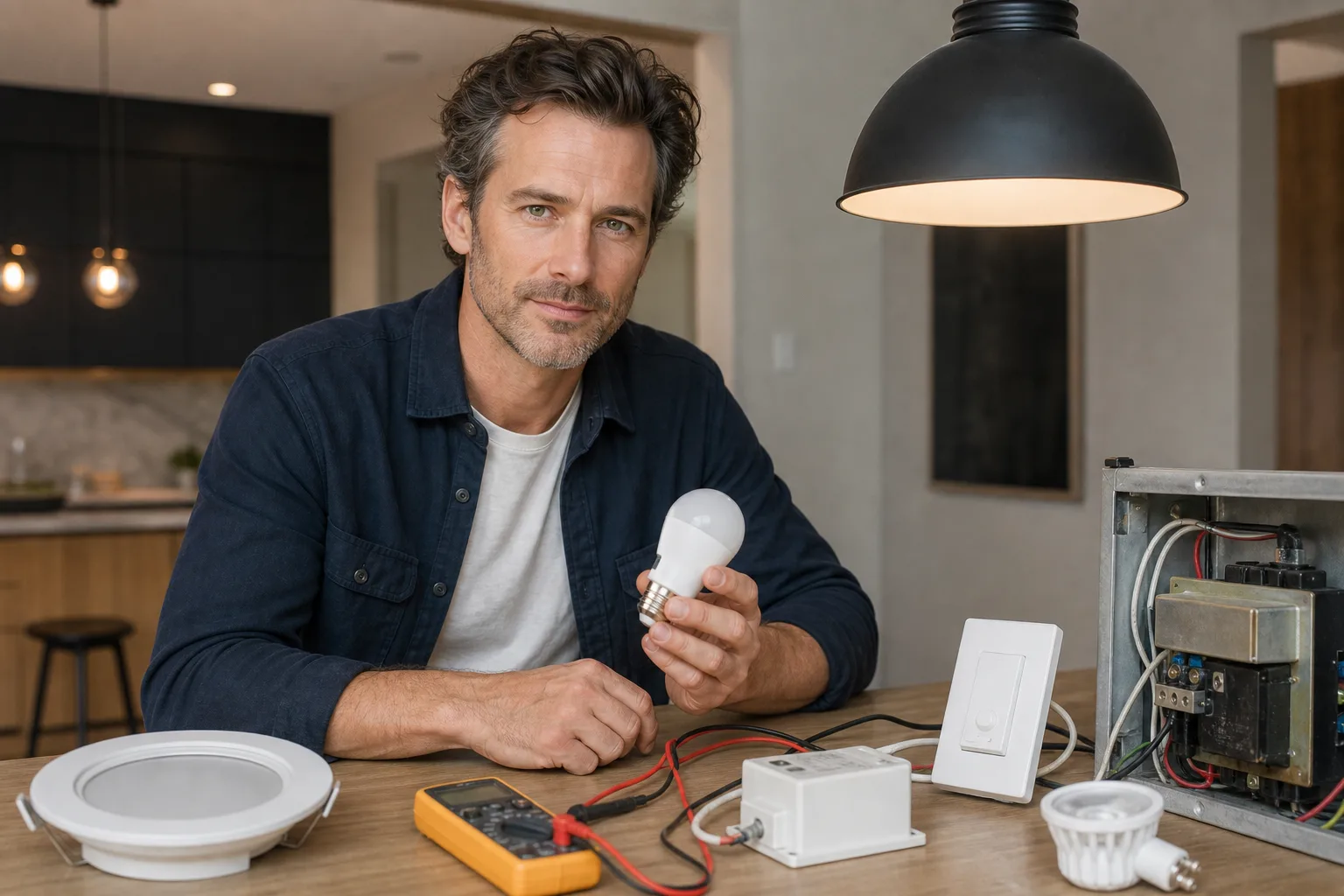
An LED light buzzing is usually caused by an interaction between the bulb or fixture driver and another component, especially a dimmer or low-voltage transformer. A loose bulb, an aging driver or a resonating fixture can also create noise. Start by locating the sound without opening any electrical enclosure. If it comes from a wall switch, outlet, wiring box or electrical panel—or is accompanied by heat, a burning smell, sparking or repeated breaker trips—turn off the affected circuit and contact a licensed electrician.
First, determine whether the buzzing is a safety warning
A faint sound from an LED bulb or integrated fixture is often a performance or compatibility problem. Buzzing from building wiring or electrical controls can be more serious. Do not assume that every electrical sound is harmless.
Stop troubleshooting and call an electrician if you notice:
- Buzzing, crackling or sizzling inside a wall, outlet, switch box or breaker panel
- A switch plate, outlet or fixture canopy that is unusually hot
- A burning, melting or sharp electrical odor
- Sparks, smoke, discoloration or visible wire damage
- A breaker that trips repeatedly when the light is used
- Buzzing that suddenly becomes much louder or is accompanied by erratic operation
UL Solutions advises stopping use and calling an electrician when buzzing originates at an outlet because loose or damaged connections can allow current to jump between conductors. Its electrical-warning guidance also treats sparking, unusual odors and hot outlets as reasons for professional inspection. Review the UL Solutions electrical warning signs.
Do not remove a switch plate, fixture canopy, junction-box cover or electrical-panel cover as part of this guide. Turning a wall switch off does not prove that every conductor inside an enclosure is de-energized.
Why LED lights buzz
An LED does not operate directly from ordinary household alternating current. Electronics called a driver convert and regulate the power for the light-emitting diodes. Depending on the product, the driver may be built into a replaceable bulb, an integrated fixture or a separate module. Electrical and magnetic components within the complete system can produce audible vibration when the incoming waveform is irregular or incompatible.
Dimmer and LED incompatibility
This is one of the most common causes when the sound changes as the light level changes. A dimmable label means the LED can work with some dimmers; it does not guarantee good performance with every dimmer. Older controls designed for incandescent lamps may have load requirements or electrical characteristics that do not suit a low-wattage LED driver.
U.S. Department of Energy testing has found that interactions among LED lamps, dimmers and transformers can produce audible noise, flicker, dead travel, sudden dropout and other unwanted behavior. ENERGY STAR therefore requires certified dimmable downlights to publish compatible or known-incompatible control information. See the ENERGY STAR downlight criteria.
Low-voltage transformer mismatch
MR16 and some other low-voltage lamps may share a system with an electronic or magnetic transformer. The lamp, transformer and dimmer must work together. In a DOE study of LED MR16 systems, audible-noise results varied substantially among transformer-and-dimmer configurations, demonstrating why a lamp that is quiet in one installation may buzz in another. Read the DOE MR16 system report.
Loose lamp or vibrating fixture parts
A replaceable bulb that is not seated correctly can make intermittent contact or transfer driver vibration into a socket or shade. Lightweight trim, glass, metal panels and decorative parts may amplify a quiet driver vibration. Do not continue using a lamp if its base, socket or contacts appear burned, cracked or corroded.
Aging or defective driver
A lamp that was previously quiet but now buzzes at every setting may have a deteriorating driver. Heat can accelerate component aging, particularly when a bulb not rated for enclosed fixtures is used inside a sealed globe or other restricted enclosure. Replacement is generally more practical than attempting to repair a consumer LED bulb.
A safe LED buzzing test sequence
Use the least invasive test first. Keep notes about when the noise occurs, because a buzz that appears only at low dimmer settings suggests a different problem from one that continues at full output on a standard switch.
| Observation or test | Likely direction | Appropriate next step |
|---|---|---|
| Buzz comes from an outlet, wall box or panel | Possible connection or wiring fault | Stop using the circuit and call a licensed electrician |
| Noise appears only when dimmed | LED and dimmer incompatibility or unstable low-end operation | Check both manufacturers' compatibility information |
| Buzz is loudest at full output | Driver, transformer or fixture resonance | Test a compatible replacement lamp, if the lamp is replaceable |
| One bulb buzzes while identical bulbs remain quiet | Loose, damaged or failing bulb | Reseat it with power off; replace it if the noise remains |
| Every bulb on one dimmer buzzes | Control compatibility, loading or wiring issue | Verify the dimmer model, LED rating and supported lamps |
| Low-voltage MR16 lamps buzz | Lamp, transformer and dimmer interaction | Use a documented compatible combination or seek professional assessment |
| Integrated fixture buzzes on a standard switch | Fixture driver or internal component issue | Check the warranty; have the fixture serviced or replaced |
1. Locate the sound without disassembly
Listen from a safe distance and compare the bulb or fixture with the wall control. Do not press an ear or hand against energized equipment. If the source cannot be distinguished, an electrician can isolate the components safely.
2. Record the operating conditions
- Does the buzz begin immediately or after the light warms up?
- Does it change at low, middle and full brightness?
- Does it affect one lamp or every lamp on the control?
- Is there also visible LED flicker, delayed starting or sudden dropout?
- Did the problem begin after a bulb, dimmer, smart control or transformer was changed?
3. Reseat a replaceable bulb
Unplug a portable lamp or switch off the relevant breaker, allow the bulb to cool and confirm that it is the correct voltage and base. Remove and reinstall it gently according to the fixture instructions. Do not overtighten it. If the socket is loose, damaged or discolored, leave the fixture off and arrange repair. See the bulb replacement guide for basic handling precautions.
4. Try one known-compatible lamp
If the fixture accepts replaceable bulbs, test one correctly rated lamp from the dimmer manufacturer's compatibility list. Match the base, supply voltage, fixture type and enclosure rating. A quiet replacement points toward the original bulb; continued buzzing points toward the dimmer, transformer or fixture.
Fixes for the most common causes
Replace a noisy or unsuitable bulb
Choose a bulb specifically marked dimmable when it will be connected to a dimmer. For an enclosed fixture, use a product approved for that environment. Match lumens rather than relying only on an old incandescent wattage: lumens describe light output, while watts describe electrical power. The LED bulb selection guide explains the other important specifications.
Use a compatible LED dimmer
Find the exact model numbers of both the LED and dimmer, then check the manufacturers' current compatibility tables. Do not rely only on broad descriptions such as LED compatible or universal. If no tested pairing is listed, changing either product may solve the noise, but performance cannot be guaranteed without a documented match.
Check the permitted LED load as well. A basic load calculation is:
Total lamp load in watts = number of lamps × watts per lamp.
For example, six 9-watt lamps create a nominal 54-watt lamp load. This calculation assumes identical lamps and does not account for startup behavior or driver interactions, so it cannot replace the dimmer manufacturer's lamp list or LED-specific rating. A dimmer's allowable LED load may be lower than its printed incandescent rating. Use the LED dimmer guide before selecting a control.
Some controls offer a user-accessible low-end setting that can keep the lights above an unstable range. Follow the control manufacturer's instructions. If adjustment requires removing a wall plate or exposing wiring, have a licensed electrician do it.
Correct a low-voltage system mismatch
For MR16 and similar systems, identify the lamp voltage, transformer type and dimmer type before buying replacements. Do not bypass or replace a transformer as a casual test. Transformer selection, concealed wiring and hardwired control replacement belong within an electrician's scope unless local rules and the product instructions clearly allow otherwise.
Replace or service an integrated fixture
An integrated LED fixture does not have a conventional replaceable bulb. Its driver may be replaceable on some models, but only with a manufacturer-specified part and the required electrical-safety procedures. Check the warranty first. If the fixture is hardwired, arrange service by a qualified professional.
How much buzzing is acceptable?
There is no single household rule that makes every faint sound acceptable. Room background noise, distance, hearing sensitivity and mounting construction all affect perception. As one useful product benchmark, current ENERGY STAR criteria state that certified dimmable downlights must not exceed 24 dBA at minimum light output. dBA means A-weighted decibels, a sound-pressure measure adjusted to approximate human hearing. That test requirement applies to covered products under specified conditions; it is not a universal pass-fail test for every lamp or room.
A quiet fixture may be noticeable in a bedroom or reading corner but masked in a busy kitchen. If a particular fixture remains intrusive, replacement can be reasonable even when no immediate hazard is evident. In a layered plan, separate ambient, task and accent lighting onto suitable controls so one incompatible dimmer does not compromise every light in the room. The layered lighting guide explains this approach.
Prevention checklist
- Confirm that a bulb is dimmable before connecting it to a dimmer.
- Use the exact lamp-and-dimmer combinations listed by the manufacturers.
- Check LED-specific minimum and maximum control loads.
- For low-voltage lighting, verify compatibility among the lamp, transformer and dimmer.
- Use bulbs rated for enclosed or damp locations when those conditions apply.
- Keep wattage within the fixture rating, even though LEDs usually consume less power.
- Retain model numbers, packaging and receipts until the system has been tested through its full dimming range.
- Do not mix unrelated bulb models on one dimmer unless the control manufacturer permits it.
- Have hot, damaged, sparking or wall-mounted buzzing equipment inspected rather than repeatedly resetting or testing it.
Most LED buzzing can be narrowed down without opening electrical equipment: identify where the sound originates, observe whether dimming changes it, reseat or replace an accessible bulb with power off, and verify compatibility documentation. Stop at the electrical-safety boundary whenever the suspected cause is inside a wall, control, transformer, fixture enclosure or panel.
Frequently asked questions
Why does my LED light buzz only when dimmed?
The LED driver and dimmer are probably not operating well together, especially near the bottom of the dimming range. Verify that the bulb is marked dimmable and that its exact model appears on the dimmer manufacturer's compatibility list.
Is a buzzing LED bulb dangerous?
A faint buzz from the bulb may be a compatibility or driver problem rather than an immediate hazard. Stop using the circuit and call an electrician if the sound comes from a wall, outlet, switch box or panel, or if there is heat, odor, sparking, discoloration or repeated breaker tripping.
Will changing the dimmer stop LED buzzing?
It may, particularly if the current dimmer was designed for incandescent loads or is not listed for the installed LEDs. Select an LED-rated dimmer that has documented compatibility with the exact lamp or fixture model.
Why did an LED fixture start buzzing after working quietly?
A newly developed buzz can indicate an aging driver, heat-related deterioration, a loose lamp or fixture part, or a changed control or power condition. Replace an accessible bulb if appropriate, but have a hardwired integrated fixture inspected when the sound persists or is accompanied by other warning signs.
Questions & discussion
Share a question or a useful experience about this guide. Comments appear immediately. Your name and comment are public. Email is optional and stays private; reply emails are not enabled yet. Comment privacy.