
The short answer: when several LED bulbs start flickering, dimming or dying much earlier than expected, do not assume another box of bulbs will solve it. First find out whether the failure follows the bulb or stays with one socket. With the light switched off, the bulb cool and no visible damage, move a compatible known-good bulb into the suspect position. If that good bulb immediately flickers in the same socket but works normally elsewhere, stop using the socket and have the fixture or circuit checked. The result points away from a single bad bulb and toward a contact, lampholder, fixture or wiring problem.
This test does not identify the exact defect, and it does not make internal socket work safe. It simply tells you which side of the system deserves attention before you spend more money.
Start with the free test: does the problem follow the bulb?
A useful real-world example comes from a homeowner who described six decorative G25 LED bulbs in an open bathroom vanity bar. After about a year, bulbs began flickering and fading out. Newer hallway bulbs also showed trouble. The tempting conclusion was that the bulb brand or the older house wiring must be responsible.
Then the homeowner moved a working bulb into a problem position. The known-good bulb started flickering almost immediately. The failed bulb stayed failed while the good bulb developed the symptom in the suspect socket. That is the most useful fact in the case: the problem stayed with the location.
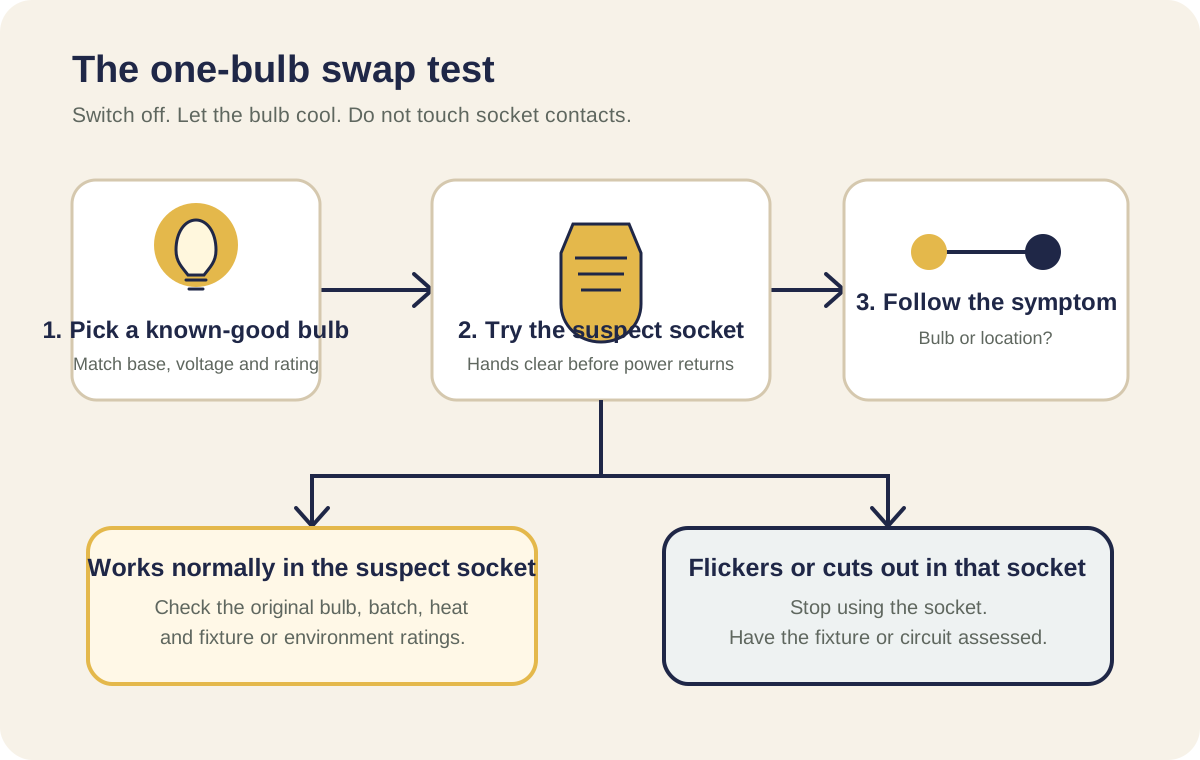
Run the swap test without turning it into electrical work
- Stop for warning signs. Do not continue if you see scorching, cracked parts, moisture inside the fitting, melted plastic or exposed metal, or if you notice heat, a burning odor, crackling, sparks or repeated breaker trips.
- Switch the light off and let every bulb cool. Use a stable access method. Handle only the bulb, not contacts or internal fixture parts.
- Choose one compatible known-good bulb. Match the base and supply voltage, stay within the fixture rating, and use a bulb suitable for the fixture type and location.
- Try it in the suspect socket. Restore normal operation only after the bulb is installed and your hands are clear.
- Compare the result. If the known-good bulb works normally, the original bulb or its batch becomes the stronger suspect. If the known-good bulb flickers or cuts out only in that position, stop using that socket and arrange an electrician's assessment.
Do not keep cycling a bulb in a socket that produces arcing, crackling, burning odor or unusual heat. A swap test is a one-step divider, not permission to keep operating a faulty fitting.
Read the result before buying anything
| Swap-test result | What it suggests | Next move |
|---|---|---|
| The symptom follows the original bulb to a sound socket | The bulb's driver, internal connection or batch is the leading suspect | Replace or claim warranty; check fixture and environment ratings before buying the same type again |
| A known-good bulb fails or flickers in one particular socket | The lampholder, fixture connection or circuit side needs attention | Stop using that position and have a licensed electrician inspect it |
| Several sockets in one fixture behave badly | A fixture connection, control, supply or common environmental problem is possible | Stop product swapping and have the fixture and circuit assessed |
| Bulbs fail across unrelated rooms | Different causes may be involved; the pattern is wider than one socket | Record locations, timing and other symptoms for an electrician |
| The bulb works until it heats up, then dims or flickers | Thermal stress or a temperature-sensitive driver fault is possible | Check enclosed-fixture and location ratings; discontinue use if overheating occurs |
If the lamp has not yet failed and flicker is the main symptom, use the separate guide to LED flickering causes and safe checks. It covers dimmers, transformers and multi-light patterns in more detail.
Why one bad socket can look like a bad bulb
A screw-base lampholder makes contact at two places: the threaded shell and a small contact at the bottom. Wear, corrosion, heat damage, deformation or a loose connection can reduce the contact quality. Intermittent contact may show up as flicker, delayed starting, cutting out or heat at the connection. Those symptoms can also damage a bulb over time, so a failed bulb and a socket problem can coexist.
An electrician investigating the same complaint in a similar vanity fixture found the center contact flattened after years of use. That case fits this homeowner's swap result, but it does not prove that every early-failure case has the same cause. A qualified electrician still needs to inspect the actual socket, fixture connections and supply.
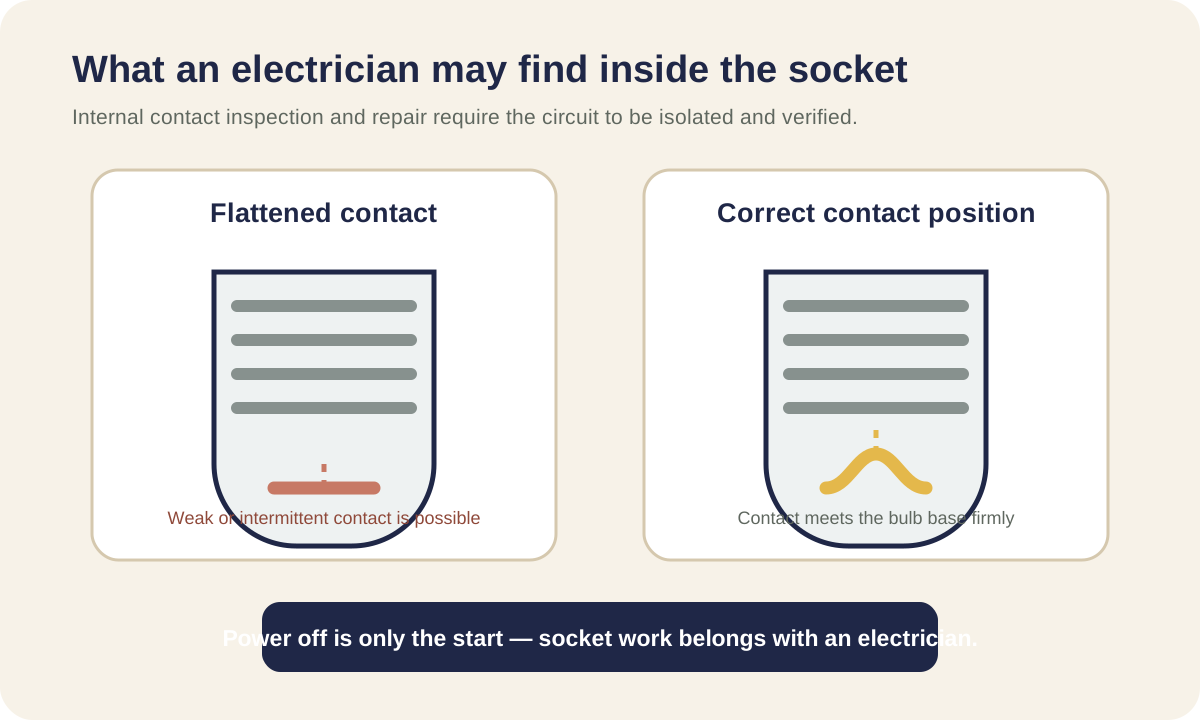
Do not reach into a lampholder or bend its contact. The center contact is normally associated with the live conductor, and switching a light off is not a substitute for safely isolating and verifying the circuit. A socket that needs internal inspection, adjustment or replacement is electrician work. Replacement is often the more dependable answer when the lampholder is heat-damaged, brittle, corroded or mechanically worn.
Why the electronics can fail before the LEDs
“LED life” is easy to misread. The U.S. Department of Energy's LED overview describes useful life as the operating time until light output falls to 70% of its initial level. That lumen-maintenance point is not a promise that every complete bulb will remain fully functional until that hour. DOE also notes that catastrophic failure usually involves electronics and that electronic parts can fail before the LED source itself.
A household LED bulb contains a driver that converts and regulates incoming power. The driver's capacitors, diodes, switching parts, solder joints and other components all experience electrical and thermal stress. DOE's LED luminaire lifetime guide identifies driver electronics as an important reliability concern and explains that component operating temperature affects failure rates. In plain terms, a long-lived LED chip cannot compensate for a weak or overheated power supply around it.
Decorative filament-style bulbs have less room for thermal design
Clear G25 and Edison-style bulbs prioritize a visible filament look and all-around light. Their structure differs from the familiar opaque A-lamp with a broad heat-conducting body, so the complete product still has to manage heat within a decorative envelope and compact base. That does not mean every filament bulb is short-lived. It means shape, operating position, fixture conditions and the manufacturer's thermal design matter.
A low price or an unfamiliar brand is not a diagnosis. More useful questions are whether the exact model has traceable safety certification, a stated rated life, a written warranty, the required fixture and environmental ratings, and documentation you can find again after purchase. Owner experiences with brands contradict one another, so no brand recommendation follows from them.
Bathroom moisture adds a separate compatibility check
A bathroom is not automatically one uniform electrical environment. Exposure depends on the fixture's position, ventilation, condensation and whether water can drip or splash onto it. UL defines a damp location as an area normally or periodically subject to moisture condensation; a wet location can receive dripping, splashing or flowing water. Products marked for wet locations can be used where that level of exposure exists, while a dry-only product is not a substitute.
Check both the fixture instructions and the bulb packaging for the actual location. “Suitable for damp locations” and “suitable for wet locations” are meaningful markings; a vague product title mentioning bathrooms is not the same thing. If the label or manufacturer documentation cannot establish suitability, choose a product whose rating is clear.
Moisture suitability does not explain a known-good bulb flickering in one socket by itself. It is a second filter: first locate the fault pattern, then verify that the replacement product and fixture suit the environment.
What an electrician should hear about the pattern
“Old wiring does not like LEDs” is too broad to guide a repair. LEDs can reveal control, connection or voltage problems because their drivers respond differently from incandescent filaments, but house age alone does not identify a defect. Give the electrician observations that can be tested:
- which exact sockets fail and whether a known-good bulb also misbehaves there;
- whether all bulbs share one fixture, switch or circuit;
- whether a fan, appliance or other load changes the symptom;
- whether the fault begins immediately or after warm-up;
- whether you have seen heat, discoloration, odor, noise, moisture or breaker operation;
- the bulb model, actual input watts, voltage, dimming status and environment rating;
- when electrical work or fixture replacement was last performed.
A bathroom fan sharing a switch with the light is worth reporting, but whether the fan played any role is unproven. Treat it as a diagnostic detail, not a confirmed mechanism. The electrician can assess the shared circuit, connections and voltage behavior rather than guessing from the switch arrangement.
NFPA's residential electrical-safety checklist advises contacting a qualified electrician for recurring breaker problems, warm or discolored outlets, burning odors, flickering or dimming lights and sparks. Those signs matter more than the age printed on a bulb box.
Use better buying criteria after the fault is located
If the test points to the bulb side and the fixture is sound, replace the bulb by specification rather than brand folklore. The Ross Light LED bulb guide explains the full selection process. For this failure pattern, concentrate on:
- Documented rated life: understand it as a tested or projected performance claim, not a guarantee that every unit will avoid early electronics failure.
- Traceable certification: look for a mark from a recognized testing organization and verify it where the organization provides a directory.
- Fixture suitability: confirm open, enclosed or recessed use as applicable.
- Environmental rating: match dry, damp or wet exposure to the installation.
- Control compatibility: a non-dimmable lamp does not belong on a dimmer; smart controls and sensors may need documented compatibility.
- Warranty and receipt: keep the model number, date code, packaging and proof of purchase so a repeated batch failure can be documented.
- One model per multi-lamp fixture: matching bulbs simplify comparison and reduce visible differences in color and dimming behavior.
If repeated driver or module replacement is becoming the main maintenance problem, compare the tradeoffs in integrated LED fixtures versus replaceable bulbs. Neither format removes the need for correct thermal, environmental and electrical conditions.
Do not mix a separate afterglow symptom into this diagnosis
The same homeowner also mentioned bedroom bulbs that took a few seconds to go completely dark after switch-off. The cause was never pinned down, and that behavior does not prove the bathroom socket has the same fault. A brief fade can involve energy stored in a driver; a continuing glow or repeated flash can involve a control or circuit. Use the dedicated guide to an LED bulb glowing when off and keep the two observations separate unless testing links them.
The five-step decision path
- Check for danger signs. Stop for heat, odor, sparks, crackling, damage, moisture inside the fitting or repeated breaker trips.
- Run one known-good-bulb swap. Keep to compatible, user-serviceable bulbs and do not touch the socket contacts.
- Follow the symptom. If it follows the bulb, investigate the bulb, batch, thermal conditions and ratings. If it stays with the socket, stop using the socket.
- Verify the environment. Check fixture type, ventilation and dry/damp/wet markings before selecting a replacement.
- Escalate at the boundary. Internal socket, fixture, switch and fixed-wiring checks belong with a licensed electrician.
Bottom line: a bulb that dies early may be a bad bulb. A good bulb that immediately flickers in the same position is a different message. Let the swap test decide where to look, then stop at the point where the work moves inside the socket or fixed wiring.
Frequently asked questions
Why do LED bulbs burn out earlier than their rated life?
An LED bulb is a system, not just an LED chip. Its driver electronics, internal connections and thermal design can fail before the LEDs reach the advertised lumen-maintenance point. Excess heat, an unsuitable fixture or environment, a poor product batch and a faulty socket or circuit are different possibilities, so the failure pattern matters.
How can I tell whether the bulb or socket is bad?
With the light switched off, the bulb cool and no visible damage, place a compatible known-good bulb in the suspect socket. If the known-good bulb also flickers there but works normally elsewhere, stop using that socket and have the fixture or circuit assessed. Do not touch or bend contacts inside a lampholder.
Can I pull up the center tab in a light socket myself?
That contact can be energized and an ordinary wall switch is not proof that every part is safe. Ross Light does not recommend reaching into or bending a socket contact. Switch off the circuit and use a licensed electrician when the socket needs inspection or repair.
Do bathrooms need damp-rated LED bulbs?
Use the fixture and lamp markings for the actual exposure. UL defines a damp location as one normally or periodically subject to moisture condensation, while a wet location can receive dripping, splashing or flowing water. A bathroom is not one uniform zone, so check the product instructions and the location of the fixture rather than relying on the room name alone.
Does a brief fade after switching off mean the bulb is failing?
Not necessarily. A short fade can be associated with energy stored in the driver, while a continuing glow or repeated flashes can have other causes. Treat that as a separate symptom and use the Ross Light guide to an LED bulb glowing when off.
Questions & discussion
Share a question or a useful experience about this guide. Comments appear immediately. Your name and comment are public. Email is optional and stays private; reply emails are not enabled yet. Comment privacy.