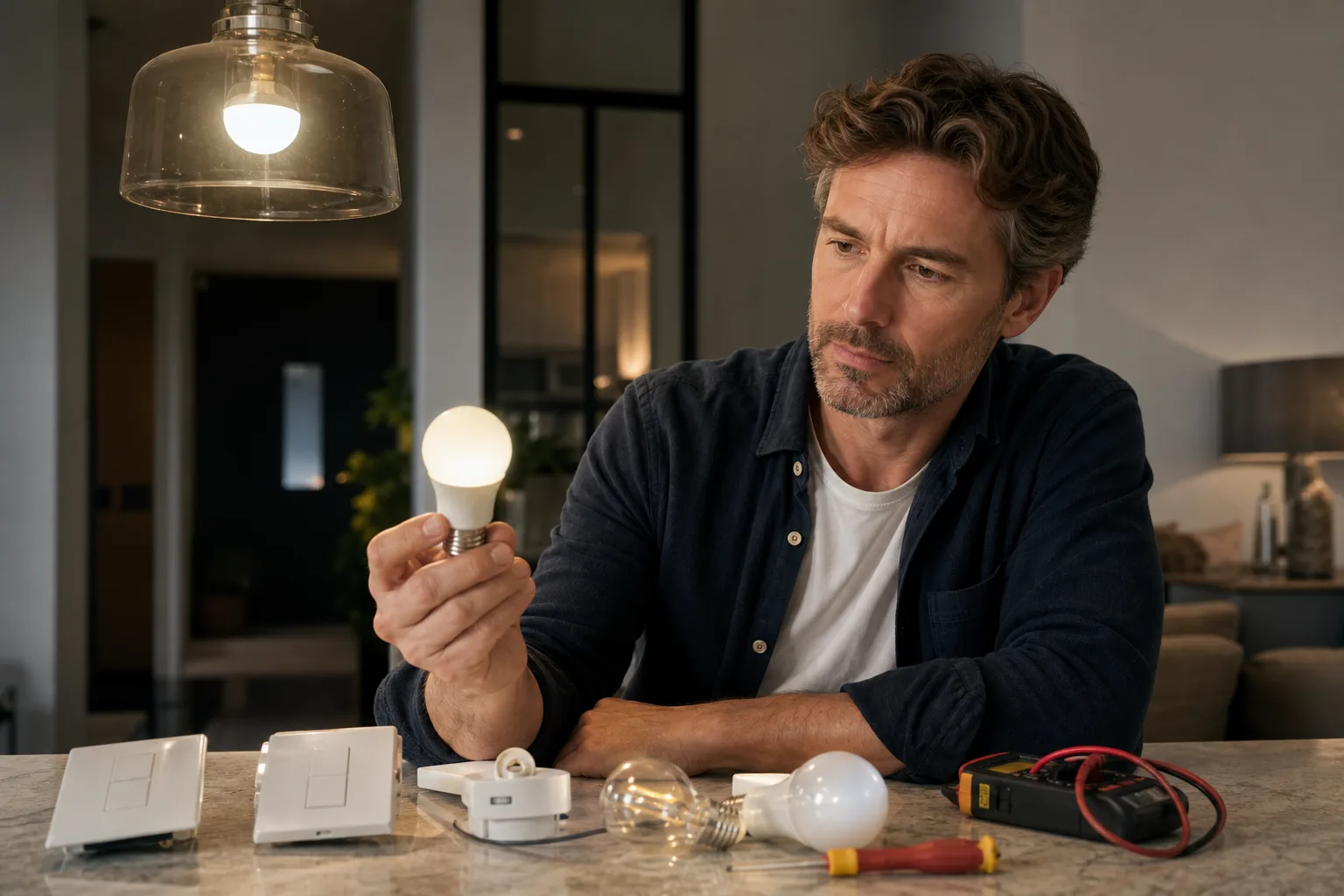
If an LED bulb glows when off, a small amount of electrical energy is usually still reaching—or remains stored inside—the bulb’s electronic driver. Common causes include an incompatible dimmer, a smart or illuminated switch that passes a small off-state current, the bulb’s driver design, or coupling between nearby wires. A brief fade is often less concerning than a continuous glow or repeated flash, but brightness alone cannot tell you whether the circuit is safe. Start with observation and bulb compatibility checks; leave switch-box, fixture and branch-circuit testing to a licensed electrician.
Why an LED can produce light with the switch off
An LED lamp is not simply a glowing filament. It contains semiconductor light sources and a driver that converts household alternating current into the controlled current the LEDs need. The U.S. Department of Energy describes an integrated LED lamp as a combination of an LED source, driver, base and other electrical, thermal and optical components.
LEDs respond rapidly to the current supplied by that driver. Consequently, an amount of current too small to produce visible light from an incandescent filament may charge or partially operate some LED drivers. Department of Energy research on phase-cut dimming specifically documents off-state current producing low-level operation known as ghosting. It also notes that some combinations instead produce erratic flashes because the driver repeatedly starts but cannot sustain operation. DOE’s phase-cut dimming report explains this control-and-load interaction.
Brief afterglow versus continuing ghost glow
- Fades away within seconds: energy stored in the lamp electronics may be discharging. Driver designs vary, so compare the behavior with the bulb manufacturer’s information.
- Remains steadily visible: a small continuing current is probably reaching the driver.
- Flashes every few seconds: the driver may be charging until it starts, discharging through the LEDs and then repeating the cycle.
- Appears only in darkness: the electrical cause may still be present during the day; the low output is simply easier to see after your eyes adapt.
This problem is different from the phantom-array effect, which is a visual artifact caused by a light fluctuating while the observer’s eyes move. Here, “ghost glow” means that the lamp itself visibly emits light after its control has been switched off.
Most likely causes
1. The LED bulb and dimmer are not compatible
Legacy dimmers were commonly designed around higher-wattage incandescent loads. LEDs draw much less power and present a different electronic load, so an old dimmer may not switch cleanly or operate within its intended load range. Some two-wire electronic dimmers also need a small current for internal functions even when the lighting load is nominally off.
Compatibility can be model-specific: marking a bulb “dimmable” does not mean it will perform properly with every dimmer. ENERGY STAR advises checking the lamp or fixture manufacturer’s recommended-dimmer list and trying a different approved pairing when problems occur. See ENERGY STAR’s guidance on matching LED lights and dimmers.
2. A smart, illuminated or sensor control uses off-state current
Some wall controls power indicator lights, wireless radios, timers or sensors through the lighting circuit. The resulting current may be harmless to a compatible load but visible through a sensitive LED driver. This is especially plausible when the problem began after installing a smart switch, occupancy sensor, timer, illuminated switch or electronic dimmer.
A control designed to use a neutral connection may behave differently from a two-wire model that obtains operating current through the load. Do not assume the presence or absence of a neutral conductor, and never improvise one. The control’s wiring requirements and compatible-load list should determine how it is installed.
3. The bulb’s driver is unusually sensitive or defective
Two LED bulbs with the same base, wattage and lumen rating can respond differently to a tiny off-state current because their driver circuits differ. If one bulb glows but another compatible bulb does not in the same socket, the original bulb is likely more sensitive or may be failing. Other driver-related symptoms can include buzzing, unstable dimming, delayed starting or flickering while the light is on.
4. Voltage is being coupled from nearby wiring
Alternating voltage in one conductor can couple a very small current into an adjacent conductor through capacitance or electromagnetic interaction. Long cable runs and multiway switching arrangements can make this more noticeable. Because confirming the cause requires suitable instruments and knowledge of circuit configuration, it is an electrician-level diagnosis—not a reason to add a homemade component across the lamp.
5. The switch is interrupting the wrong conductor or wiring is damaged
A wiring error can leave parts of a lampholder or fixture energized even though the light appears switched off. Leakage associated with damaged insulation, moisture, a loose connection or another fault is also possible. These conditions cannot be identified reliably by looking at the glow. The current National Electrical Code is intended to protect people and property from electrical hazards, and branch-circuit alterations should comply with the code adopted in your jurisdiction. NFPA describes the safety scope of the 2026 NEC.
Safe checks you can make without opening electrical boxes
The goal of these checks is to identify a pattern, not to prove that wiring is safe. Do not remove a wall plate, dimmer, ceiling canopy or hardwired fixture. Do not touch lamp contacts, insert a tester into a lampholder or work on energized conductors.
| Check | What to observe | What it may indicate |
|---|---|---|
| Time the glow | Does it fade quickly, stay steady or pulse? | A short fade can involve stored energy; continuous or repeating output suggests continuing current. |
| Identify the control | Standard toggle, dimmer, smart switch, sensor, timer or illuminated switch? | Electronic controls make compatibility or off-state current more likely. |
| Review the bulb label | Is it marked dimmable, and is that exact model approved for the control? | A non-dimmable or unlisted pairing should be corrected. |
| Substitute a compatible bulb | With power disconnected and the lamp cool, try a known-compatible bulb of the correct base, voltage, shape and fixture rating. | If the glow disappears, the original driver was likely more sensitive or defective. |
| Check other lamps on the circuit | Do all controlled lamps glow, or only one? | One lamp points toward the bulb; several lamps point more strongly toward the control or circuit. |
| Switch off the identified breaker | Only if you can operate the correct breaker normally without removing the panel cover, note whether the glow stops immediately. | An immediate stop supports a circuit-fed cause. This does not identify the exact fault or make internal work safe. |
For a plug-in table or floor lamp, you can also move the bulb to a different, suitable lamp controlled by a basic mechanical switch. Disconnect the plug before changing the bulb. If the symptom follows the bulb, replacement is a reasonable next step. If it occurs only at the original location, investigate that lamp or control rather than repeatedly buying bulbs.
Choose the fix that matches the cause
Replace an incompatible or failing bulb
Use a lamp with the correct base, supply voltage, physical size, enclosed-fixture rating where applicable and dimming designation. Match brightness by lumens rather than relying only on an incandescent-equivalent claim. Our guides to choosing an LED bulb, watts versus lumens and replacing a bulb safely cover those checks.
When a dimmer is present, choose from the bulb manufacturer’s tested compatibility list. If several bulbs share one dimmer, keep their type and model consistent unless the manufacturers explicitly permit mixing.
Correct the dimmer or electronic-control pairing
If the glow started after a control change, review the control’s instructions, LED load limits and approved lamp list. Some controls provide an adjustable low-end trim, but that setting primarily addresses low-level dimming and may not eliminate off-state current. Do not exceed the control’s LED rating even when the total lamp wattage appears low.
A suitable solution may be an LED-rated dimmer, a control that uses a neutral connection, or a manufacturer-approved accessory intended to stabilize small LED loads. Selection and installation should be handled by a licensed electrician where fixed wiring is involved. See how to choose an LED dimmer before comparing models. Our dimmer installation guide also defines the point at which professional help is appropriate.
Have the wiring examined
Call a licensed electrician when a compatible bulb still glows on a basic switch, several fixtures are affected, the circuit uses three-way or four-way switching, the symptom began after wiring work, or the behavior changes when unrelated loads operate. An electrician can determine whether the cause is control current, coupled voltage, an incorrectly switched conductor, a loose connection or insulation leakage.
Do not install a loose resistor, capacitor or so-called bypass device inside a ceiling box unless it is specifically listed or approved for that control and installed according to its instructions. Components connected to household voltage must have appropriate ratings, enclosure, spacing and thermal performance. A generic online “bleeder” fix can introduce shock, overheating or code-compliance risks.
When to stop troubleshooting immediately
A faint glow by itself does not reveal how hazardous—or harmless—the underlying condition is. Stop using the light, switch off the circuit if that can be done safely and contact a qualified electrician if you notice any of the following:
- a hot or discolored switch plate, outlet, lampholder or fixture;
- a burning, scorched or unusual electrical smell;
- crackling, arcing, sparking or buzzing from a switch or connection point;
- frequent breaker trips or blown fuses;
- visible moisture, damaged wiring or a loose fixture;
- a shock or tingling sensation from a lamp or switch;
- unexpected behavior after renovation, storm damage or electrical work.
NFPA’s residential electrical-safety checklist recommends calling a qualified electrician for warm or discolored outlets, burning smells, flickering lights, sparks and recurring protection-device problems. UL Solutions similarly advises professional attention for hot, sparking or buzzing wiring devices. Review NFPA’s electrical-safety checklist and UL Solutions’ wiring warning signs.
A practical decision checklist
- Observe: note whether the lamp fades, glows continuously or flashes.
- Identify: record the exact bulb and control model numbers.
- Verify compatibility: check the manufacturers’ published lamp-and-control lists.
- Substitute carefully: with power disconnected, try a suitable known-compatible bulb.
- Replace the failed component: replace a bulb that alone produces the symptom.
- Escalate fixed-wiring work: have an electrician replace or diagnose hardwired controls and circuits.
- Stop for warning signs: heat, odor, noise, sparks, shocks or breaker trips require prompt professional attention.
In many homes, the lasting fix is simply a better-matched LED bulb and dimmer. If ghost glow remains with a compatible lamp on a plain mechanical switch, however, treat it as a circuit-diagnosis problem rather than a cosmetic annoyance.
Frequently asked questions
Is it dangerous if an LED bulb glows when switched off?
Not necessarily, but the glow alone cannot establish that the circuit is safe. A compatible electronic control may pass a tiny off-state current, while wiring errors or damaged insulation require professional correction. Call an electrician if the light is on a basic switch and continues to glow, or if you notice heat, odor, buzzing, sparks, shocks or breaker trips.
Why does my LED bulb flash every few seconds when off?
A small continuing current may be charging the bulb’s driver until it starts briefly, discharges and repeats. Incompatible dimmers, smart switches, sensors and illuminated controls are common possibilities. Verify the exact bulb-and-control pairing before replacing components.
Will changing the LED bulb stop ghost glow?
It may. LED drivers differ in their response to very small currents. If a suitable known-compatible bulb does not glow in the same socket, the original bulb was probably more sensitive or defective. If multiple compatible bulbs glow, investigate the control or circuit.
Can I add a resistor or capacitor to stop an LED glowing?
Do not add a generic component across a household-voltage lamp. Use only an accessory specifically approved for the control and application, installed according to its instructions. Fixed-wiring modifications should be completed by a licensed electrician.
Questions & discussion
Share a question or a useful experience about this guide. Comments appear immediately. Your name and comment are public. Email is optional and stays private; reply emails are not enabled yet. Comment privacy.