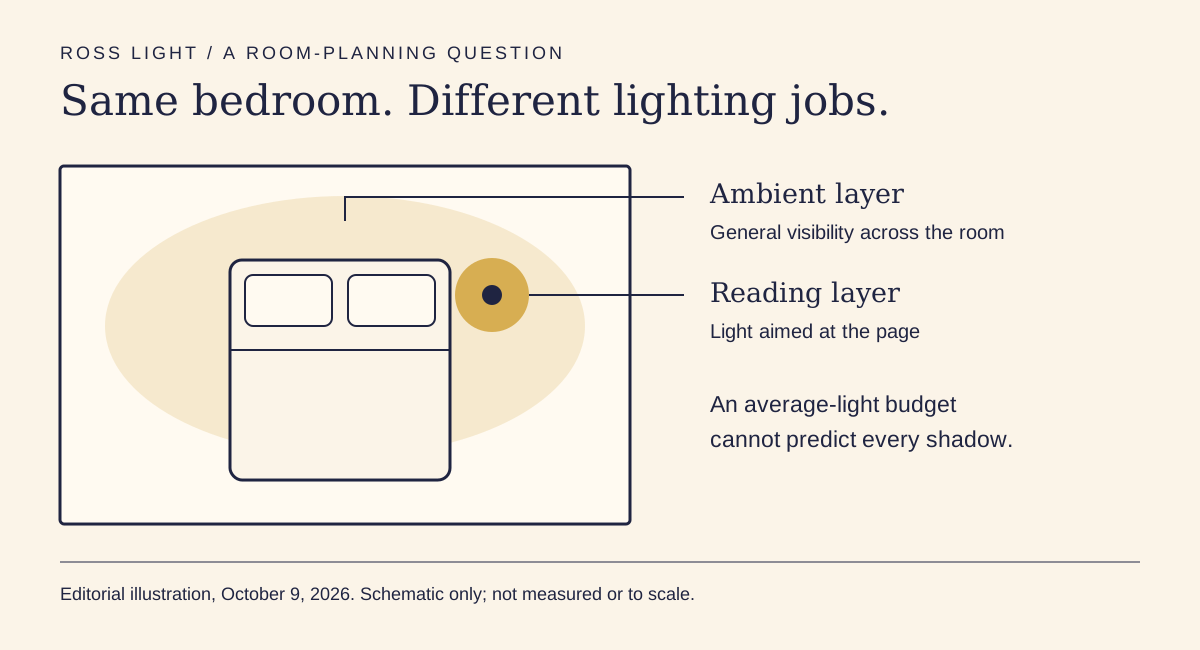
I would start with modest ambient light and a separate reading light, rather than choosing the brightest ceiling fixture. For this quiz, imagine a bedroom with light-colored walls, an area of 12 m², and a 2.7 m ceiling (illustrative editorial brief, October 9, 2026). How much light needs to reach the reference plane? Choose your answer below, then check my assumptions. The answer is a planning exercise, not a lamp-shopping specification.
The question
I am asking about a deliberately simplified ambient-light budget across a horizontal reference plane covering the room’s floor area. I assume no daylight and uniform delivery, with no utilization or maintenance losses. That lets us isolate the relationship between area and illuminance before discussing actual fixtures.
The wall color and ceiling height describe the scenario; I have not converted them into measured reflectance or a lighting model. Reading, dressing, and nighttime movement may need different arrangements. Choose first; my calculation appears after the quiz.
Try your own room
I would write down the room area, the activity, and the surface that needs illumination before comparing lamps. A reading page is not the whole bedroom. Nor does a single total-lumen figure tell me whether the pillow area will suffer glare or a wardrobe will remain shadowed.
The metric calculator linked at the end accepts square meters and lux, plus utilization and light-loss factors. Keep its units together; do not enter metric values into a tool asking for feet and footcandles. Its factors are inputs to verify, not measured properties of your room.
Limits
I have not measured a bedroom, tested fixtures, or modeled glare, uniformity, wall reflectance, or mounting geometry. This is an estimate of average illumination, not a professional lighting design. Planning is not electrical work: permanent wiring, load calculations, and code compliance belong with a licensed professional.
Over to you
Choose the closest idealized delivered-light budget. All options are from the illustrative editorial brief, October 9, 2026; they are not measured lamp outputs.
The answer and the math
B is closest under my stated assumptions. I chose 100–150 lux as this exercise’s low ambient-light target, not a universal bedroom standard (editorial assumption, October 9, 2026). I would use a separate task light for reading.
Lux describes lumens arriving per square meter (NIST SI definitions, accessed October 9, 2026). My original calculation is:
| Editorial calculation, October 9, 2026 | Idealized delivered light |
|---|---|
| 12 m² × 100 lux | 1,200 lumens |
| 12 m² × 150 lux | 1,800 lumens |
| 1,500 lumens ÷ 12 m² | 125 lux |
Those are lumens reaching the reference plane, not necessarily the rating printed on a fixture. For emitted-light planning, I use required lumens = area × target lux ÷ utilization factor ÷ maintenance factor. Utilization describes the share reaching the plane; maintenance accounts for output losses over time (ERCO maintenance-factor explanation, accessed October 9, 2026). Neither factor was measured here; lower factors raise the required emitted lumens.
Why the other options fail
Against this exercise’s target, A falls below the calculated range; C and D exceed it. They are not universally wrong purchases. Different losses, tasks, or dimming arrangements could change the choice. I cannot classify a room as residential or commercial from its total lumens alone.
Got it wrong? Check the assumptions before changing your lights.
Next steps
Read next: Lux to Lumens Calculator · Does a Viral Sunset Lamp Work? What “16 Colors” Can—and Can’t—Do.
Copy the calculation above to estimate your own bedroom’s lighting needs.