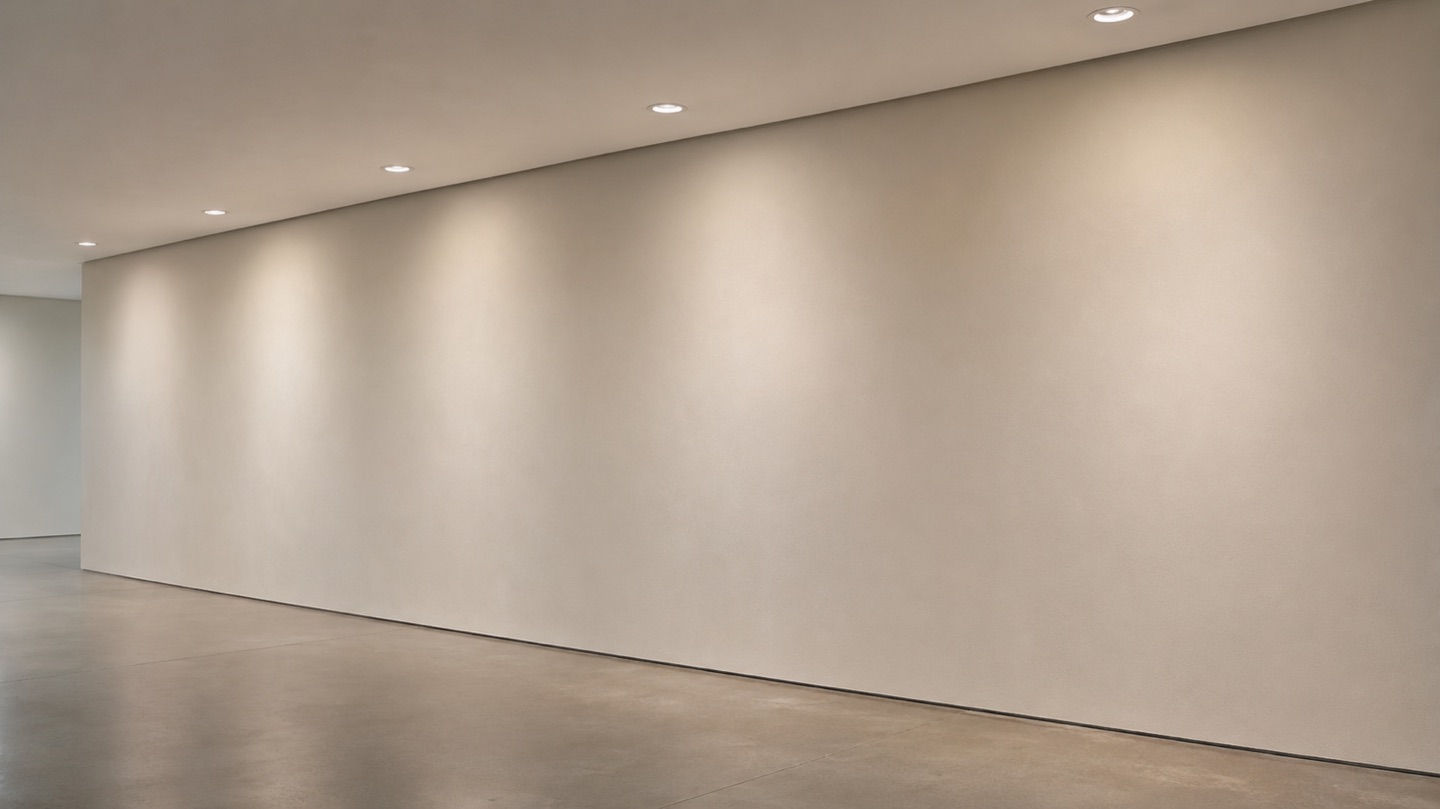
Ceiling lights washing a plaster gallery wall
Wash a wall when you want it to read as an even surface. Graze it when you want the ridges, joints or grain to stand out. I start with the look the wall needs from the doorway or the seat you actually use.
Choose the effect before choosing the distance
Try an even wash on smooth plaster or an exhibition backdrop where bright scallops would compete with the display. Try grazing light on textured stone or brick when you want the relief to read clearly. That same shallow light can make joints or uneven patching more visible. Check glossy surfaces from the actual viewing route for reflections.
A purpose-built wallwasher controls light across the vertical surface. A standard downlight or strip at the same position can leave a very different pattern.
Calculate a starting setback for lens wallwashers
ERCO’s reception-area guidance uses a horizontal setback from the wall to the fixture center of about one third of the room height for suitable lens wallwashers. In that arrangement, adjacent fixtures can be spaced up to about 1.3 times the setback.
- h is the room height in this ceiling-mounted layout.
- a is the horizontal distance from the finished wall face to the fixture center. Start with a ≈ h ÷ 3.
- d is the center-to-center distance between adjacent fixtures in the row. The reference limit is d ≤ 1.3 × a.
For a hypothetical room height of 3 m, the starting setback is about 1 m. The reference upper spacing is 1.3 m. This is planning arithmetic. Check the exact fixture’s layout data for the mounting height, coverage and end conditions before using the result. It does not give a guaranteed fixture count or uniformity.
Set grazing distance with the actual optic
A close position makes the wall texture more pronounced. For its Lightgap grazing light wallwashers, ERCO specifies a wall setback greater than 10 cm (a > 10 cm) in the Lightgap product page’s luminaire arrangement guidance. Its Site outdoor in-ground family shows an arrangement around 30 cm. Each number belongs to its own system. Use the selected model’s instructions and check the wall from the viewing positions that matter.
Check the top, bottom and ends of the wall as well as the center. Look for dark bands, stray light and exposed bright sources. For a wood panel or slat wall, check the panel and channel details separately. If the target is a framed piece or glazed work, use the artwork lighting guide.
Mark and compare positions before committing. Have a qualified electrician handle hardwired fixtures, new circuits or outlets, concealed wiring and uncertain circuits. Keep any planning mock-up within the equipment’s mounting and electrical instructions.
Frequently asked questions
What is the difference between wall washing and wall grazing?
Wall washing aims for even coverage across the wall. Grazing light runs close along the surface to bring out texture and shadows.
Should I always set a wallwasher back by one third of the room height?
Use that only as a starting point for suitable lens wallwashers under the cited layout guidance. Check your model and the wall conditions before fixing positions.
Should every grazing light be 10 cm from the wall?
No. The offset depends on the optics and mounting arrangement. Check the model’s layout data and judge the effect on your wall.
Questions & discussion
Share a question or a useful experience about this guide. Comments appear immediately. Your name and comment are public. Email is optional and stays private; reply emails are not enabled yet. Comment privacy.