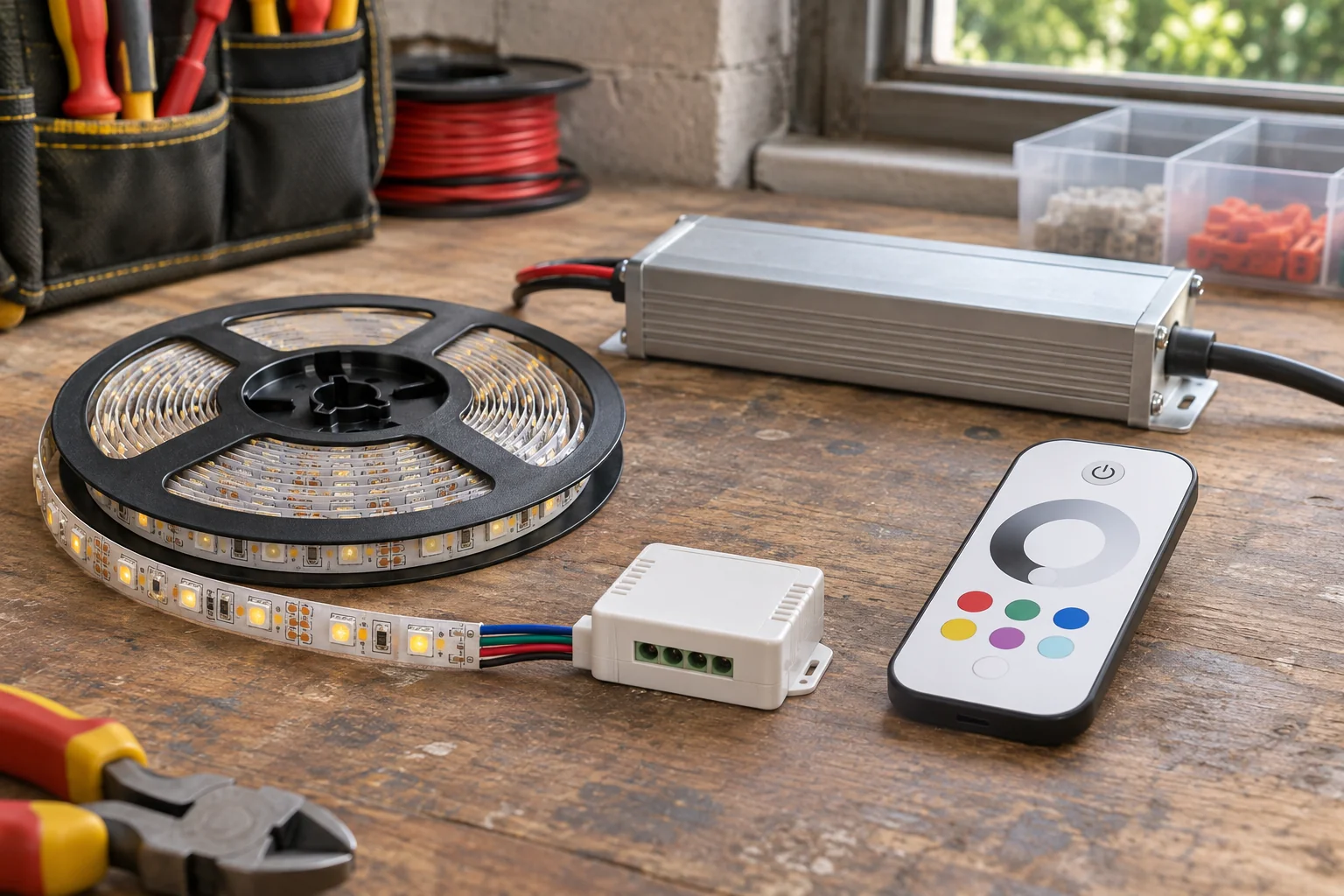
I choose the controller only after identifying the strip and deciding how the room should be operated. A controller changes the output sent to compatible LEDs; it does not automatically replace the power supply, wall dimmer or control-network gateway.
Begin with the strip terminals
A single-colour strip has one light colour, even if its brightness can change. A compatible dimming controller adjusts that output. A tunable-white strip adds separate warm and cool channels that must be controlled together to change the colour appearance. RGB strips use red, green and blue channels; RGBW adds a separate white channel. Product wiring and channel arrangements vary, so match the actual terminal diagram rather than buying by connector appearance.
Confirm the strip’s supply voltage and output type, the controller’s input rating and its output arrangement. A constant-voltage controller is not a universal substitute for a constant-current LED driver. If a luminaire contains its own driver or integrated control electronics, obtain the maker’s intended control method before adding another device.
Compare the control paths
A local remote or wall station can be enough for a small installation. Check what happens when its battery is depleted, power is interrupted or the remote is lost. A hardwired control station can provide straightforward everyday operation without depending on a phone, but its wiring still has to match the controller.
An app-connected system introduces a radio or network protocol and may require a hub, account or internet connection. Ask which functions remain available locally and what happens if the service or gateway is unavailable. A shared protocol name does not establish every feature: verify pairing, channel control, scenes and recovery with the exact models being proposed.
DALI and DMX belong to wider control-system decisions. A compatible decoder or driver translates the relevant control signal into the output the LEDs need. Read the DALI guide when architectural groups and building controls are involved. Do not assume that an app controller accepts a wired lighting-control bus.
Check every electrical limit
Obtain the permitted load for each channel and for the controller as a whole. Check the installed load in the units used by the manufacturer and include every connected strip section. A controller with enough total capacity may still exceed a single channel’s limit. Power supplies, connectors and cables have their own limits; the lowest applicable limit governs the arrangement.
No universal capacity margin is established for an unspecified controller. Use the maker’s temperature derating and installation conditions. Do not conceal a controller in an enclosure that prevents access or cooling, and do not improvise extra supplies on connected outputs. The LED strip power tool can organise the load inputs, but cannot establish compatibility.
Trial the everyday controls
Ask for a demonstration of dimming, colour changes and power recovery with the specified components. Check low-level stability, switching delays, unwanted brightness at startup and whether ordinary wall operation remains understandable to another household member. Record pairing and reset instructions where the owner can find them.
This is separate from choosing a mains wall dimmer. For that decision, use how to choose an LED dimmer; combining dimmers and controllers requires explicit manufacturer approval. Disconnect power before handling components. Mains wiring, permanent modifications and uncertain electrical assemblies need a qualified electrician or appropriately trained installer.
Browse the related guides.
Sources
ENTTEC — CVC4 Constant Voltage Dimmer
MEAN WELL — LED driver FAQ: CV, CC and CV+CC
DALI Alliance — Introducing DALI
Questions & discussion
Share a question or a useful experience about this guide. Comments appear immediately. Your name and comment are public. Email is optional and stays private; reply emails are not enabled yet. Comment privacy.