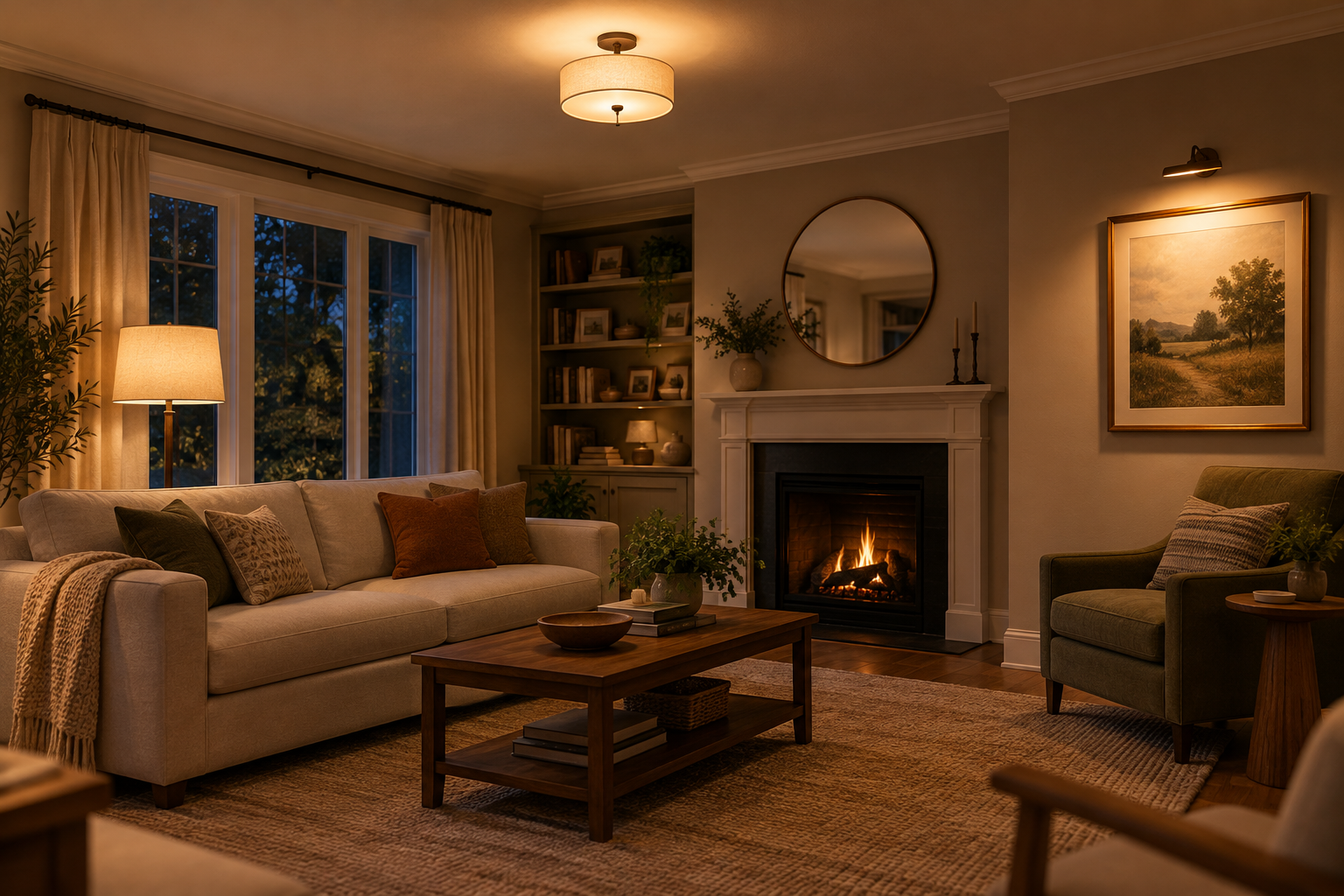
Start with the place you want to see, not a bigger bulb. A single ceiling fixture can make the center of a room bright while a favorite chair, a wall or a bookcase still feels forgotten. Add one light aimed at that particular place, then decide how much general light you still need.
I like to work from the room's actual evening use: where you sit, what you look at and which view feels uncomfortable. Start with a movable lamp if you can, so you can compare positions before committing to a fixture.
First, identify your kind of single-light room
Use the room after dark with the lights set as you normally use them. The comparison below is schematic: it shows the idea, not a measured lighting plan.
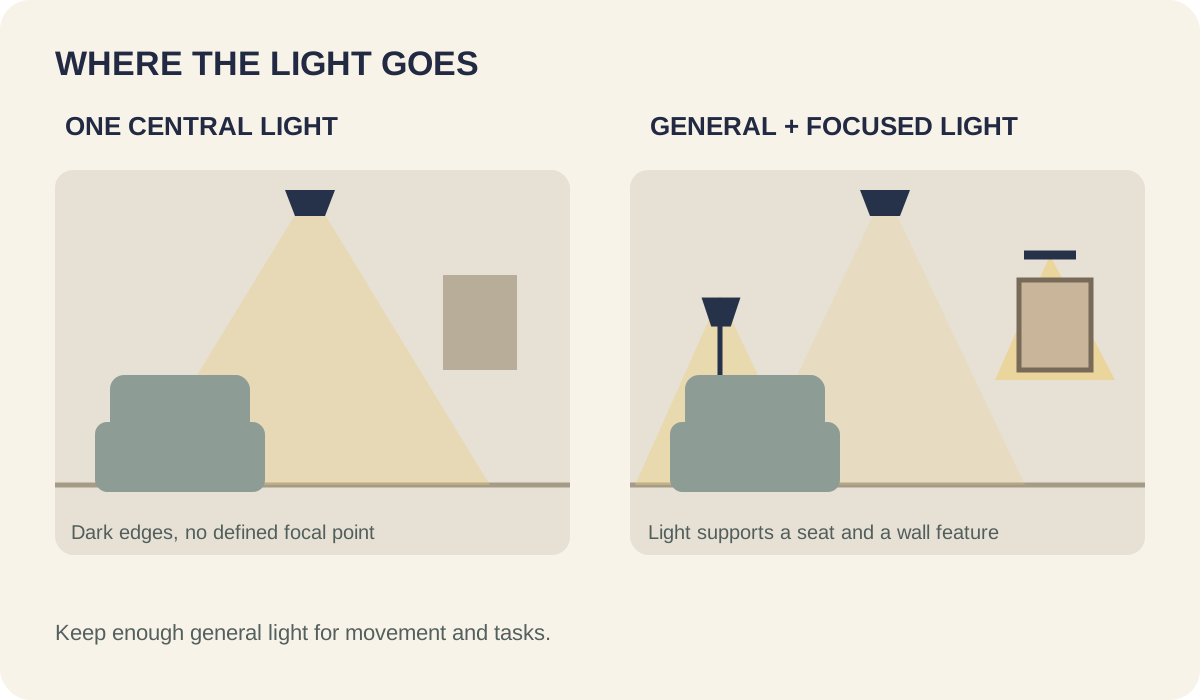
| What you notice | What to try first | What to avoid |
|---|---|---|
| The central fixture is bright or exposed in your view | Check its shade, position and compatible dimming options; add a separately controlled lamp near the area you use. | Do not simply add more exposed bright bulbs. See the glare guide for other ways to reduce discomfort. |
| The center is bright enough but a wall or corner looks dark | Try a shaded lamp or directional light at that side; aim at the wall, shelf or object rather than your eyes. | Do not assume a larger ceiling bulb will put light where it is missing. |
| There is no ceiling light and portable lamps leave the middle too dark | Keep a lamp that provides broad general light, then add a focused light where needed. Check the walking route from the doorway. | Do not switch off all general light just because the accent looks attractive. |
If the whole room is still hard to use, work through why a room feels dark first. An accent light can improve emphasis and the appearance of a wall; it does not automatically replace sufficient room-wide or task lighting.
What counts as accent lighting?
Accent lighting is a light you direct toward a particular feature or area—a picture, textured wall, shelf or architectural detail—so it stands out from its surroundings. A reading light aimed at a book is primarily task lighting; a general light makes the room usable. One fixture can serve more than one purpose, but name the job you need before buying it.
The idea of combining those jobs is called layered lighting. Here the practical question is narrower: what should you add to the room you already have?
Why might a room have only one main light?
Installation cost, the chosen look and the ability of an efficient LED fixture to deliver substantial light are all plausible influences. They are not a measured explanation for your home, and there is no reliable basis here for ranking them. A room may also have been designed around portable lamps or changed during a later renovation.
More fixtures do not guarantee a better result: poorly aimed older spotlights can be uncomfortable too. Equally, some people prefer to keep an overhead light for everyday use. Your aim is a room that works for you, not a rule that ceiling lights must always be on or always be off.
Pick the route that fits your room
Follow the choices below as a schematic decision aid. A plug-in fixture still needs an appropriate outlet, a safe cord route and any mounting required by its manufacturer.
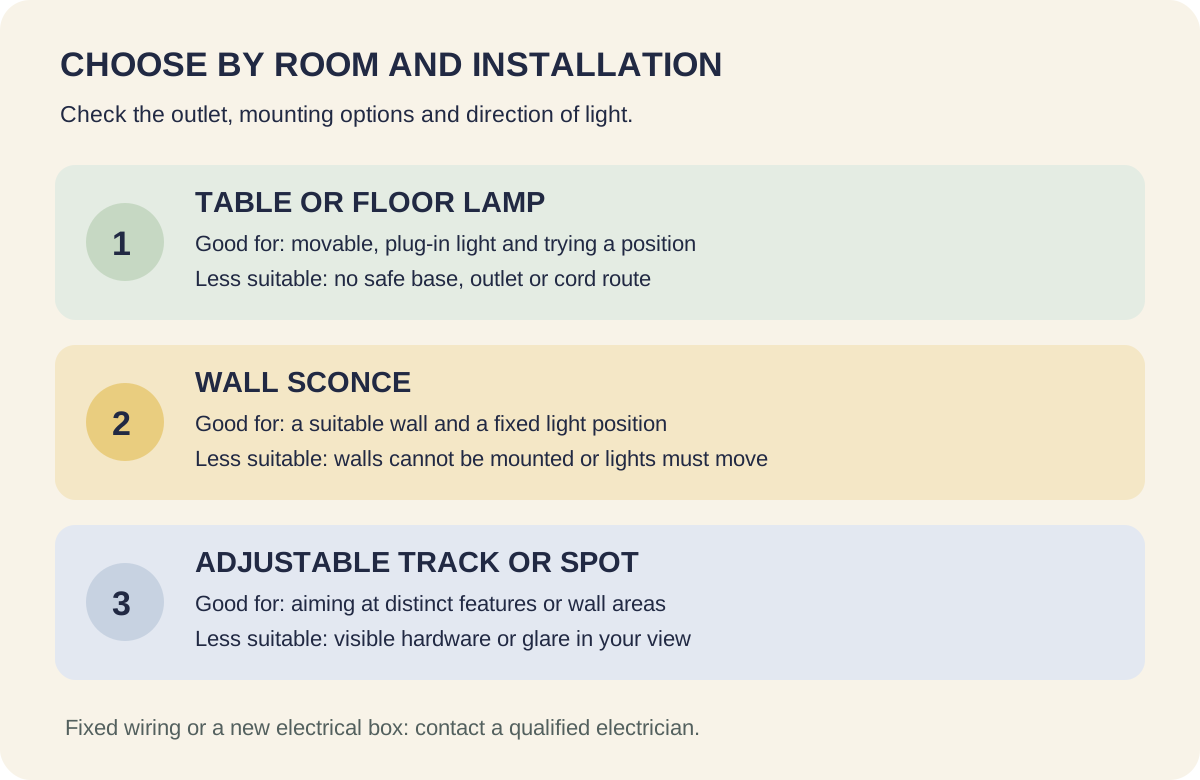
1. Try a table lamp or floor lamp
Choose it when: you rent, want to avoid fixed wiring, have an accessible outlet or want to test a position before buying anything permanent. A shaded floor lamp can lift a dark corner; a small adjustable lamp can highlight a shelf or wall.
Look elsewhere when: there is no safe place for the base or cord, or when a portable lamp cannot aim at the feature you want. Keep the cord out of walkways and away from heat, water, doors and pinching furniture. Do not run it under a rug or use an extension cord as a permanent substitute for an outlet. Check the fixture's bulb and location ratings.
2. Consider a wall sconce
Choose it when: a wall needs a more permanent light, such as beside a bed or along a suitable hallway, and the mounting position works for the people using it. Some sconces plug into an outlet; others connect to fixed wiring. A plug-in model can still require wall mounting and a visible cord, so check the product and rental rules.
Look elsewhere when: you cannot mount anything on the wall, need to move the light frequently, or the proposed location would put the exposed bulb in your line of sight. Compare up/down light, shade and switch position in the wall-sconce guide.
3. Use an adjustable track or spotlight for precise aim
Choose it when: you need to point separate beams at a picture, wall and another defined area, and the mounting and power supply suit the fixture. Some products plug in; many track systems are hardwired. Check the exact system's instructions, support requirements and whether the heads and dimmer are compatible.
Look elsewhere when: visible track hardware clashes with the room, the ceiling is low, or the heads would be seen directly from the sofa or bed. People differ on the appearance of track lights. To control glare, look for a recessed light source, shield or narrow opening, and aim the beam at the feature rather than toward seated eyes. Test the view from the doorway and each seat; a tighter beam is not automatically less glaring.
Electrical boundary: for a new junction box, fixed-wiring changes, a hardwired sconce or track, use a qualified electrician. A wall switch alone does not prove that fixture wiring is isolated. Do not open a ceiling connection or attempt to adapt a hardwired track to a plug. If an outlet is damaged or the circuit trips, stop and have it assessed.
Match the light, then adjust the balance
- Compare the labels. For lights sharing a wall or seating area, start with similar color-temperature labels—for example, both marked 2700 K or both 3000 K. Warm and cool light can be mixed deliberately, but a large unexpected difference may be distracting.
- Compare in the room. Switch on the lamps together at night and look at the wall, furniture and people from normal positions. The same Kelvin number describes color appearance, not a guarantee of an exact visual match; different products can render colors differently.
- Use lumens as a starting point. Lumens describe the bulb's total light output, not exactly how bright the illuminated object will look. A shade, beam direction, distance and wall color all matter. Start modestly and change one lamp or position at a time.
- Keep controls independent where possible. Leave enough general light for safe movement, then adjust the accent to make its target noticeable without a bright source in your eyes. If using a dimmer, choose a dimmable product and confirm compatibility with the particular control; do not assume every LED works with every dimmer.
- Check for flicker or color changes. If a light flickers, buzzes or behaves oddly on a control, check the manufacturer's compatibility information and use the flicker troubleshooting guide. Do not treat color temperature alone as a diagnosis.
Start differently in each room
Living room: begin with the seating area and the wall you see from it. A shaded floor lamp may make the room easier to occupy while a separate picture light or adjustable spot gives one wall emphasis. Keep a general-light option for cleaning and guests. For a wider plan, use the living-room guide.
Bedroom: first make bedside reading and getting in and out of bed comfortable. A shaded lamp or adjustable bedside light may solve the immediate task; add a wall accent only if you want one. Aim away from the pillow and check the view while lying down.
Hallway: prioritize seeing the floor and the way through before highlighting art. A suitable sconce can contribute to both, provided it does not project into the route or create glare. Check local requirements with the electrician when altering fixed lights; an accent alone may leave the route inadequately lit.
Five-minute check before you buy or book work
- Identify whether the problem is glare, a dark area or insufficient general light.
- Choose one target and check it from the places where you sit, stand and walk.
- Confirm the outlet or mounting location, the cord route and the product's rating.
- Choose a portable lamp, sconce or adjustable spot based on whether you can mount or change wiring.
- Compare color appearance and the view of each light source after dark.
- Keep adequate room and task light, and hire an electrician for fixed wiring or a suspect circuit.
Start with one useful change. If the room becomes easier to use and the feature you chose is comfortably visible, you can stop there; a successful plan does not need a fixture in every corner.
Questions & discussion
Share a question or a useful experience about this guide. Comments appear immediately. Your name and comment are public. Email is optional and stays private; reply emails are not enabled yet. Comment privacy.