Start by identifying the rail and deciding where you want each beam to land. An adjustable head is useful when you have a picture, wall or work surface to light. It is frustrating when the adapter will not fit the rail, the beam crosses your line of sight or your own shadow covers the work.
Match the system before choosing a head
H, J and L are labels you will encounter when shopping for conventional track. Find the make and model on the existing rail or its paperwork. Use the rail profile and adapter markings to help the supplier identify it, then ask for written confirmation that the exact head is supported. A photo of a similar-looking head is a poor substitute for a model number. If the markings cannot be seen without opening the fitting, ask an electrician to identify it.
Some tracks provide separate circuits. In one documented J2 system, the position of a compatible head’s contact determines which circuit powers it. Check your own model documentation for the supported options. Before paying for independent groups, check which circuits the rail provides, what each head can select and which switches or controls the system supports. Confirm compatibility for the rail, heads, connectors, feed and controls as a set. A dimmable lamp or driver still needs a supported control.
For magnetic track, check the manufacturer’s list of compatible modules, power supplies and controls. The magnets describe how the module attaches. Buy replacement heads only after confirming that the rail and module are electrically and mechanically compatible. Ask about spares if you want to keep the rail for years.
Decide what the track should light
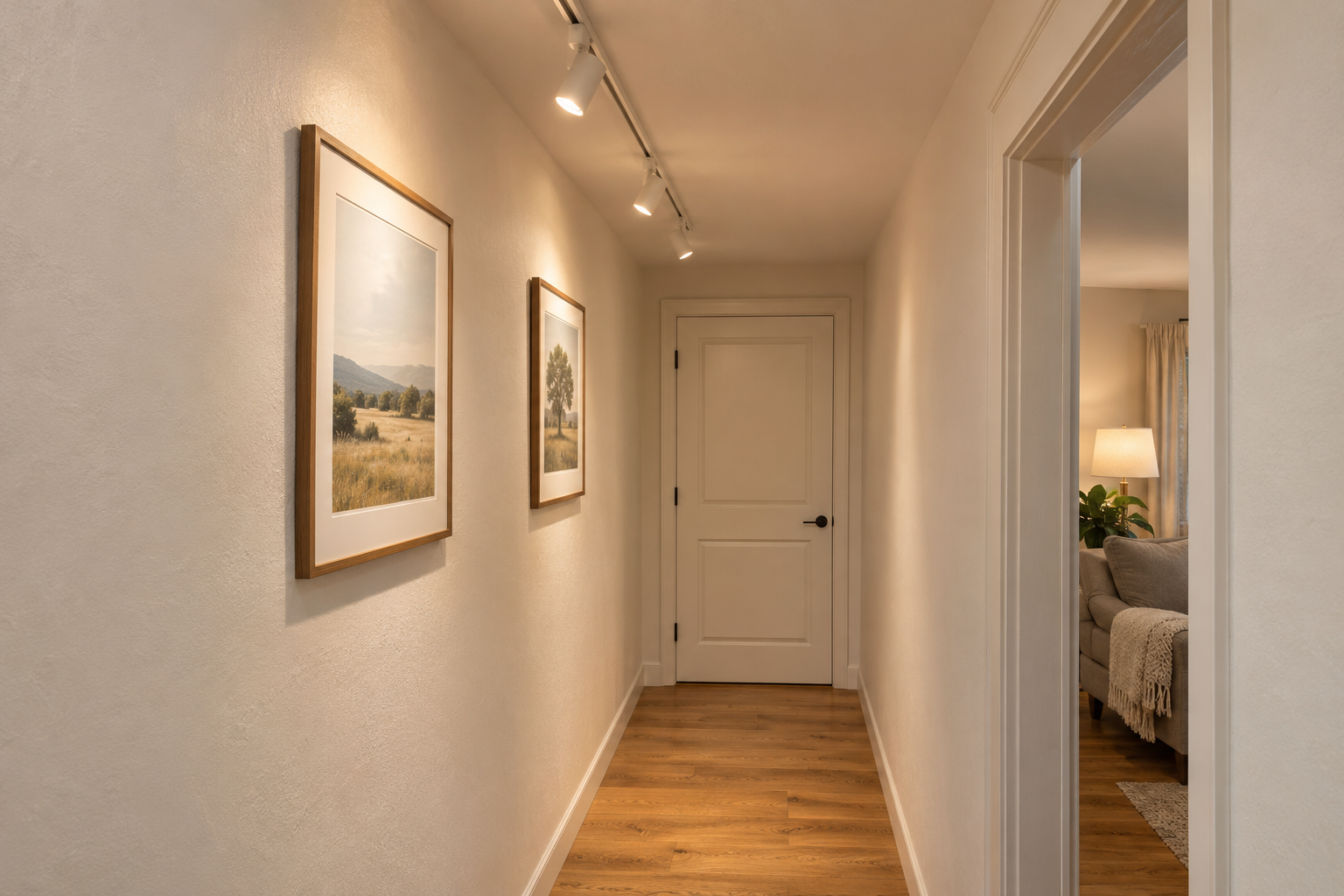
For a gallery wall, place the heads so the beams cover the pictures from your normal viewing position. Check glare on picture glass before adding more brightness. For a hallway, decide whether you need broad route lighting, accent light on the wall or both. See the hallway lighting guide and the artwork lighting guide for the placement decisions specific to those jobs.
At a kitchen counter, stand where you actually prepare food and trace a line from the proposed head to the work surface. If your head or shoulders intercept that line, the beam can leave the work in shadow. Use a task layer that reaches the counter and check how the track looks from adjacent seating. A set of bright spots on the floor can still leave the walls and work surfaces dim.
Check the view before committing to the layout
- Mark the rail position and the target of each head on a room plan.
- Check ceiling height, head clearance and the seated and standing sightlines.
- Ask for the beam options and verify that the proposed heads fit the rail.
- Decide which lights need separate control and confirm the complete system supports it.
- Have a licensed electrician assess line-voltage installation, changes to wiring and dimmer compatibility.
A track earns its place when its adjustable heads solve a lighting problem in the room. If the main job is broad ambient light, compare that requirement with the focused beams on offer before choosing the system.
Questions & discussion
Share a question or a useful experience about this guide. Comments appear immediately. Your name and comment are public. Email is optional and stays private; reply emails are not enabled yet. Comment privacy.