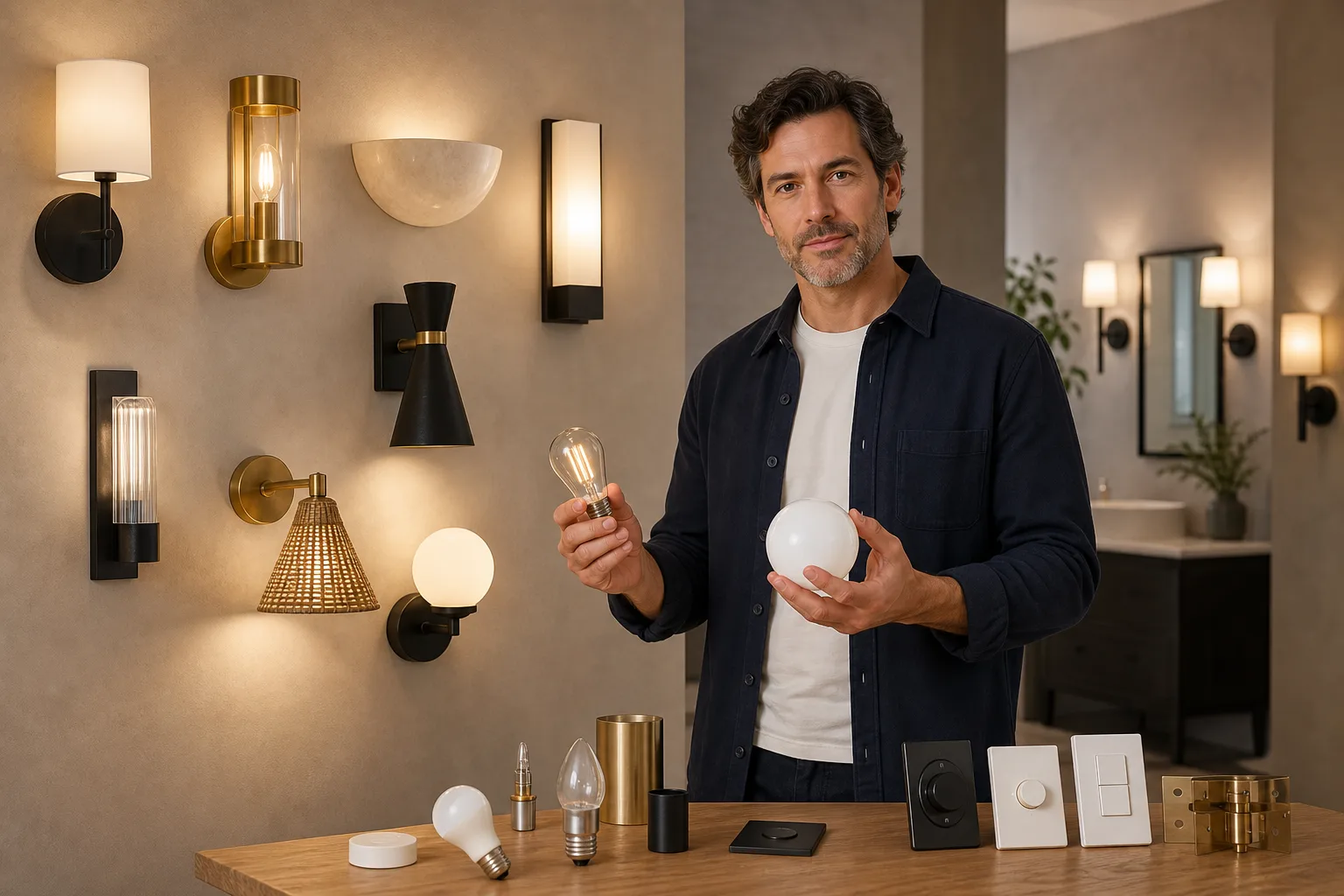
Wall sconces are wall-mounted light fixtures used for ambient, task, accent or pathway lighting. The right choice depends on more than appearance: compare light distribution, lumen output, glare control, color quality, wall projection, location rating and control compatibility. In most rooms, sconces work best as one layer of a broader lighting plan rather than as the only source of light.
What wall sconces are best used for
A sconce can put light where a ceiling fixture cannot, provide illumination at approximately eye level and leave tables and floors clear. Its role should be decided before its style. A decorative fixture with a visible bulb behaves differently from an opaque fixture that washes the wall, even if both use the same number of watts.
Four useful lighting roles
- Ambient lighting: Broad uplight, diffused globes and shaded fixtures can contribute comfortable general illumination.
- Task lighting: Adjustable or swing-arm sconces can direct light onto a desk, reading chair or bedside surface.
- Accent lighting: Narrow beams and picture lights can emphasize artwork, masonry, shelving or architectural details.
- Guidance lighting: Low-output fixtures can make stairs, halls and nighttime routes easier to navigate without flooding adjacent rooms with light.
Use sconces to complement ceiling lights, portable lamps and daylight. This layered approach makes it easier to provide brighter task light where it is needed while keeping the rest of the room comfortable. It also allows individual layers to be switched or dimmed independently.
Types of wall sconces and their light distribution
The fixture's optical design determines where its lumens go. Product photographs may not show this clearly, so inspect the dimensional drawing, diffuser material and photometric information when available.
| Sconce type | Typical distribution | Good uses | Watch for |
|---|---|---|---|
| Uplight | Light aimed mainly at the upper wall and ceiling | Soft ambient light in living rooms, halls and hospitality-style spaces | Dark ceilings absorb more light; open tops collect dust |
| Downlight | Light directed below the fixture | Artwork, work surfaces, entries and exterior doors | Bright pools and hard shadows if the beam is narrow |
| Up-and-down light | Separate beams above and below | Feature walls, columns and contemporary interiors | Visible scallops may expose uneven spacing or wall texture |
| Shaded or diffused sconce | Soft light through fabric, glass or plastic | Bedrooms, living areas and circulation spaces | Diffusers reduce delivered light and may reveal LED hot spots |
| Globe or exposed-lamp sconce | Broad light in several directions | Decorative ambient lighting and vanity areas | Glare from visible lamps; bulb shape becomes part of the design |
| Adjustable or swing-arm sconce | Aimable task beam | Reading, bedside use, desks and displays | Arm reach, cord location, pinch points and wall clearance |
Direct versus indirect light
Direct light travels from the fixture toward the task or floor. It can be efficient and useful but may produce glare or sharp shadows. Indirect light first reflects from a wall or ceiling, creating a softer effect at the cost of some output. Pale matte surfaces generally return more useful light than very dark or glossy finishes.
If a sconce will be seen from close range, look for a shielded source, deep shade or well-diffused lens. A fixture that appears comfortable in a tall showroom may feel glaring beside a bed or in a narrow hall.
Specifications that matter when buying
Lumens and watts
Lumens describe light output; watts describe electrical power. Compare brightness in lumens rather than treating wattage as a brightness rating. For efficiency, divide lumens by watts: efficacy = lumens ÷ watts. A 900-lumen, 10-watt fixture has a stated efficacy of 90 lumens per watt.
Fixture lumens are especially useful for integrated LED sconces because they account for the complete product rather than the LED package alone. For replaceable-bulb fixtures, confirm the maximum permitted wattage, base type, bulb dimensions and whether the enclosure is open or closed. The U.S. Department of Energy notes that enclosed fixtures can trap heat and that an LED lamp should be specifically approved for that application.[1] ([energy.gov](https://www.energy.gov/cmei/femp/purchasing-energy-efficient-light-bulbs?utm_source=openai))
Color temperature and color rendering
Correlated color temperature, or CCT, describes the apparent warmth or coolness of white light and is measured in kelvins. Lower values such as 2700K appear warmer; higher values such as 4000K appear cooler or more neutral. Keep nearby fixtures reasonably consistent unless a deliberate contrast is part of the design.
Color rendering index, or CRI, is a summary measure of how a source renders colors compared with a reference source. DOE purchasing guidance identifies 80 CRI as a baseline associated with qualified general-service products.[1] ([energy.gov](https://www.energy.gov/cmei/femp/purchasing-energy-efficient-light-bulbs?utm_source=openai)) For faces, food, textiles and artwork, it can be worth comparing products above that baseline, while recognizing that CRI alone does not describe every aspect of color quality.
Dimensions, projection and construction
- Check fixture width and height against the available wall area.
- Measure projection from the wall, particularly in halls and beside door swings.
- Confirm that the backplate covers the existing electrical box and unfinished opening.
- Look for a listed maximum lamp size if the sconce uses replaceable bulbs.
- Verify the fixture's permitted mounting orientation; some products cannot be installed upside down.
Dry, damp and wet-location ratings
Match the fixture marking to the environment. UL guidance distinguishes dry locations from areas exposed to condensation and wet locations where water may drip, splash or flow against electrical equipment. A damp-rated fixture is not automatically suitable for direct rain or spray; wet locations require a fixture marked for wet-location use.[3] ([code-authorities.ul.com](https://code-authorities.ul.com/wp-content/uploads/2014/09/Luminaires_MG.pdf?utm_source=openai)) Bathrooms, covered porches and exposed exterior walls may have different requirements depending on the exact mounting position and local electrical code.
How to plan quantity and placement
There is no universal mounting height or spacing that works for every sconce. Fixture dimensions, ceiling height, furniture, viewer position, beam shape and accessibility all matter. Before wiring, tape a paper outline of the fixture to the wall and check it while standing, sitting and walking through the room.
A practical lumen estimate
For a preliminary whole-room estimate, choose a target illuminance appropriate to the activity, then calculate:
Delivered lumens = target footcandles × floor area in square feet
A footcandle is one lumen per square foot.[2] ([ies.org](https://www.ies.org/definitions/footcandle/?utm_source=openai)) Because not every emitted lumen reaches the working plane, a rough planning adjustment is:
Initial fixture lumens ≈ target footcandles × area ÷ (utilization factor × maintenance factor)
For illustration only, consider a 12-by-14-foot room, a chosen target of 10 footcandles, an assumed utilization factor of 0.50 and a maintenance factor of 0.80. The estimate is 10 × 168 ÷ (0.50 × 0.80) = 4,200 initial fixture lumens. If four identical sconces were the only fixtures, that would average about 1,050 lumens each.
Those factors are assumptions, not universal constants. Dark finishes, narrow beams, high mounting and indirect distribution may lower utilization. A room with ceiling lights or lamps should allocate only part of its lumen allowance to sconces. For critical tasks, commercial projects or accessibility requirements, use project-specific photometric calculations and applicable Illuminating Engineering Society criteria rather than this simplified estimate.
Placement checklist
- Keep bright lamps outside normal seated and standing sightlines.
- Place paired fixtures symmetrically around mirrors, beds or architectural features when visual balance matters.
- Check that doors, cabinet fronts, curtains and adjustable arms can move freely.
- Avoid placing sharp downlights directly above highly reflective artwork or screens.
- For stairs and halls, verify that fixtures do not narrow the usable path or create distracting alternating bright and dark patches.
- Review outlet, switch and junction-box locations before finalizing decorative spacing.
Bulbs, integrated LEDs and controls
Replaceable-bulb sconces
These fixtures allow the lamp to be changed independently. They offer flexibility in output, CCT, beam shape and replacement, but the bulb must physically fit and comply with the fixture's markings. Check the base—such as E26 or candelabra—and do not exceed the labeled wattage. For enclosed shades, select a bulb explicitly rated for enclosed fixtures.
Integrated LED sconces
An integrated fixture packages the LEDs, optics and driver as one system. This can produce a slim profile and controlled distribution, but future service may require replacing a driver or the complete fixture. Compare fixture lumens, input watts, CCT, CRI, rated life, warranty terms and whether replaceable service components are available. Treat a long rated life as a laboratory-based projection, not a guarantee of service life in every installation.
Dimmers, sensors and smart controls
Do not assume every LED and dimmer combination will work well. DOE guidance recommends checking that an LED lamp is dimmable and compatible with the intended control.[1] ([energy.gov](https://www.energy.gov/cmei/femp/purchasing-energy-efficient-light-bulbs?utm_source=openai)) Incompatible combinations may cause flicker, buzzing, a limited dimming range, delayed starting or failure to turn fully off.
- Use separate controls for ambient and task sconces when practical.
- Consider occupancy or vacancy sensors in intermittently used halls and utility spaces.
- Use timers or suitable photocontrols for exterior fixtures.
- Check whether a smart sconce requires constant power, a neutral conductor, a hub or a specific wireless system.
- Confirm that wall controls are rated for the connected LED load and circuit type.
Installation, troubleshooting and final buying checklist
When to use a licensed electrician
Hardwired lighting is safety-sensitive. Hire a licensed electrician when adding or relocating wiring, installing a new junction box, changing circuit conductors, working in a damp or wet area, resolving grounding problems, or completing work that requires a permit or code inspection. Local requirements take precedence over general online guidance.
Even a like-for-like fixture replacement requires the circuit to be switched off and verified de-energized with appropriate test equipment. Stop if wiring is damaged, identification is uncertain, the electrical box is loose or the new fixture is not compatible with the existing box and conductors.
Common problems after installation
- Glare: Try a lower-output lamp, frosted bulb, deeper shade or different mounting angle.
- Uneven wall patterns: Recheck fixture spacing, level and orientation. Surface texture can make beam edges more obvious.
- Flicker or buzzing: Confirm lamp, driver and dimmer compatibility. An electrician should investigate persistent symptoms or wiring concerns.
- LEDs fail early: Check whether the lamp was approved for an enclosed fixture and whether insulation or nearby materials restrict required ventilation.
- Color mismatch: Compare the labeled CCT and, for tunable products, confirm that every fixture has the same setting.
Before ordering
- Define whether the sconce is for ambient, task, accent or guidance light.
- Record fixture lumens, watts, CCT, CRI and dimming information.
- Confirm dimensions, projection, backplate size and mounting orientation.
- Verify the required dry, damp or wet-location marking.
- Check bulb base, bulb size and enclosed-fixture compatibility where applicable.
- Confirm control compatibility and whether switches should operate sconces independently.
- Mock up the position at full scale before new wiring is installed.
- Use a licensed electrician for new wiring, uncertain conditions and code-regulated work.
A successful wall sconce plan starts with the desired lighting effect, not the fixture finish. Select the distribution and output first, control glare at normal viewing positions, and then choose a design that fits the room's scale and materials.
Frequently asked questions
Can wall sconces provide enough light for an entire room?
They can in some small rooms, but sconces usually work better as one layer alongside ceiling fixtures, lamps or daylight. Check total fixture lumens, distribution, room finishes and the illuminance needed for the room's activities.
How high should wall sconces be mounted?
There is no single correct height. Mounting depends on fixture dimensions, ceiling height, furniture, beam direction and normal sightlines. Make a full-size paper template and check for glare while both standing and sitting before wiring.
Do LED wall sconces need a special dimmer?
Often, yes. The LED lamp or integrated driver must be dimmable, and the dimmer must be compatible with that product and load. Check both manufacturers' compatibility information to reduce the risk of flicker, buzzing or poor low-end performance.
Can a damp-rated wall sconce be installed outdoors?
Only where the fixture will not receive direct rain, splashing or flowing water and where its instructions permit the installation. Exposed outdoor locations generally require a wet-location-rated fixture. Confirm local code requirements with a licensed electrician.
Questions & discussion
Share a question or a useful experience about this guide. Comments appear immediately. Your name and comment are public. Email is optional and stays private; reply emails are not enabled yet. Comment privacy.