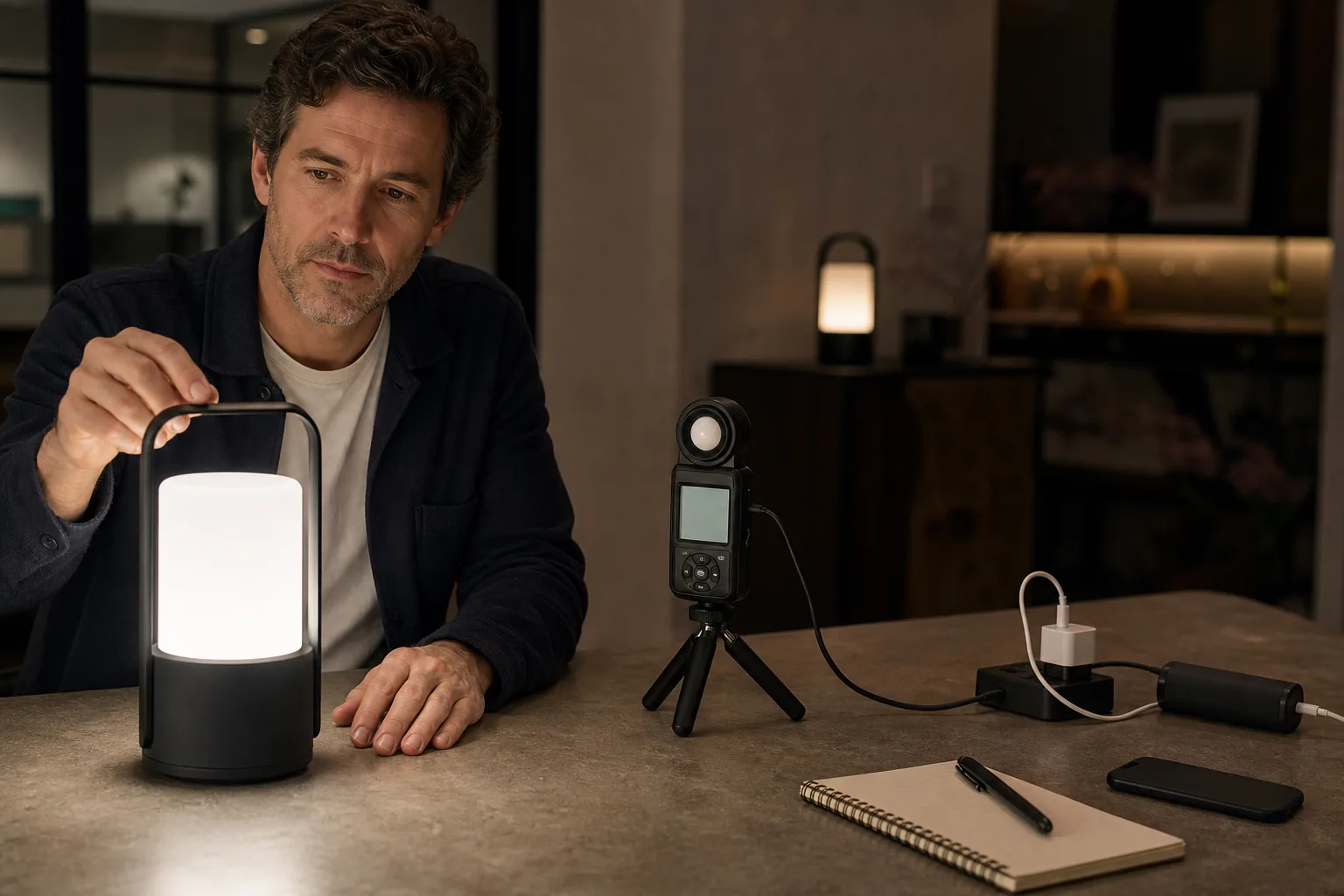
A rechargeable lamp’s advertised runtime does not necessarily tell you how long it remains useful at its brightest setting. Some lamps regulate their output and stay relatively steady before switching off; others gradually dim to extend their total “hours on.” For a meaningful comparison, measure illuminance at a fixed location over time. Record both the period near the lamp’s initial brightness and the longer period during which it still supplies enough light for its intended job.
What rechargeable lamp runtime should mean
When investigating a lamp, look for more than one runtime number. The most useful results separate maximum runtime from brightness retention:
- Hours-on runtime: the time from switching on the fully charged lamp until it turns off. This is the easiest figure to advertise, but it can include a long, dim tail.
- Near-full-output runtime: the time during which measured illuminance remains at or above a chosen percentage of its initial value.
- Usable runtime: the time during which the lamp remains above the minimum illuminance you need at the table, desk or reading surface.
There is no universal consumer threshold that makes a rechargeable table lamp “usable” in every room. A decorative dinner-table lamp and a task lamp have different jobs. For buyer comparisons, this guide uses 90% of initial illuminance to identify near-full output and 70% to expose substantial dimming. These are transparent comparison thresholds, not claims that every application becomes unsuitable below 70%.
Why lumens alone cannot answer the question
Lumens describe the total visible light emitted by a source, while watts describe electrical power. ENERGY STAR advises buyers to compare brightness in lumens rather than treating wattage as a measure of light output. However, a lamp’s lumens do not show how much light reaches your book, keyboard or dining surface. Shade geometry, beam direction, mounting height and distance all affect the result. Learn more in the Ross Lighting guides to lumens, watts versus lumens and beam angle. [1]
Why lux is the practical test unit
Lux measures illuminance: the quantity of light reaching a surface. One lux equals one lumen per square meter. An illuminance meter, commonly called a lux meter, measures illuminance on a plane. The Illuminating Engineering Society notes that better meters account for the spectral and angular response of incoming light through color and cosine correction. A phone application may reveal a large brightness decline, but its uncalibrated sensor should not be treated as laboratory-grade evidence. [2]
A repeatable lux-over-time test
This procedure is designed for comparing consumer lamps under controlled household conditions. It is not a substitute for an accredited photometric or battery-safety test. Consistency matters more than choosing a particular distance, provided the lamp, meter and room remain unchanged throughout every test.
Equipment and setup
- The rechargeable lamp and its supplied or manufacturer-approved charging equipment
- A dedicated lux meter, preferably with documented cosine correction
- A timer or spreadsheet
- Masking tape for marking the lamp and sensor positions
- A room where daylight and other lighting can be kept stable
- A thermometer if you want to document room-temperature differences between tests
Choose a realistic work-plane position, such as the center of a book or the place setting directly beside the lamp. Keep the meter’s sensing plane in the same orientation for every reading. As a practical starting point, place the sensor at least 0.5 meter from the LEDs unless the intended use requires a closer measurement. NIST cautions that illuminance-meter error can increase greatly very close to a source when the meter’s reference plane is not correctly defined. [3]
Test sequence
- Charge the lamp fully according to its instructions. Disconnect it from external power before testing battery runtime.
- Select the highest steady brightness setting and a fixed color-temperature setting, if available. Disable automatic, motion-responsive or color-cycling modes.
- Mark the lamp base and meter positions. Do not move the lamp, shade, sensor or nearby reflective objects during the test.
- With the lamp off, record ambient illuminance as Eambient. A darker room reduces the correction required.
- Turn on the lamp and start the timer. Record the first on-reading after 60 seconds as Eon,0. Use the same one-minute starting point for every lamp.
- Record readings every five minutes for the first 30 minutes, then every 15 minutes until output drops below 70% of the initial corrected reading. Continue at suitable intervals until the lamp switches off if you also want maximum runtime.
- Note visible step-downs, flicker, unexpected mode changes, excessive surface heat and the final shutoff time.
- Recharge and repeat the test at least once. Report both runs or use the shorter result for conservative purchasing decisions.
If ambient light changes, pause the comparison or measure the new lamp-off background. Do not subtract an old ambient value from readings taken after daylight has entered the room.
Calculate full-brightness and usable runtime
First subtract the background light from each reading:
Corrected lux at time t = Eon,t − Eambient,t
Then calculate brightness retention:
Retention at time t (%) = corrected lux at time t ÷ corrected initial lux × 100
For example, assume a lamp produces 212 lux with the lamp on and the room contributes 12 lux. Its corrected initial result is 200 lux. If a later corrected reading is 180 lux, retention is 180 ÷ 200 × 100 = 90%. If it later reaches 140 lux, retention is 70%.
| Result | How to determine it | What it tells a buyer |
|---|---|---|
| T90 runtime | Time until corrected illuminance first falls below 90% of its initial value | How long the lamp remains near its measured starting output |
| T70 runtime | Time until corrected illuminance first falls below 70% | When substantial dimming becomes measurable |
| Task-threshold runtime | Time until corrected illuminance falls below your chosen minimum lux | How long the lamp serves a particular location and task |
| Hours-on runtime | Time until the lamp switches off | Total operating time, including any dim tail |
| Repeatability | Difference between two or more runs under the same conditions | Whether the observed result appears consistent |
A strong product listing should state the brightness mode associated with its runtime claim and explain whether output is regulated. Treat an unqualified “up to” figure as a starting point for investigation rather than a guarantee of full-output operation.
Estimating runtime from battery capacity
If the manufacturer supplies battery voltage and amp-hour capacity, nominal stored energy can be estimated as:
Battery watt-hours = nominal voltage × amp-hours
A 3.7-volt, 4-amp-hour battery is nominally 14.8 watt-hours. A rough planning estimate is:
Estimated runtime = battery watt-hours × assumed usable-system efficiency ÷ average system watts
If the lamp averaged 4 watts and an illustrative 80% of nominal battery energy reached the operating system, the estimate would be 14.8 × 0.80 ÷ 4 = 2.96 hours. This is not a performance claim. Actual results depend on the discharge curve, driver efficiency, thermal control, battery age and any programmed dimming. A lux-over-time test remains more informative than capacity arithmetic alone.
Match the result to the room and lighting layer
Do not judge a rechargeable lamp only by its runtime graph. First decide what role it must perform. In a layered lighting plan, portable lamps may contribute task, accent or localized ambient light while ceiling fixtures provide broader illumination.
Decorative and dining use
A low-output lamp may work well for atmosphere even after it has declined below 70% of its initial reading. Check that the shade controls glare at seated eye level and that the lamp does not block sight lines. Warm appearance and smooth dimming may matter more here than maximum lux.
Reading and desk use
For reading or paperwork, test at the actual page position and angle. A lamp that produces an attractive pool of light immediately beneath its shade may provide much less illuminance where the user sits. Compare its task-threshold runtime with the duration of a normal work or reading session. The home-office lighting guide and glare guide cover placement considerations.
Backup lighting
For outage planning, record both T70 and total hours on. A controlled step-down may be acceptable if it preserves navigation light, but the lamp should not be presented as maintaining full brightness for the entire period unless measurements support that interpretation. Rechargeable table lamps complement rather than replace required emergency lighting, smoke alarms or code-compliant egress provisions.
Controls, batteries and buying checks
Multi-level controls can extend runtime because lower light output generally reduces battery demand, but test every lamp on the level you expect to use. A claim obtained on the lowest mode cannot predict rechargeable lamp runtime at full brightness.
Buyer checklist
- Is runtime stated separately for high, medium and low settings?
- Does the specification give initial lumens or another measurable output figure?
- Does the lamp maintain output, step down at a stated time or gradually fade?
- Can brightness and color temperature be selected independently?
- Can a depleted or aging battery be replaced through an authorized service route?
- Are the charger voltage, current and connector clearly identified?
- Is the complete lamp listed or certified by a recognized independent testing organization?
- Does the warranty address the battery as well as the LEDs and controls?
- Will the lamp remember its selected level, or restart at maximum after every use?
UL Solutions reports that UL 153 includes battery-operated portable luminaires and addresses areas including battery compliance, charging and discharging conditions, impact resistance, water ingress and photobiological hazards. Certification does not tell you how many hours a particular lamp will remain above your preferred lux threshold, but it is relevant to safety evaluation. [4]
Troubleshooting short runtime or rapid dimming
If a lamp’s useful output is much shorter than expected, repeat the test before concluding that it is defective. Confirm that it reached the manufacturer’s full-charge indication, that the selected mode did not change and that the charger meets the stated specification. For a lamp that loses brightness unusually quickly, see why a rechargeable lamp dims.
Common causes to check
- Testing the wrong mode: touch controls can make adjacent brightness levels difficult to distinguish.
- Changing geometry: small changes in lamp height, shade angle or sensor position can cause large lux differences.
- Ambient-light contamination: daylight or another fixture can conceal output decline.
- Thermal step-down: some drivers reduce power as internal temperature rises.
- Battery condition: capacity may decline with age, storage conditions and charge cycles.
- Charging problems: a damaged cable, unsuitable adapter or contaminated port can prevent a complete charge.
Charging and electrical safety
Follow the lamp manufacturer’s charging instructions and use the specified battery and charging equipment. NFPA advises keeping lithium-ion batteries away from combustible materials while charging and stopping use if a device develops excessive heat, swelling, leakage, unusual odor, color change or abnormal sounds. Do not open an integrated battery enclosure, bypass protection electronics or substitute an unapproved cell. [5]
A self-contained, low-voltage rechargeable lamp normally does not require an electrician. Hire a licensed electrician when adding or relocating a receptacle, altering branch-circuit wiring, converting a portable product to a hardwired installation, or investigating a hot, damaged, sparking or repeatedly tripping outlet. Do not continue testing equipment that shows signs of battery or electrical damage.
How to report a useful runtime result
A credible buyer note should report the lamp model, brightness and color settings, charge procedure, measurement distance, sensor orientation, ambient correction, initial corrected lux, T90, T70, task threshold, shutoff time and number of test runs. Include room temperature if tests were performed in substantially different conditions.
The final comparison should read something like: “At the marked work-plane position, the lamp remained at or above 90% of its corrected initial illuminance for X hours, above 70% for Y hours and switched off after Z hours.” This format distinguishes stable, useful output from the less informative claim that the lamp was merely still glowing.
Frequently asked questions
How is rechargeable lamp runtime at full brightness measured?
Fully charge the lamp, disconnect external power, select its highest steady setting and measure lux at a fixed point over time. Report how long corrected illuminance remains above a declared threshold, such as 90% of its initial value, rather than recording only when the lamp switches off.
Why does a rechargeable lamp get dimmer before its battery is empty?
The battery voltage may decline during discharge, or the lamp’s control system may intentionally reduce LED power to manage temperature or extend total operating time. The behavior depends on the battery, driver and programmed controls.
Can a phone measure rechargeable lamp runtime?
A phone lux application can help identify a large relative decline if the phone remains fixed, but different phones have different sensor responses. Use a dedicated lux meter for more defensible comparisons, and do not present uncalibrated phone readings as laboratory measurements.
Is advertised battery capacity enough to calculate lamp runtime?
No. Voltage and amp-hour capacity can provide a rough watt-hour estimate, but actual runtime also depends on LED power, driver efficiency, battery discharge limits, temperature and programmed dimming. A lux-over-time test shows the usable result.
Should a rechargeable lamp require an electrician?
A normal self-contained rechargeable lamp should not require electrical installation. Use a licensed electrician if you need a new outlet, altered building wiring or a hardwired conversion, or if an outlet becomes hot, damaged, sparking or prone to tripping.
Questions & discussion
Share a question or a useful experience about this guide. Comments appear immediately. Your name and comment are public. Email is optional and stays private; reply emails are not enabled yet. Comment privacy.