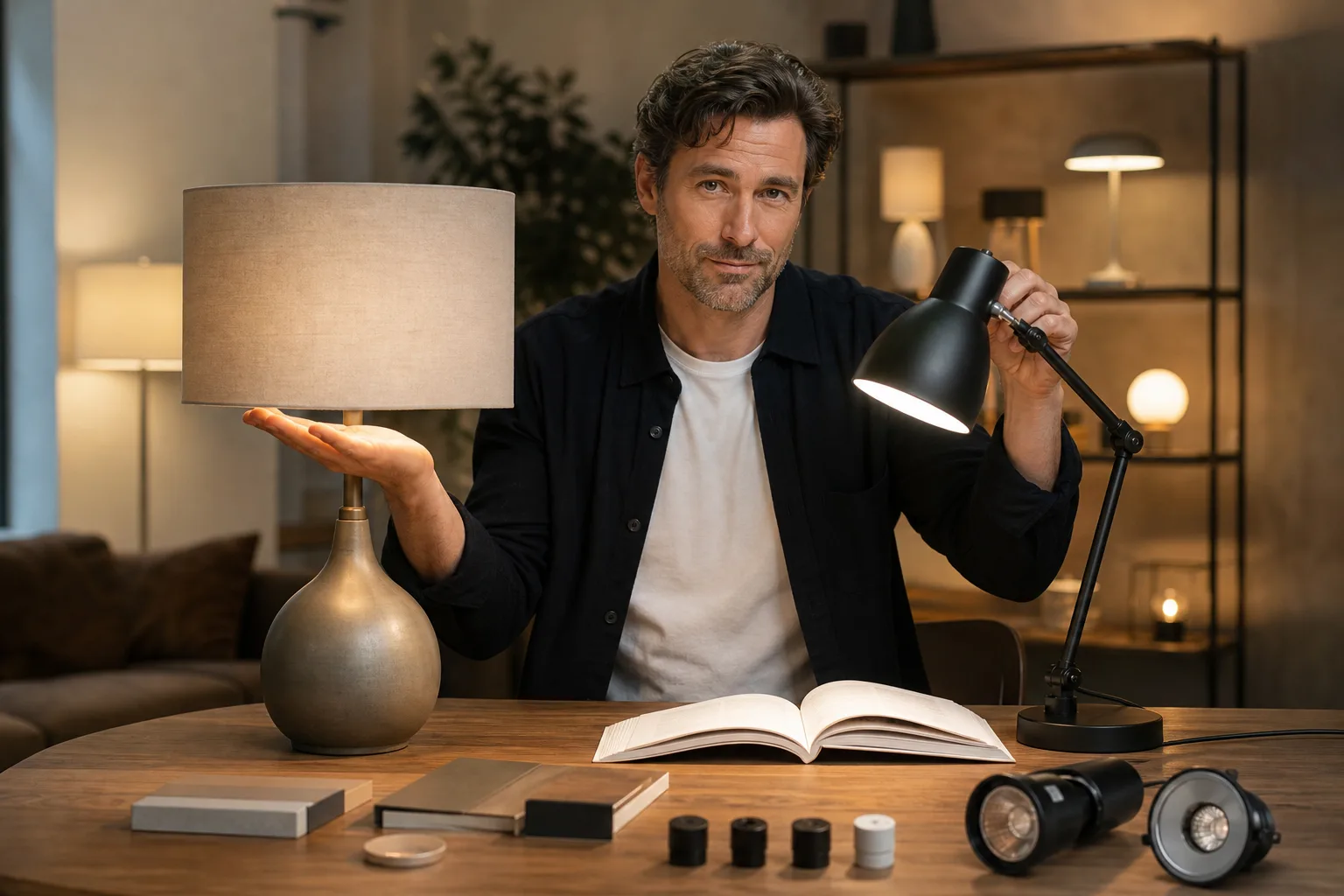
The practical difference between an accent lamp and a reading lamp is not the style of the base or shade. It is where the light goes. An accent lamp adds visual interest, soft background light or emphasis to an object. A reading lamp delivers enough controlled light to a book, magazine or work surface without shining uncomfortably into your eyes. If reading is the priority, choose for distribution, adjustability, glare control and distance first; treat appearance as the next filter.
Accent lamp vs reading lamp: the quick answer
Buy an accent lamp when your main goal is atmosphere, decorative sparkle, a softly illuminated corner or emphasis on art, plants or architectural texture. Buy a reading lamp when you need dependable light on a page, keyboard, craft project or other visual task.
Product names are not enough to make the decision. A decorative table lamp may work for reading if its shade sends useful light downward and the lamp sits close to the page. A fixture sold as a reading lamp may perform poorly if its exposed LED causes glare, its arm will not hold position or its beam is too small.
| Feature | Accent lamp | Reading lamp |
|---|---|---|
| Primary job | Create mood or visual emphasis | Illuminate a specific task surface |
| Typical distribution | Diffuse, upward, outward or narrowly aimed at a feature | Directed toward the page, usually with spill around it |
| Best placement | Where the fixture or illuminated feature contributes to the room | Beside or behind the reader, within easy aiming distance |
| Useful controls | Dimmer, timer or smart control | Reachable switch, dimmer and adjustable arm or head |
| Main buying risk | Too little visible effect or a distracting bright spot | Glare, shadows, a small beam or inadequate task illuminance |
| Best role in a lighting plan | Accent or decorative layer | Task layer |
Judge useful light, not watts alone
Lumens describe output
Lumens measure the light emitted by a lamp or fixture. Watts measure electrical power, so they are not a direct measure of brightness. ENERGY STAR recommends choosing the lumens you need and then comparing wattage for efficiency. Its familiar reference points include about 450 lumens for a traditional 40-watt replacement, 800 lumens for a 60-watt replacement and 1,100 lumens for a 75-watt replacement.1 See the Ross Lighting guides to lumens and watts versus lumens for a fuller explanation.
As a shopping starting point rather than a universal rule, compact accent lamps often use the lower part of that range, while reading lamps commonly benefit from roughly 450 to 1,100 available lumens plus dimming. Do not assume all of those lumens reach the book. Shade opacity, beam direction, mounting height and distance can make two equally rated lamps perform very differently.
Lux describes light arriving at the page
Lux measures illuminance: one lux equals one lumen per square meter.2 Foot-candles are another illuminance unit; one foot-candle is approximately 10.76 lux. Illuminance should be considered at the task surface, not merely at the floor or next to the fixture. The Illuminating Engineering Society likewise defines a task-surface recommendation as applying at the height where the visual task occurs.3
A useful estimation formula is:
Estimated task illuminance in lux = lumens reaching the task ÷ illuminated area in square meters.
For example, assume a 500-lumen lamp directs 40% of its output onto a 0.5-square-meter reading area. The estimate is 500 × 0.40 ÷ 0.5 = 400 lux. This is only a planning estimate: the percentage reaching the task is usually unknown, and reflections, beam shape and measurement angle affect the result. A basic lux meter can check the page after installation. For ordinary print, trying approximately 300 to 500 lux at the page is a reasonable practical starting range, but small type, low contrast, aging eyes or detailed work may require more. Adjust for comfort rather than treating one value as correct for everyone.
Distribution, distance and glare matter most
Look for a beam that covers the task
A reading lamp should illuminate the open book, not just a bright circle in its center. A wider or adjustable beam is generally easier to position for books and documents. A narrow beam can suit a small task or create accent drama, but it becomes frustrating when your hands, page edges or notes fall into darkness.
Beam angle describes distribution rather than total output. Department of Energy guidance categorizes approximately 10 degrees as a spotlight, 25 degrees as a narrow flood and 60 degrees as a wide flood.4 Consumer lamps do not always publish beam angle, so examine product diagrams, shade openings and photographs showing the lit area. The beam angle guide explains how spread changes with distance.
Control the view of the light source
Glare occurs when a bright source or reflection makes seeing uncomfortable or more difficult. For reading, the shade, lens or reflector should shield the LED from your normal seated view while allowing light to reach the page. A bare bulb at eye level is usually a warning sign, especially in an otherwise dim room.
- Place the lamp beside and slightly behind the shoulder when possible.
- For right-handed writing, position it toward the left to reduce hand shadows; reverse that arrangement for left-handed writing.
- Aim the head so the brightest reflection does not bounce from glossy paper into your eyes.
- Keep some ambient light in the room rather than creating a bright page surrounded by complete darkness.
- Choose a deeper shade, diffusing lens or recessed light source if you can see a harsh LED image.
Read more about identifying and correcting lighting glare.
Distance changes performance
Moving a lamp closer normally increases illuminance and reduces the output needed, but it also makes the covered area smaller. Moving it farther away expands the beam while reducing the light arriving at the page. This is why a stable adjustable arm is often more useful than simply buying a higher-lumen bulb. Check the fixture's reach from its intended table, headboard or floor position before buying.
Plan both lamps as part of layered lighting
A comfortable room rarely depends on one portable lamp. Layered lighting combines ambient light for orientation, task light for activities and accent light for visual hierarchy. A reading lamp and accent lamp therefore are not mutually exclusive: they solve different parts of the same plan.
Living rooms
Use a floor or table reading lamp at the chair where reading actually occurs. Then add an accent lamp on a console, shelf or sideboard to brighten a darker edge or feature. Avoid placing an accent lamp where its exposed source reflects in a television. The living-room lighting guide covers additional placement options.
Bedrooms
A bedside lamp can perform both roles if it has a dimmer, a shielded downward component and enough reach to cover the page. A decorative lamp with a dark or fully opaque shade may illuminate the wall attractively but leave the book dim. For shared beds, a controlled beam helps limit spill toward the other person.
Home offices and study corners
A desk lamp should cover documents without producing screen reflections. Position it to the side of the monitor rather than aiming it toward the display. If the surrounding room feels gloomy after the task light is set correctly, add ambient light instead of increasing the desk lamp until it becomes glaring. See home-office lighting for a complete room approach.
Compare bulbs, integrated LEDs and color quality
Replaceable bulb or integrated LED?
A replaceable-bulb lamp lets you change lumens, color temperature and bulb type later. Before buying, confirm the socket, maximum permitted wattage, bulb dimensions and whether the shade is open or enclosed. LEDs can be larger near the base than older incandescent bulbs, so physical fit matters.
An integrated LED lamp can provide a thinner head and more precise optics, but the light source may not be replaceable. Compare the complete fixture's stated lumens, dimming range, warranty and expected service arrangement. The choice is explained further in integrated LED versus bulb fixtures.
Color temperature and CRI
Color temperature describes whether white light appears warmer or cooler. Approximately 2700K to 3000K usually blends well with relaxed residential rooms; 3500K can look more neutral for a work area. Higher color temperature does not automatically mean more light, so compare lumens separately. If the lamp will serve both evening accent lighting and daytime work, selectable or tunable white can add flexibility. Use the color-temperature guide to coordinate it with existing fixtures.
Color Rendering Index, or CRI, is a broad indicator of how faithfully colors appear compared with a reference source. A higher-quality source can make printed images, textiles and finishes easier to distinguish, but CRI does not describe brightness, glare or beam coverage. Check all of those characteristics rather than using one specification as a quality shortcut.
Controls can turn a good fixture into a useful one
For a reading lamp, the switch should be reachable without standing or reaching behind furniture. Continuous dimming is especially useful because daylight, paper reflectance and visual needs change. For an accent lamp, a timer, switched outlet or smart control may be more valuable than an articulated arm.
- Choose onboard dimming when possible; it avoids uncertainty between an LED bulb and a separate plug-in dimmer.
- Verify compatibility before combining a dimmable bulb with an external control.
- Check the lowest setting. Some lamps turn off abruptly, flicker or remain too bright near minimum.
- Prefer simple manual control for a lamp that must remain usable when an app, hub or internet connection is unavailable.
- Consider memory behavior. Confirm whether the lamp returns to its previous level after power is interrupted.
If an LED buzzes or flickers, first verify that every part of the dimming combination is intended to work together. Then try the lamp at full output, reseat a replaceable bulb and test a compatible bulb if permitted by the fixture label. Persistent flicker, heat, odor, sparking or repeated circuit trips calls for disconnection and professional assessment rather than continued troubleshooting. Relevant Ross Lighting resources include LED flickering and LED buzzing.
Final buying checklist
Use this checklist before ordering either type:
- Define the job: atmosphere, object emphasis, reading or a combination.
- Measure the distance from the proposed lamp position to the page or feature.
- Confirm that the arm, neck or head can reach and hold the required angle.
- Check lumens, not only wattage or an incandescent-equivalent label.
- Look for a distribution diagram, beam angle or clear image of the illuminated area.
- Make sure the shade or lens hides the bright source from the normal viewing position.
- Choose a reachable switch and dimming range appropriate to the task.
- Verify bulb base, dimensions, maximum wattage and enclosed-fixture restrictions where applicable.
- Check cord length without planning to stretch it across a walkway or pinch it behind furniture.
- For rechargeable models, distinguish claimed battery runtime from runtime at the brightness you intend to use.
Portable plug-in lamps generally do not require electrical installation, but basic electrical limits still matter. Follow the fixture's lamp type and maximum-wattage markings. A UL safety notice concerning one portable luminaire illustrates that an unsuitable lamp can create overheating, fire and shock hazards.5 Stop using a lamp with a damaged cord, loose socket, scorching, unusual heat or intermittent connection. Have a licensed electrician handle new outlets, hardwired wall lamps, damaged building wiring or repeated breaker trips.
Bottom line: choose an accent lamp for visual effect and a reading lamp for controlled task illumination. If one fixture must do both, prioritize a shielded adjustable head, sufficient dimmable output and a beam broad enough to cover the page. Those features are more dependable than the category printed on the product listing.
Frequently asked questions
Can an accent lamp be used as a reading lamp?
Yes, if it directs enough light across the full page, shields the bulb or LED from your eyes and sits close enough to the reading position. A decorative label does not prevent good task performance, but many accent lamps have diffuse or upward distribution that leaves the page too dim.
How many lumens should a reading lamp have?
Roughly 450 to 1,100 available lumens with dimming is a practical shopping range for many residential reading positions, but fixture distribution and distance determine how much light reaches the page. A well-aimed lower-output lamp can outperform a brighter lamp that sends light in the wrong direction.
Is warm or cool light better for reading?
Neither is universally better. Around 2700K to 3000K usually suits relaxed evening rooms, while 3500K can appear more neutral in a work area. Brightness, glare control, print contrast and personal preference are more important than choosing the highest color temperature.
Where should a reading lamp be placed?
Place it beside and slightly behind the reader, then aim it across the page without exposing the bright source to the eyes. For handwriting, placing the lamp opposite the writing hand helps reduce shadows.
Questions & discussion
Share a question or a useful experience about this guide. Comments appear immediately. Your name and comment are public. Email is optional and stays private; reply emails are not enabled yet. Comment privacy.