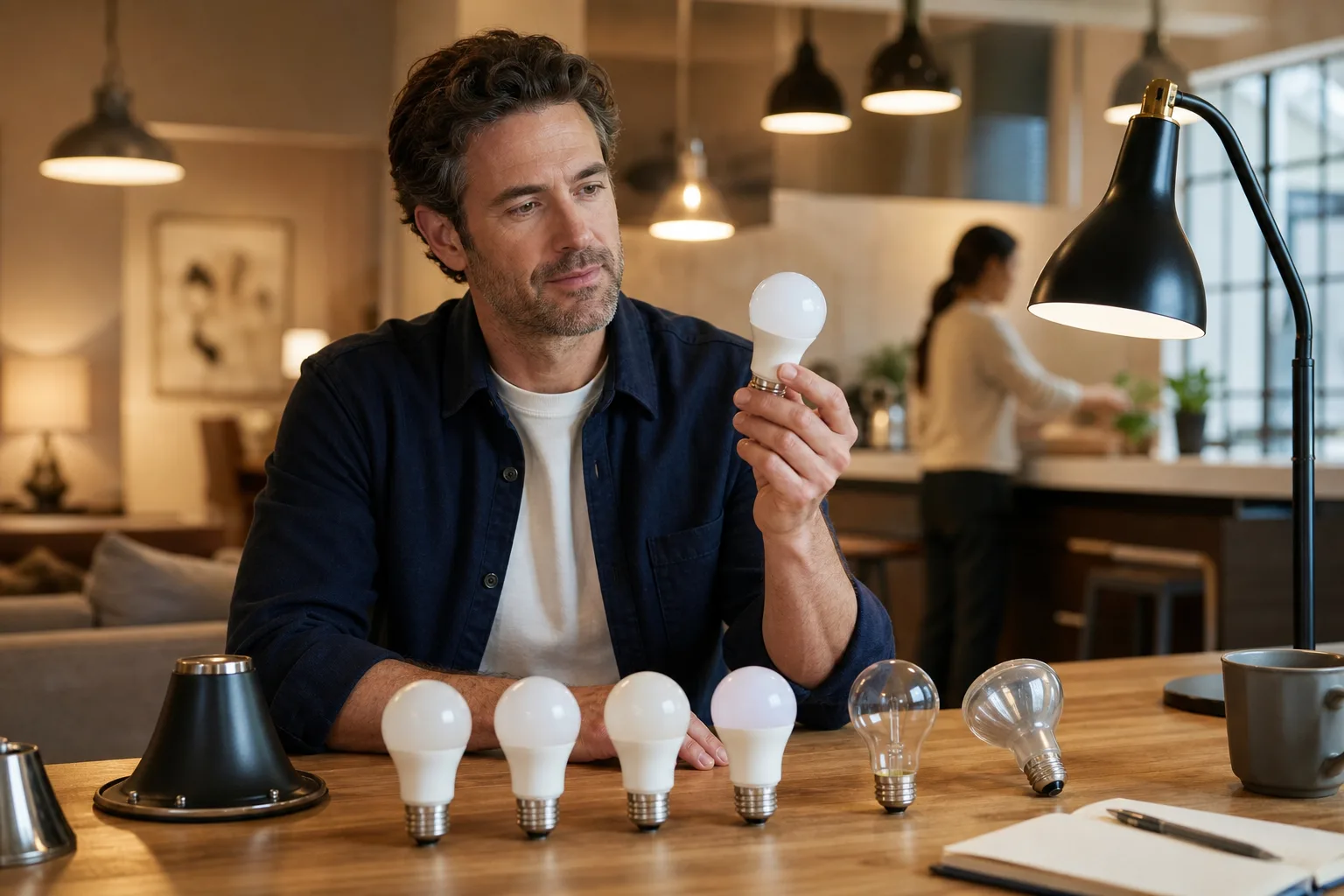
An A19 light bulb is the familiar pear-shaped bulb used in many table lamps, floor lamps, pendants, ceiling fixtures and wall lights. “A19” identifies the bulb’s shape and nominal diameter, not its brightness, wattage or screw base. For most household applications, an A19 LED with an E26 medium base is the practical starting point—but you still need to match its lumens, dimensions, voltage, controls and fixture ratings to the job.
What does A19 mean?
The “A” is the designation for the traditional general-service bulb shape. The number 19 indicates a nominal maximum diameter of 19 eighths of an inch: 19 ÷ 8 = 2.375 inches, or about 60 millimeters. A U.S. Department of Energy benchmark describes A19 lamps this way and notes that they commonly use an E26 medium screw base. Bulb length can still vary, especially where an LED driver makes the neck or base wider, so check the manufacturer’s dimensional drawing when clearance is tight. DOE A-lamp benchmark.
A19 and E26 are not interchangeable terms
A19 describes the visible bulb envelope; E26 describes a screw base approximately 26 millimeters in diameter. They commonly appear together in the United States, but neither label guarantees the other. Confirm the base on the package and compare it with the socket before buying.
- A19: bulb shape and nominal diameter.
- E26: common U.S. medium screw base.
- Lumens: total visible light produced.
- Watts: electrical power consumed, not brightness.
- Kelvin: the warm or cool appearance of white light.
- CRI: a simplified indication of how naturally colors appear.
Do not assume that every bulb marketed as a “60-watt replacement” has identical dimensions, light distribution or dimming behavior. Use the replacement claim as a quick reference, then compare the actual specifications.
Which A19 bulb type should you choose?
For a new purchase, an LED is normally the most versatile A19 option because it produces useful light with less input power than an incandescent bulb and is available in many brightness, color and control configurations. The correct subtype depends on the fixture and how you use the room.
| Type | Best suited to | Check before buying |
|---|---|---|
| Standard LED | Everyday lamps and general room lighting | Lumens, color temperature, CRI and fixture enclosure rating |
| Dimmable LED | Living rooms, bedrooms and dining areas | Bulb-to-dimmer compatibility and minimum dimming level |
| High-CRI LED | Artwork, wardrobes, food preparation and color-sensitive tasks | CRI value plus color temperature; CRI alone does not describe every color |
| Three-way LED | Lamps with three-way sockets | Three lumen levels and an explicit three-way marking |
| Smart or tunable LED | Scheduling, remote control and adjustable white or colored light | App, hub, network and wall-switch requirements |
| Incandescent or halogen | Legacy or specialist applications where specifically allowed | Fixture wattage limit, heat and current product availability |
Choose lumens before watts
Lumens tell you how much light a bulb emits. ENERGY STAR’s brightness guide uses approximately 450 lumens for a traditional 40-watt replacement, 800 lumens for 60 watts, 1,100 lumens for 75 watts and 1,600 lumens for 100 watts. These are shopping reference points rather than promises that every fixture will deliver the same illumination. ENERGY STAR brightness guidance.
After selecting the required lumens, compare watts to judge energy use. Luminous efficacy can be calculated as:
Efficacy (lm/W) = bulb lumens ÷ input watts
For example, an 800-lumen bulb using 8.5 watts has an efficacy of about 94 lm/W. Higher efficacy means more stated light output per watt, although it does not by itself guarantee good color, low glare, quiet dimming or long service life. See the Ross Lighting guides to lumens and watts versus lumens for more detail.
Specifications that affect comfort and appearance
Color temperature
Correlated color temperature, measured in kelvins, describes whether white light looks warmer or cooler. Lower values appear warmer and more yellow; higher values appear cooler or bluer. The Department of Energy identifies 2700K as a typical warm residential choice and 3000K as a somewhat cleaner warm white. Values around 3500K to 4000K can suit work-oriented spaces when they coordinate with the room’s other light sources. DOE bulb purchasing guidance.
- 2200K–2700K: very warm to familiar incandescent-like light.
- 3000K: warm but slightly crisper.
- 3500K–4000K: neutral to cool white for task-oriented areas.
- 5000K and above: distinctly cool or daylight-like appearance.
These ranges describe appearance, not quality. Keep adjacent bulbs at the same nominal color temperature unless a deliberate contrast is part of the plan. Use the color temperature picker when comparing room finishes and activities.
CRI and color rendering
CRI is commonly shown on a 0–100 scale. A higher value generally indicates closer color fidelity to a reference source of the same color temperature. CRI 80 is adequate for many general-lighting applications, while 90 or above is a useful buying target where skin tones, food, clothing or artwork matter. CRI is not a complete description of color performance: the Illuminating Engineering Society notes that the more detailed TM-30 method evaluates additional aspects of fidelity and gamut. IES position on light-source color rendition.
Clear, frosted and filament-style bulbs
A frosted A19 typically softens the visible source and is a sensible choice behind an open shade or diffuser. Clear and filament-style bulbs emphasize sparkle and can complement transparent fixtures, but exposed bulbs may create uncomfortable glare. If the bulb is visible from normal eye level, reduce its luminance with a shade, diffuser or lower-output lamp rather than relying only on a dimmer. Learn more in the guide to controlling glare.
Match the bulb to the fixture and controls
A correct base is only one part of compatibility. Before installing an A19 light bulb, check every item in this list:
- The fixture accepts the bulb’s base, voltage and physical dimensions.
- The bulb’s actual wattage does not exceed the fixture’s maximum rating.
- An LED used inside a closed globe or sealed shade is explicitly rated for enclosed fixtures.
- A bulb used outdoors or in a damp area carries the location rating required by the fixture and installation.
- A dimmable circuit uses a bulb marked dimmable and a compatible LED dimmer.
- A three-way socket uses a three-way bulb rather than a standard single-level lamp.
- A motion sensor, timer or photocell is compatible with the selected LED load.
- The bulb will not touch a shade, lens, insulation or another component.
Enclosed fixtures retain heat, which can affect an LED driver’s performance and life. DOE purchasing guidance therefore recommends checking the package or technical specifications for enclosed-fixture suitability. It also notes that some LED lamps are larger near the base than incandescent bulbs. DOE bulb and fixture guidance.
Dimmers and smart controls
“Dimmable” does not mean compatible with every dimmer. An unsuitable pairing can cause flicker, buzzing, a limited adjustment range, delayed starting or failure to turn fully off. Look for the bulb manufacturer’s tested-dimmer list and confirm that the dimmer supports the total LED load. UL identifies LEDs as a distinct controllable load type because dimmers may be designed and evaluated for different electrical loads. UL dimmer testing overview.
Smart bulbs usually require continuous power, so a conventional wall switch must generally remain on for schedules and app control to work. Do not install a smart bulb on a wall dimmer unless both manufacturers expressly permit that combination. For wired control changes, consult the guides to choosing an LED dimmer and dimmer installation.
Plan A19 bulbs as part of layered lighting
An A19 bulb is usually a broad-distribution source rather than a tightly controlled beam. It works well for ambient light in shaded lamps, pendants and diffused ceiling fixtures, but it may be inefficient for highlighting artwork or concentrating light on a small work surface. Directional reflector lamps or integrated fixtures are often better for those tasks.
A transparent room-planning calculation
For a rough starting estimate, use:
Required bulb lumens ≈ target foot-candles × floor area in square feet ÷ utilization factor
Assume, for example, a 12 × 14-foot room, a planning target of 15 foot-candles for ambient light and a utilization factor of 0.65:
12 × 14 = 168 sq ft
15 × 168 ÷ 0.65 ≈ 3,877 bulb lumens
That could be distributed across five nominal 800-lumen bulbs rather than concentrated in one bright source. The 15-foot-candle target and 0.65 utilization factor are stated planning assumptions, not universal requirements. Shades, fixture efficiency, mounting height, wall reflectance and light distribution can change the delivered result substantially. Use a higher task-light level at a desk or reading chair instead of raising the entire room’s ambient output.
This is the basis of layered lighting: combine ambient light for orientation, task light where work occurs and accent light for visual emphasis. The lumens calculator can help with an initial estimate, while the home-lighting planning guide covers layout and controls.
Good uses by room
- Living room: shaded table and floor lamps, preferably dimmable, supporting rather than replacing task and accent lighting.
- Bedroom: warm, low-glare bedside lamps with independent controls.
- Home office: ambient fixtures plus a dedicated desk light positioned to limit screen reflections.
- Kitchen: general ceiling or pendant lighting, supplemented by directional worktop lighting.
- Hall or utility area: simple broad light where the bulb and fixture have the required location rating.
Room-specific guidance is available for the living room and home office.
Installation safety and troubleshooting
To replace an ordinary screw-in bulb, switch the light off, allow the old bulb to cool and follow the fixture and bulb instructions. Use dry hands, support the bulb without forcing it and stop if the base is stuck, broken or cross-threaded. Never exceed the fixture’s marked maximum wattage, even when a bulb physically fits.
Turn off the circuit at the breaker before inspecting a damaged socket or working beyond routine bulb replacement. Use a licensed electrician if there are scorch marks, melted parts, exposed wiring, a loose socket, repeated breaker trips, persistent burning odors or a need to alter fixed wiring. Dimmer replacement may also require a licensed electrician where local rules demand it or where the circuit cannot be identified and isolated safely.
Common A19 problems
| Symptom | Likely checks |
|---|---|
| Flicker or pulsing | Confirm dimmer compatibility, tighten the cooled bulb with power off, and test on a standard switch if safe. |
| Buzzing | Check the bulb and dimmer pairing; replace either component with a documented compatible model. |
| Early failure | Look for an enclosed fixture, excessive heat, high switching frequency or a loose socket connection. |
| Bulb will not fit | Compare maximum length, diameter and base-neck width rather than relying on the A19 label alone. |
| Room still feels dim | Check shade opacity, fixture placement and surface colors; add task lighting before simply increasing glare. |
| Bulbs look mismatched | Match brand or product family, color temperature, CRI and lumen output across the group. |
If a known-good bulb fails in one fixture but operates normally elsewhere, discontinue use of the suspect fixture until its switch, socket and wiring have been assessed. For a step-by-step overview of ordinary replacement, see how to replace a light bulb.
Frequently asked questions
Is an A19 bulb the same as an E26 bulb?
No. A19 describes the bulb shape and nominal diameter, while E26 describes a medium screw base about 26 millimeters in diameter. They are commonly paired in the United States, but you should verify both labels.
How many lumens should an A19 light bulb produce?
Choose lumens according to the task and the number of fixtures. Common reference points are about 450 lumens for a 40-watt replacement, 800 for 60 watts, 1,100 for 75 watts and 1,600 for 100 watts.
Can an A19 LED be used in an enclosed fixture?
Only if the bulb is explicitly rated for enclosed fixtures. Closed globes and sealed shades trap heat, which can reduce the performance or service life of an unsuitable LED.
Can any A19 LED work with a dimmer?
No. The bulb must be marked dimmable, and the dimmer must support that LED model or load type. An incompatible pairing can cause flicker, buzzing, poor range or failure to switch off completely.
What color temperature is best for an A19 bulb?
Warm 2700K light suits many living rooms and bedrooms, while 3000K offers a slightly crisper warm white. Neutral 3500K to 4000K can suit task-oriented areas, provided it coordinates with nearby lighting.
Questions & discussion
Share a question or a useful experience about this guide. Comments appear immediately. Your name and comment are public. Email is optional and stays private; reply emails are not enabled yet. Comment privacy.