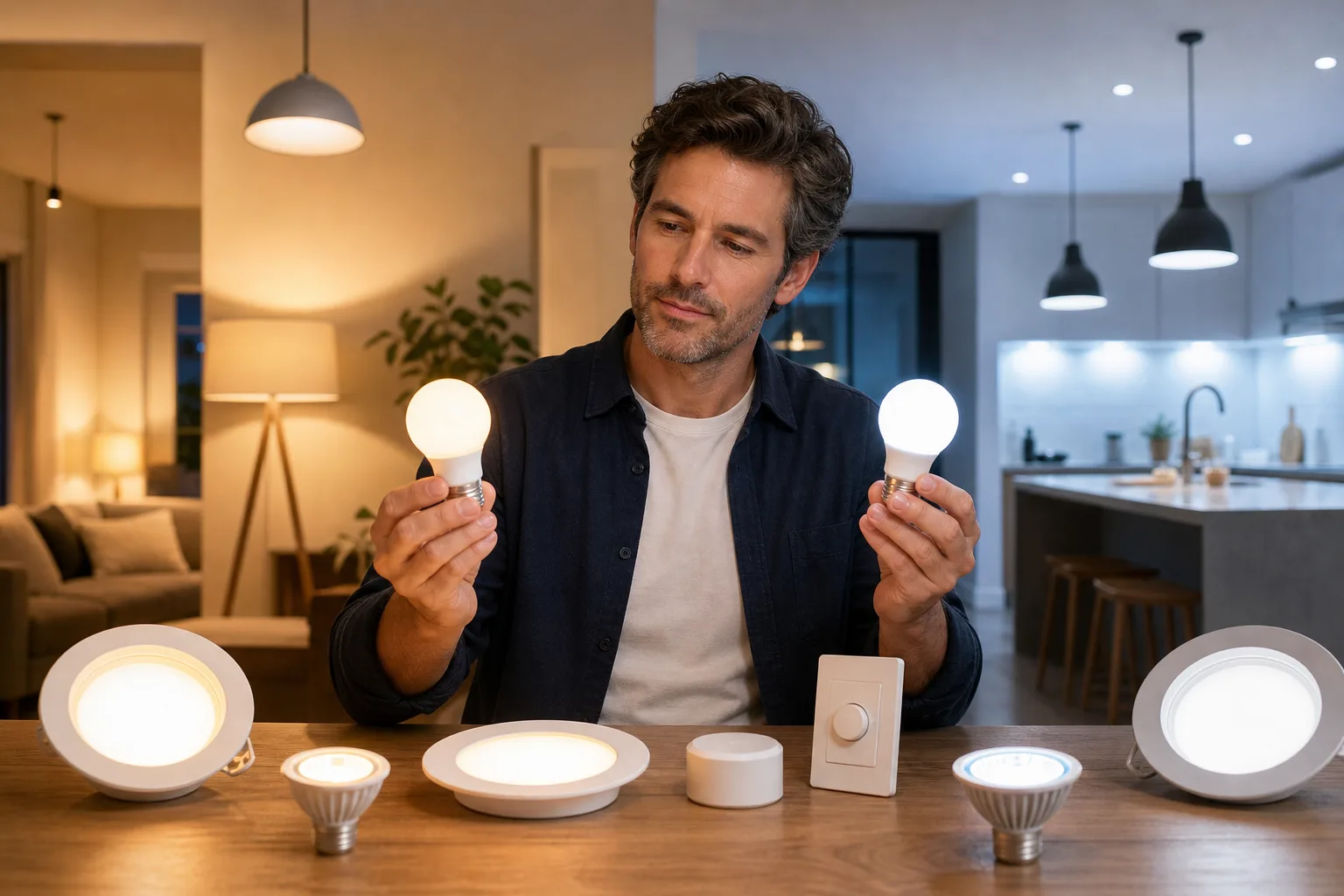
When comparing warm white vs daylight bulbs, choose warm white for most living rooms, bedrooms and evening-use spaces; choose daylight selectively for workshops, utility areas and task lights where a crisp appearance helps you see detail. Warm white usually means 2700K to 3000K, while bulbs labeled daylight are commonly 5000K to 6500K. Neither is automatically brighter, more efficient or better quality: Kelvin describes the color appearance of the light, while lumens describe light output. If you want one adaptable system, a dimmable 3000K source or a tunable-white fixture is often easier to live with than daylight bulbs throughout the home.
Warm white vs daylight at a glance
The practical difference is visual character. Warm white has a yellowish tone similar to traditional incandescent lighting. Daylight is a cooler white that may look slightly blue, especially after sunset or beside warmer lamps. The US Department of Energy identifies 2700–3000K as warm or soft light and 5000–6500K as blue-white light intended to resemble daylight. DOE bulb-selection guidance also treats brightness and color as separate buying decisions.
| Factor | Warm white | Daylight |
|---|---|---|
| Typical label | Soft white or warm white | Daylight or natural daylight |
| Common CCT range | 2700K–3000K | 5000K–6500K |
| Visual character | Yellowish, relaxed and familiar | Crisp, cool and sometimes bluish |
| Useful starting points | Living rooms, bedrooms, dining areas and decorative lamps | Workshops, garages, laundry rooms and focused task lights |
| Potential drawback | Can make a low-light work area feel subdued | Can feel stark at night or clash with warm finishes |
| Brightness | Determined by lumens, not Kelvin | Determined by lumens, not Kelvin |
These are starting points rather than rules. A bright 2700K bulb can provide more light than a low-lumen 5000K bulb, and a well-designed warm-white task light may be more useful than a glaring daylight bulb.
What Kelvin does—and does not—tell you
Color temperature describes the appearance of white light
Correlated color temperature, or CCT, is expressed in kelvins and summarizes whether a white source looks warmer or cooler. Counterintuitively, lower numbers look warmer and higher numbers look cooler. NIST notes that lamps around 5000K to 5600K are typically marketed as daylight or full-spectrum products. NIST's Kelvin introduction explains the physical reference behind this scale. For a practical overview, see the Ross Lighting guide to color temperature.
Do not interpret “daylight” as an exact reproduction of sunlight. Natural daylight changes with weather, time, location and the surfaces around you. A daylight-labeled bulb is a fixed electric-light source unless it is specifically tunable.
Lumens determine how much light the bulb emits
Lumens measure light output; watts measure electrical power. ENERGY STAR advises shoppers to compare bulbs by lumens and then consider wattage when evaluating energy use. As familiar reference points, approximately 450 lumens replaces the output associated with a traditional 40-watt incandescent, 800 lumens corresponds to a 60-watt replacement and 1600 lumens to a 100-watt replacement. ENERGY STAR's brightness guide provides the comparison table. Learn more about watts versus lumens before matching a replacement bulb.
Color quality is a separate specification
Two bulbs with the same Kelvin rating can make furniture, food and skin tones look different because their spectral output differs. CRI is a commonly listed color-rendering measure, although it cannot describe every aspect of LED color quality. DOE identifies color appearance and the rendering of object colors as distinct characteristics. DOE's LED basics provides additional context. Compare the CCT and CRI labels rather than assuming that daylight automatically renders colors more accurately.
Which color temperature works best in each room?
Start with what happens in the room, when it is used and which surfaces dominate the view. Warm woods, cream fabrics and traditional finishes often feel coherent under 2700K or 3000K. White cabinetry, gray finishes and work surfaces may tolerate a cooler source, but very cool light is not required for adequate task illumination.
| Room or activity | Practical starting point | Planning note |
|---|---|---|
| Living room | 2700K–3000K | Use warm ambient light, then add brighter reading or display lights where needed. |
| Bedroom or nursery | 2700K | Prioritize low-glare, dimmable light for evening use. |
| Dining area | 2700K–3000K | Check how food, wood and upholstery look under the selected bulb. |
| Kitchen | 3000K–4000K | Keep ceiling and under-cabinet lighting reasonably consistent; use sufficient task lumens on counters. |
| Home office | 3000K–4000K, or tunable white | Control screen reflections and illuminate documents separately from the room background. |
| Laundry or closet | 3000K–4000K | Good color rendering and adequate output matter more than choosing the coolest label. |
| Garage or workshop | 4000K–5000K | Use broad, even lighting plus targeted illumination at benches and equipment. |
| Reading lamp | 3000K–5000K according to preference | Place the source to reduce page shadows and glare; increase lumens before assuming cooler light is needed. |
For detailed layouts, use the room-specific guidance for the living room, kitchen, home office or workshop. If you are uncertain, test one returnable bulb in the actual room during both daytime and evening before buying a full matching set.
Plan light in layers instead of relying on bulb color
Use ambient, task and accent lighting
A room usually works better when one source does not have to perform every job. Ambient lighting provides general visibility, task lighting concentrates light on counters, desks or reading material, and accent lighting draws attention to art, shelving or architecture. This layered-lighting approach lets you keep the room comfortable while providing stronger illumination where it is genuinely useful.
For example, a kitchen might combine 3000K ceiling fixtures with 3000K under-cabinet task lights. A workshop could use 4000K general fixtures and a brighter movable bench light. Avoid mixing 2700K and 6500K sources within the same sightline unless the contrast is intentional; the difference will usually be obvious.
Estimate lumens before selecting Kelvin
A simple planning estimate is:
Required lumens = target foot-candles × floor or task area in square feet.
For example, a 12-by-14-foot room has 168 square feet. If your chosen design assumption is 15 foot-candles for general illumination, the estimate is 15 × 168 = 2520 lumens. That total could be divided among several fixtures. This is an initial estimate, not a guarantee or a code-compliance calculation: shades, beam angles, ceiling height, surface reflectance, fixture losses and the location of the work plane all affect delivered light. Use the lumens calculator to explore assumptions, then judge the result in the finished space.
Use this bulb and fixture buying checklist
After deciding on a tentative color temperature, check the complete lighting system rather than buying by the front-of-box color name alone.
- Read the Kelvin number. Marketing terms vary. The printed CCT is more useful than “cozy,” “natural” or “sunlight” wording.
- Match the required lumens. Do not compensate for a dim room merely by switching from warm white to daylight.
- Confirm the base and shape. Check whether the fixture needs an E26 lamp, candelabra base, reflector, globe or another format.
- Check physical fit. Some LED bulbs are wider near the base and may not fit a tight shade or socket enclosure.
- Verify fixture compatibility. Use a bulb marked for enclosed fixtures if the lamp will be installed in one. Also follow damp- or wet-location requirements where applicable.
- Compare color rendering. Look beyond CCT when accurate or pleasing object colors matter.
- Check beam angle. A narrow reflector lamp and a wide A19 bulb can distribute the same lumen output very differently.
- Match all visible bulbs. Buy the same model and CCT for a multi-bulb fixture to reduce obvious color variation.
- Check dimming claims. The bulb must be marked dimmable, and the dimmer manufacturer should identify compatible LED loads.
- Consider replaceability. Compare a standard replaceable bulb with an integrated LED fixture before committing to a permanent installation.
DOE also cautions that enclosed fixtures can trap heat and affect unsuitable LED products, and that LEDs used with dimming systems need compatible controls. These considerations are included in its energy-efficient bulb purchasing guidance.
Controls can remove the either-or decision
Dimming changes output, but not always color
A conventional dimmable LED normally becomes less bright while staying near its rated CCT. A “dim-to-warm” product intentionally shifts to a lower, warmer CCT as it dims, approximating the visual behavior of incandescent lighting. This can suit dining and living areas that need brighter functional light early in the evening and softer light later. See the guide to dim-to-warm lighting.
Tunable white provides a wider range
Tunable-white products can move between warmer and cooler settings using a wall control, remote or app, depending on the system. DOE describes white-tunable products as combining warm and cool LED channels to create intermediate settings. DOE's overview of color-tunable LEDs also notes that color appearance can vary across the tuning range, so compare specifications and sample the product when possible.
Tunable white is most useful when a room genuinely changes roles, such as a home office that becomes a guest room. For a space used consistently, a fixed 2700K, 3000K or 4000K source may be simpler and less expensive. The color temperature picker can help narrow the starting range.
Troubleshooting and electrical safety
If the new bulbs look wrong
- Too yellow or orange: try the next standard step upward, such as 2700K to 3000K or 3000K to 3500K, rather than jumping immediately to 5000K.
- Too blue or clinical: move down from daylight to 4000K or 3000K and reassess at night.
- Bright but uncomfortable: reduce glare with a shade, diffuser, wider beam or lower-lumen lamp. See lights that feel too bright.
- Colors do not match: verify that every bulb has the same model number and CCT. The guide to wrong color temperature covers common causes.
- Flickering or buzzing: check whether the lamps are dimmable and listed as compatible with the control. ENERGY STAR notes that not every LED works well with every dimmer and recommends consulting compatibility information. ENERGY STAR downlight guidance explains this matching process.
Know when to stop and call an electrician
For a simple bulb change, switch the light off, allow the old lamp to cool and follow the fixture's wattage, lamp-type and location labels. Stop using a fixture if you find scorching, melting, a loose socket, damaged insulation, repeated breaker trips or persistent arcing sounds. Hardwired fixture replacement, dimmer installation and wiring diagnosis are safety-sensitive tasks. Use a licensed electrician when you cannot positively de-energize and verify the circuit, when wiring is damaged or unfamiliar, or when local rules require professional work. The 2026 National Electrical Code addresses electrical installation requirements intended to reduce shock, fire and equipment hazards.
The bottom line
For most homes, warm white is the safer default for evening comfort and visual continuity: choose 2700K for a traditional, relaxed appearance or 3000K for a slightly cleaner white. Reserve 5000K daylight bulbs for locations where you deliberately want cool-looking task light, such as a workbench, utility area or specific reading station. If 2700K feels too yellow and 5000K feels too blue, do not force the comparison—3500K or 4000K may be the better middle ground.
Make the final decision by checking Kelvin, lumens, color rendering, beam distribution, fixture compatibility and controls together. Test the proposed bulb in the actual room, because wall colors, daylight, shades and neighboring fixtures can change how the same specification appears.
Frequently asked questions
Is warm white or daylight better for a living room?
Warm white is usually the better starting point. Choose 2700K for a traditional, relaxed appearance or 3000K for a somewhat cleaner white. Use separate task lighting if a chair, desk or hobby area needs more illumination.
Are daylight bulbs brighter than warm white bulbs?
Not necessarily. Brightness is measured in lumens, while warm white and daylight describe color temperature. Compare bulbs with the same lumen output if you want to judge their color appearance fairly.
Can warm white and daylight bulbs be used in the same room?
They can, but a 2700K bulb beside a 5000K bulb will create a conspicuous contrast. For a coordinated result, keep visible ambient sources within the same CCT range and use a different temperature only for a deliberately separate task zone.
What should I choose if warm white looks yellow but daylight looks blue?
Try an intermediate color temperature. A 3500K bulb offers a neutral appearance, while 4000K is cooler and crisper without being as blue-looking as many 5000K or 6500K daylight bulbs.
Does dimming a daylight bulb make its light warmer?
Usually not. A standard dimmable LED reduces output while remaining near its rated color temperature. Choose a dim-to-warm or tunable-white product if you want the color to shift toward warm white as the light level falls.
Questions & discussion
Share a question or a useful experience about this guide. Comments appear immediately. Your name and comment are public. Email is optional and stays private; reply emails are not enabled yet. Comment privacy.