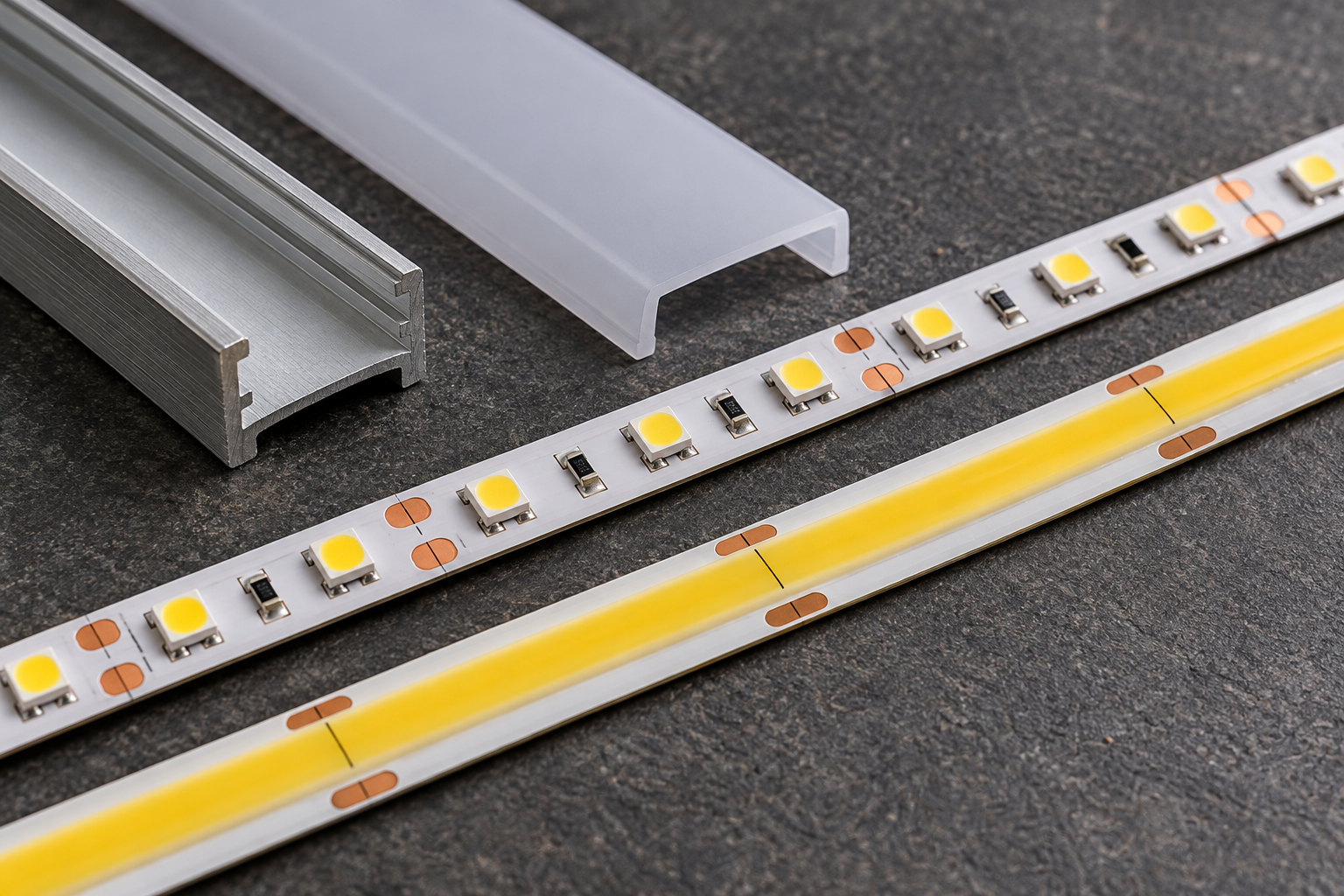
Choose between SMD and COB strips by how the finished line looks, how it is powered and what controls it needs. COB often helps hide individual light points; the name alone does not promise higher brightness, better color or lower heat. I would compare the assembled strip, channel and diffuser before choosing the reel.
What the names describe
An SMD strip carries individual surface-mounted LED packages. A white COB strip places many bare chips along the board under a phosphor layer, giving a more continuous-looking emitting surface. Those are construction descriptions, not grades of quality. Both are sold in different electrical, color and control formats.
| Decision | SMD question | COB question |
|---|---|---|
| Visible line or reflection | Are individual points visible at the intended distance? | Is the line sufficiently uniform, including cut sections and joints? |
| Diffuser and channel | Does the profile hide dots without losing too much useful light? | Does the complete assembly meet the visual and thermal requirement? |
| Required output | Compare the exact model’s lumens and watts per length | Use the same measurement basis; do not infer output from chip density |
| Controls | Confirm dimming type, channels and controller compatibility | Confirm the same; COB is not automatically a smart or addressable strip |
| Installation | Check cut marks, width, connectors and bending instructions | Check its own dimensions and instructions rather than reusing SMD accessories |
LEDSupply likewise separates construction choice from the performance of the complete system. A dense SMD strip behind a suitable diffuser can look smooth, and a continuous COB surface can still glare when viewed directly.
Start with the view that will expose a mistake
A shiny worktop, mirror or glossy wall can reveal light points that are hidden from direct view. Build a short mock-up at the intended mounting position. Check it while standing, sitting and approaching the space, with adjacent lighting on as it will normally be used. An attractive reel photograph says little about those reflections.
For a concealed cove, source visibility and the wall or ceiling finish may matter more than the package style. For an exposed line in shelving, joins and the diffuser can dominate the result. Use the cove planning guide for that assembly rather than treating “dotless” as a complete installation plan.
Compare the actual electrical and color data
Write down the selected voltage, length, input power, available output, CCT, color-rendering information and environment rating for each candidate. Check whether output figures refer to the bare strip or the strip behind its cover. Different test conditions make a precise-looking comparison misleading.
Do not apply a generic efficiency, lifetime or temperature advantage to either construction. Thermal performance depends on the product, power, mounting and surrounding conditions. Follow the maker’s channel and heat-management instructions, and leave the driver accessible.
Keep the control question separate
Single-color dimming, tunable white, RGB and individually addressable effects need different control arrangements. Match voltage, current capacity, channel order and any data protocol across the strip, controller and supply. A familiar connector shape does not prove compatibility.
If the project uses WLED, the existing WLED COB selection guide covers addressable channels, pixel grouping and controller choices. This page compares the broader physical strip constructions; neither name establishes a particular digital protocol.
Make the purchase record useful for replacement
Retain the exact model, selected color, supply/controller details, cut plan and a photograph of the approved assembly. Check replacement availability and whether later stock can be visually matched. A supplier’s generic “same COB” promise leaves voltage, tint and output unresolved.
For installation, disconnect power before cutting or connecting, use only the marked cut positions and the maker’s supported accessories, and do not work on mains connections as part of a strip comparison. Have a qualified electrician handle hardwired supplies, damaged wiring or an uncertain circuit. Choose the arrangement that meets the job with a serviceable system, rather than the construction with the stronger label.
Next steps
Plan strip installation · Calculate the strip load · Check model-level claims
Questions & discussion
Share a question or a useful experience about this guide. Comments appear immediately. Your name and comment are public. Email is optional and stays private; reply emails are not enabled yet. Comment privacy.