I start with two questions: what shape should the light make, and which parts of it must change independently? A continuous-looking line does not tell you how that line is controlled. Decide those requirements separately before buying something described as neon flex, rope light or an LED strip.
For a shelf outline, the main concern may be a smooth appearance. For a moving color effect, independently controlled sections matter too. For a curve outside the house, the mounting direction and the complete system’s suitability for the exposure can rule out an otherwise attractive product.
Treat the names as a starting point
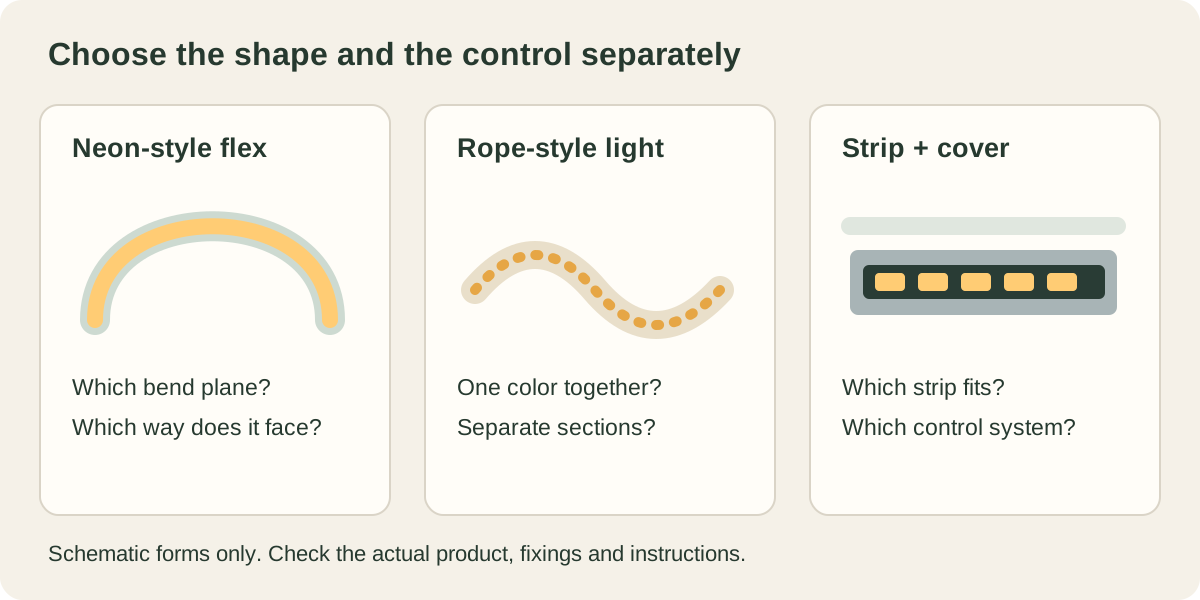
Neon flex commonly describes an LED lighting product with a flexible, diffusing exterior. The attraction is a visible line rather than exposed points. The name alone does not establish its material, bend direction, outdoor suitability or control method. Ask for a photograph or drawing of the actual cross-section and a demonstration of the intended effect.
Rope light is a particularly loose shopping term. A listing may show a simple outline light or a more elaborate product with separately controlled sections. Do not infer addressability from a round or flexible exterior. If the whole length changes together when you need moving segments, the wrong control system has been bought even if the light looks smooth.
LED strip with a separate diffuser makes the strip and its covering separate choices. That can be useful when a removable channel and cover suit the space, but the parts still need to fit and work together. For channel depth, covers and visible dots, use the LED channel selection guide; this comparison is about choosing the system, rather than repeating the channel installation process.
Specify the appearance and the effect separately
Write the desired result in ordinary language: a steady white outline, a line that changes color together, or colors that move through separate sections. Ask the seller to demonstrate that exact behavior with the proposed controller. A video of another model is not confirmation that the quoted kit supports it.
A diffusing exterior can change how emitting points are seen, while the underlying LEDs and control arrangement determine which sections can be commanded independently. Neither requirement replaces the other. A product can look continuous and still offer only whole-length control; an animated strip can still show visible points through an unsuitable cover.
If smoothness matters, compare a sample in the intended position and at the intended viewing distance. Ask about the emitting-point spacing and diffuser construction, but do not accept a single density figure as a guarantee of a seamless result. The WLED and COB selection guide covers the additional controller questions when addressable effects are part of the plan.
Choose for the job in the room
For a simple accent outline, a product with whole-length control may meet the brief. Confirm the appearance, mounting and control you actually need before paying for extra effects. A lower advertised price is not a complete comparison if the power supply, controller, connectors or fixing pieces are missing.
For an exposed decorative line, check the look of the unlit product as well as the light it produces. End pieces, joints, corners and the power lead will remain visible. Decide where those parts can sit before ordering a long length.
For animated color, request the supported control method, compatible controller and separately controllable section arrangement in writing. Keep the quoted components together as one proposed system. Physical fit is not evidence of electrical or control compatibility.
On a curve, check which way the light faces
A curved outdoor installation account raised a problem that a product photograph can hide: the light needed to face toward the wall or downward, rather than straight outward from the mounting surface. Suggested approaches included a side-bending product with clear clips and custom angled brackets. Those are ideas from one installation context, not tested instructions for another building.
Before choosing a product, draw the curve and mark the required light direction. Ask whether the proposed light bends in that plane, what bending limits apply, and whether the manufacturer’s fixing system can hold the required orientation. Do not force a product around a curve because it is described as flexible.
A custom or printed bracket also needs a suitability assessment for the environment and load. A plausible shape is not proof of long-term outdoor performance. Ask the product supplier or an appropriate installer to review the complete mounting arrangement rather than copying a bracket from a photograph.
Outdoor suitability belongs to the complete assembly
Check the intended exposure for every component: the light, its ends and joints, the connections, controller and power supply. An outdoor claim for the light body does not by itself describe the rest of the assembled system. Read the product’s actual rating and installation conditions instead of treating all neon-style products as waterproof.
Ask the supplier for the power-supply arrangement, maximum supported run, connection method and any required additional feeds. There is no useful universal voltage or power figure for all products in this category. Leave mains-voltage outdoor wiring and changes to fixed electrical installations to a qualified electrician under local requirements; this comparison does not provide wiring steps.
Before placing the order
- Describe whether the light is for accent, task illumination or an animated effect.
- Confirm the appearance with a sample of the actual product and covering.
- Specify whole-length or separately controlled color changes.
- Check the bend plane and the required direction of the emitted light.
- Include compatible controls, power, joints and fixings in the quotation.
- Confirm suitability for the complete installation environment and how parts can be accessed for service.
Choose the system that can meet those written requirements. If the answers stop at “rope light” or “neon,” the selection is not specific enough yet. Continue with the LED strip installation planning guide once the actual product and its instructions are known.
Questions & discussion
Share a question or a useful experience about this guide. Comments appear immediately. Your name and comment are public. Email is optional and stays private; reply emails are not enabled yet. Comment privacy.