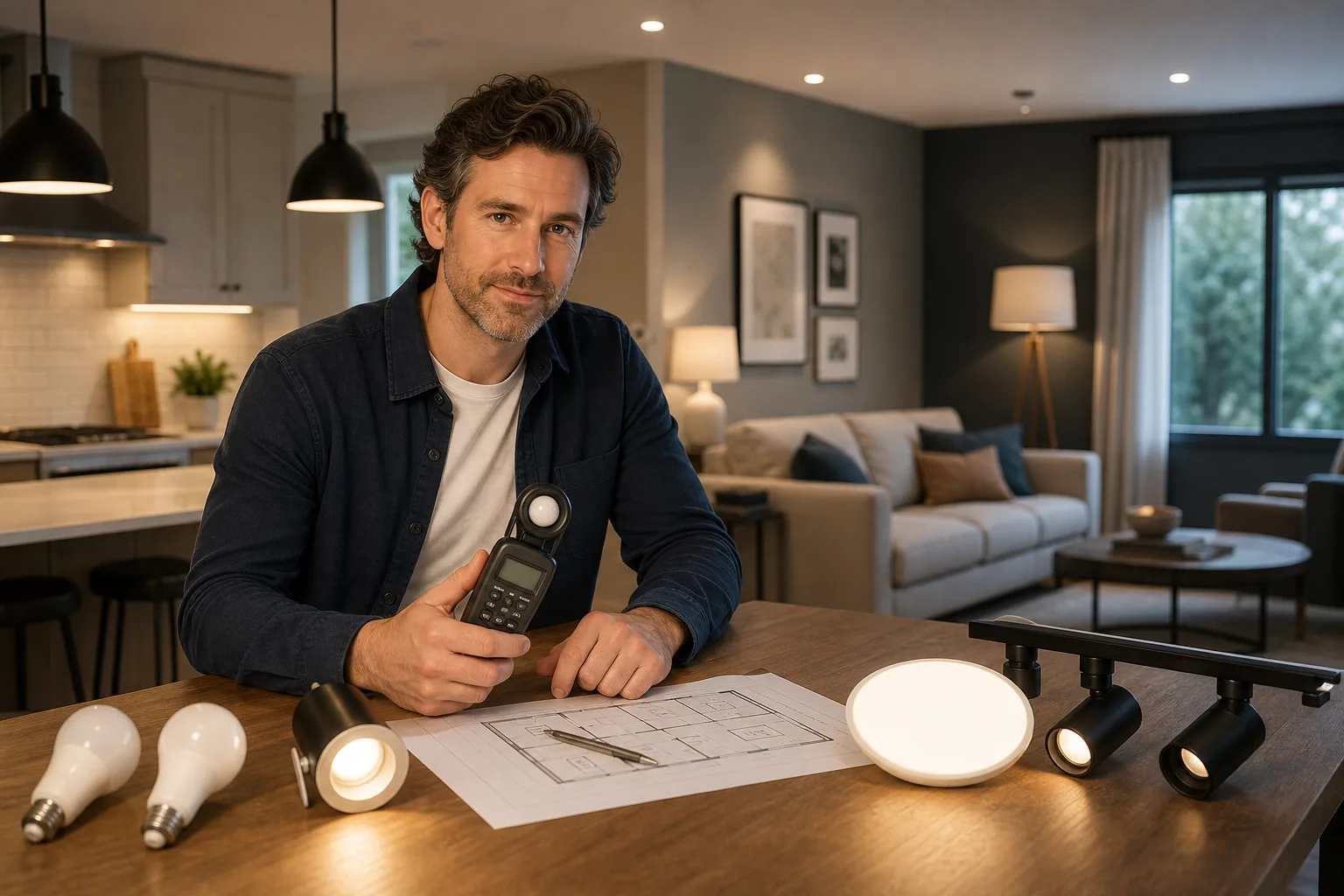
Choose lumens when comparing bulbs or fixtures, and use lux when deciding whether a desk, counter, floor or other surface receives enough light. You normally need both: lumens describe the light leaving the product, while lux describes the result in the room. A high-lumen fixture can still produce low lux where you need it if the beam is wide, the ceiling is high, the fixture is poorly positioned or dark surfaces absorb much of the light.
Lumens vs lux at a glance
The difference is output versus illumination. The lumen (lm) is the SI unit of luminous flux, while the lux (lx) is the SI unit of illuminance. One lux equals one lumen distributed over one square meter.[1]
| Question | Use lumens | Use lux |
|---|---|---|
| How much light does this bulb or fixture emit? | Yes | No |
| How bright will a desk or counter be? | Not by itself | Yes |
| Which replacement bulb has similar output? | Yes | Only after installation |
| Does the whole room have an even light level? | Not by itself | Measure at several points |
| Should I compare watts? | Compare lumens first, then watts for efficiency | Lux does not measure energy use |
Watts measure electrical power, not visible light output. ENERGY STAR advises finding the lumens you need and then comparing wattage; for reference, its replacement chart associates about 450 lumens with an old 40-watt incandescent, 800 lumens with 60 watts, 1,100 lumens with 75 watts and 1,600 lumens with 100 watts.[2] See what lumens mean, how lux is measured and the separate comparison of watts vs lumens.
How lumens become lux
The simple formula
For an ideal, perfectly uniform distribution:
Lux = lumens reaching the surface ÷ area in square meters
The reverse calculation is:
Lumens reaching the surface = target lux × area in square meters
For example, a 10 m² work area targeted at 200 lux needs 2,000 lumens to reach that area: 200 × 10 = 2,000. That does not mean a 2,000-lumen fixture will necessarily deliver 200 lux. Some output may reach walls, miss the work plane or be absorbed before it becomes useful illumination.
A more realistic planning estimate
A basic lumen-method estimate accounts for how much fixture output reaches the working plane and how performance changes in service:
Required fixture lumens = target lux × area ÷ (utilization factor × light-loss factor)
The U.S. Department of Energy describes the lumen method as an estimate of average horizontal illuminance and identifies coefficient of utilization and light-loss factor as key inputs.[3]
Suppose the same 10 m² area has a 200-lux target. If you assume a utilization factor of 0.70 and a light-loss factor of 0.80, the calculation is:
200 × 10 ÷ (0.70 × 0.80) = approximately 3,571 fixture lumens
This is a planning estimate, not a guarantee. Actual lux depends on photometric distribution, mounting height, beam angle, room proportions, surface reflectance, obstructions and measurement position. Use manufacturer photometric files or a qualified lighting designer for demanding layouts. For a quick starting calculation, try the lux-to-lumens tool.
Room and task lighting starting points
There is no single correct lux target for every home. Age, eyesight, contrast, daylight, glare sensitivity and task detail all affect what feels comfortable. The following rounded reference points are derived from residential illuminance values reproduced in a DOE lighting guide. That guide notes that the tabulated recommendations apply to occupants aged 25 to 65 and distinguishes between measurements at floors, work surfaces and vertical surfaces.[4]
| Area or activity | Planning reference | Where to assess it | Practical approach |
|---|---|---|---|
| Living-room circulation | About 30 lux | Floor | Add local reading lamps rather than raising all ambient light |
| Family-room general use | About 100 lux | Floor or activity plane | Combine diffuse ambient light with dimmable task lighting |
| Home office | About 200 lux ambient | Desk and surrounding area | Use a task lamp where paperwork requires more light |
| Kitchen general lighting | About 50 lux | Floor | Treat this as background illumination, not the counter target |
| Kitchen sink or cooktop | About 300 lux | Work surface | Position light to avoid shadows from the person working |
| Kitchen preparation counter | About 500 lux | Countertop | Use under-cabinet or well-positioned task lighting |
These are reference values rather than mandatory residential limits. Start with the task, evaluate glare and shadows, and provide adjustment where possible. Explore room-specific guidance for the living room, home office and kitchen.
Plan layers of light, not just a lumen total
A single total-lumen figure cannot describe whether a room will be comfortable. DOE residential guidance divides lighting into ambient, task and accent layers: ambient lighting supports circulation and general occupancy, task lighting serves activities such as food preparation or grooming, and accent lighting adds emphasis and visual interest.[4]
Ambient lighting
Use ambient light to make the room navigable and give walls, ceilings and furnishings a balanced appearance. Broad-distribution ceiling fixtures, indirect lighting, sconces and carefully spaced downlights can contribute. Do not expect one central fixture to provide high, even lux at every task surface.
Task lighting
Place task lighting near the work. A desk lamp, reading lamp or under-cabinet strip can raise lux precisely where needed without flooding the entire room with additional lumens. This often reduces glare and gives users more control.
Accent lighting
Accent lighting creates contrast rather than uniformity. Narrow beams may deliver high lux to a small artwork or shelf even when their total lumen output is modest. Review layered lighting principles and beam angle before comparing accent fixtures solely by lumens.
How to choose bulbs, fixtures and controls
Read more than the lumen number
Use this buyer checklist when comparing products:
- Lumens: Is the output suitable for the fixture's role and the room area?
- Distribution or beam angle: Is the light broad enough for ambient coverage or controlled enough for the task?
- Color temperature: Will the Kelvin value suit the room and match nearby sources? See the color-temperature guide.
- Color rendering: Check CRI and any available color-quality information where food, artwork, clothing or finishes matter. Learn more about CRI.
- Dimming: Confirm that the lamp or fixture is dimmable and that the manufacturer lists the intended control as compatible.
- Fixture limitations: Check enclosed-fixture suitability, wet- or damp-location ratings, insulation-contact requirements and maximum lamp ratings where applicable.
- Physical fit: Verify base, bulb dimensions, shade clearance and light-center position using the lamp size and lumens checklist.
For replacement lamps, match useful lumen output before comparing wattage. For integrated fixtures, examine total fixture lumens and distribution data rather than assuming that two products with equal wattage will perform alike.
Add control instead of excessive output
Dimmers are useful where the same room supports different activities. Occupancy or vacancy sensors can suit intermittently used spaces, while separate switching lets ambient and task layers operate independently. DOE guidance emphasizes matching controls to the room and pairing dimmers correctly with LED fixtures or lamps.[4] Consult the LED dimmer guide before purchasing.
Why the calculated lux may not match the room
The room feels dark despite enough lumens
- The light may be concentrated on the floor while walls and faces remain dim.
- Dark, matte finishes may absorb more light than the calculation assumed.
- A narrow beam may create bright pools with dark gaps between them.
- Fixtures may be too far from the task or blocked by cabinets, shades or the user.
- LED output may have declined, or a fixture lens may need cleaning.
Measure lux at the actual work plane and at several locations rather than relying on one reading. Then adjust distribution, add task lighting or review why the room feels dark.
The room meets the target but feels too bright
Excessive contrast and visible glare can make an otherwise reasonable average lux level uncomfortable. Check for exposed bright LEDs, reflective screens, concentrated downlights and fixtures located directly in the normal line of sight. A dimmer, diffuser, different beam or better fixture position may help. See solutions for lights that feel too bright.
Lux readings are uneven
Take readings on a simple grid at a consistent height. Large differences usually point to spacing, aiming or beam-distribution issues. Adding more lumens to the existing fixtures may make the brightest spots brighter without correcting the dark areas.
Final decision: use lumens to buy and lux to verify
When comparing lumens vs lux, neither measurement replaces the other. Start with a lux target based on the activity and measurement plane. Estimate the lumens needed after allowing for fixture distribution and light loss. Then select bulbs or fixtures with suitable output, beam shape, color quality and controls.
Use lux measurements after installation to identify dark work surfaces and uneven coverage, but judge the result alongside glare, shadows, wall brightness and user comfort. For major renovations, complex commercial spaces or work that alters fixed wiring, circuits, junction boxes or protective devices, use a licensed electrician and, where appropriate, a qualified lighting professional. The National Electrical Code addresses grounding, bonding and other requirements intended to reduce shock, fire and equipment hazards.[5] Local adopted-code editions and permit requirements may differ.
Frequently asked questions
How many lumens make one lux?
One lux equals one lumen reaching one square meter. If 1,000 lumens were distributed perfectly and uniformly across 10 m², the result would be 100 lux. Real fixtures lose or redirect some light, so installed results vary.
Should I buy a light based on lumens or lux?
Buy bulbs and fixtures by lumens, distribution, color quality and compatibility. Use a lux target to plan the room and measure whether the relevant surface receives enough light.
Can two fixtures with the same lumens produce different lux?
Yes. Beam angle, optics, mounting height, aiming and room surfaces determine where the lumens go. A narrow beam can create higher lux in a small area, while a broad beam spreads the same output more widely.
How do I convert lux to lumens for a room?
Multiply the target lux by the area in square meters to find the lumens that must reach the surface. For a fixture-output estimate, divide that result by reasonable utilization and light-loss factors.
Does higher lux always mean better lighting?
No. More illuminance may help detailed tasks, but excessive glare, harsh contrast or poor fixture positioning can remain uncomfortable. Evaluate distribution, shadows, color quality and adjustability as well as the lux reading.
Questions & discussion
Share a question or a useful experience about this guide. Comments appear immediately. Your name and comment are public. Email is optional and stays private; reply emails are not enabled yet. Comment privacy.