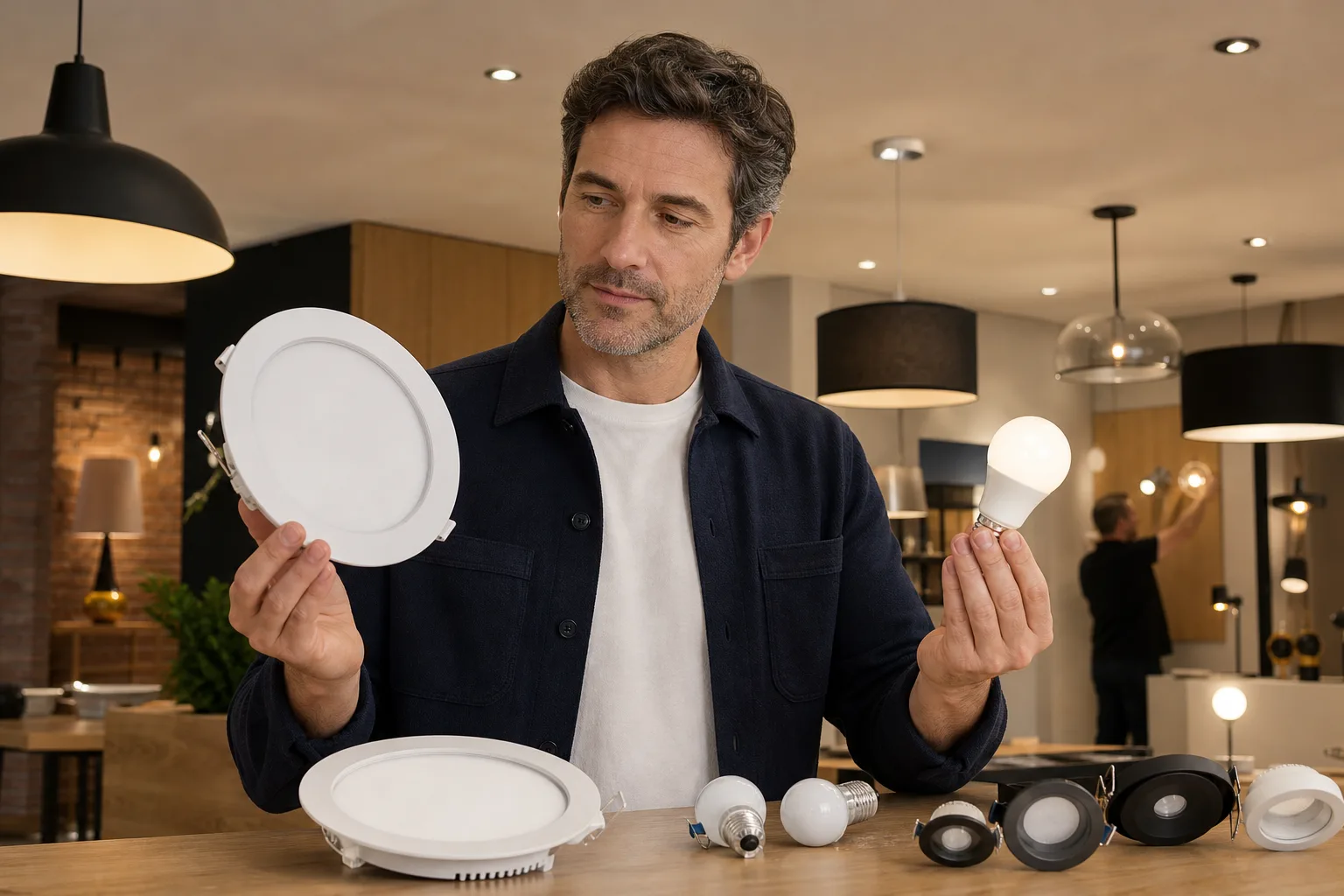
Choose a replaceable-bulb fixture when easy maintenance, future flexibility and readily available parts matter most. Choose an integrated LED fixture when you want a slim profile, precisely controlled light distribution or a design that is not practical with a conventional bulb. Neither format is automatically brighter, more efficient or longer-lasting. The better choice depends on the complete product, its light output, driver quality, thermal design, controls, warranty and repair options.
What Is the Difference?
Integrated LED fixtures
An integrated LED fixture has LEDs built into the luminaire rather than a standard socket for a removable bulb. The LEDs may be mounted on a board or light engine and powered by a separate or built-in driver. ENERGY STAR distinguishes fixtures with permanent built-in LEDs from products using replaceable lamps, while noting that hybrid replaceable light-source formats also exist. ([energystar.gov](https://www.energystar.gov/products/learn-about-led-lighting?utm_source=openai))
Integration gives the manufacturer freedom to design the housing, heat sink, diffuser and optics as one system. That makes very thin recessed lights, edge-lit panels and sculptural fixtures possible. The trade-off is that a failed LED board or driver may require a manufacturer-specific component—or replacement of the complete fixture.
Replaceable-bulb fixtures
A replaceable-bulb fixture uses a removable lamp, such as an A19 LED with an E26 base. The housing, socket and shade remain in place when the bulb is changed. This separates the durable fixture from the shorter-lived light source and driver contained in the bulb.
Replaceable bulbs make it easy to change brightness, color temperature, beam shape or smart features later. However, the bulb and fixture must be compatible. A bulb may not fit under a shade, tolerate an enclosed housing or produce the intended light distribution.
Integrated LED vs Replaceable Bulb at a Glance
| Consideration | Integrated LED | Replaceable bulb |
|---|---|---|
| Maintenance | May require a new driver, light engine or complete fixture | Usually restored by installing a compatible bulb |
| Design freedom | Excellent for thin, linear and unusual forms | Constrained by socket, bulb and enclosure dimensions |
| Future flexibility | Limited unless components are replaceable | Easy to change output, color or connected features |
| Light distribution | Optics can be engineered around the LEDs | Depends on how well the bulb works with the fixture |
| Dimming | Can perform well when the driver and control are matched | Depends on the bulb, fixture and dimmer combination |
| Failure impact | A single component failure can disable the fixture | The fixture normally remains usable after bulb failure |
| Best suited to | Low-profile downlights, panels, strips and architectural forms | Lamps, pendants, sconces and conventional ceiling fixtures |
Do not compare the two formats by wattage alone. Lumens measure total light output, while watts measure electrical input. Lumens per watt expresses efficacy, but distribution and glare also affect how useful the light feels. See watts versus lumens and the lumens guide before comparing specifications.
Longevity, Repairs and Long-Term Value
A rated LED life is not a guaranteed fixture life
LED life is often described by lumen maintenance: the point at which output is predicted to decline to a stated percentage of its initial level. That does not mean every fixture will operate without failure until that hour. The Illuminating Engineering Society warns that LED-component projections alone do not establish the lifetime of a complete luminaire; drivers, connections, optics and other components have their own failure mechanisms. ([ies.org](https://ies.org/advocacy/ps-10-18/?utm_source=openai))
This distinction is especially important for integrated products. Ask whether the quoted rating applies to the LED package, light engine or complete fixture. Also look for a clearly stated product warranty rather than relying only on a large lifetime figure.
Repairability changes the ownership calculation
With a replaceable bulb, a lighting failure is usually inexpensive and does not disturb the installed fixture. You can also keep spare matching bulbs for multi-light rooms.
For an integrated fixture, check whether the driver and LED module can be replaced without removing the housing. Manufacturer-specific parts can become difficult to source after a product line changes. The IES has highlighted field serviceability, accessible drivers and future component availability as important maintenance considerations for LED luminaires. ([ies.org](https://ies.org/lda/the-hidden-cost-of-leds-2/?utm_source=openai))
Integrated lighting can still be a sound long-term choice when the product has accessible components, documented part numbers and meaningful warranty coverage. It is less attractive when the entire decorative fixture becomes waste after one electronic component fails.
Which Format Works Best in Each Room?
Living rooms and bedrooms
Replaceable bulbs are often the practical choice for table lamps, floor lamps, pendants and conventional ceiling fixtures. They let you adjust brightness and color temperature as furnishings or preferences change. Integrated fixtures make sense for low-profile ceiling lights, linear accent lighting or a permanent architectural feature.
Kitchens, offices and workshops
Integrated downlights, under-cabinet bars and panels can distribute light evenly across counters and work surfaces. Replaceable bulbs remain useful in pendants and task lamps because their output is easy to modify. In visually demanding spaces, compare glare control, beam angle and color rendering—not merely total lumens. The kitchen lighting guide, home-office guide and workshop guide cover these room-specific decisions.
High ceilings and difficult access
A well-specified integrated luminaire can be useful where bulb replacement would require special access equipment, but only if the complete fixture and driver are credible products. A replaceable bulb does not automatically simplify maintenance if reaching it is the expensive part of the job.
Rental homes and changing spaces
Replaceable bulbs usually preserve more flexibility. Smart bulbs, higher-output lamps and different color temperatures can be installed without replacing hardwired equipment. If you are selecting permanent integrated lighting, neutral styling and field-replaceable components reduce the risk of premature obsolescence.
Plan the Light Before Choosing the Hardware
Start with the required illumination
A fixture format should follow the lighting plan, not replace it. For a simple estimate in U.S. customary units:
Initial lumens = room area in square feet × target foot-candles ÷ utilization allowance.
For example, assume a 150-square-foot room, a starting target of 15 foot-candles and a 0.70 utilization allowance for light lost in shades, surfaces and distribution:
150 × 15 ÷ 0.70 = approximately 3,215 initial lumens.
This is a planning estimate, not a guarantee at every point in the room. Ceiling height, wall reflectance, daylight, fixture distribution and task locations can change the result. One foot-candle equals one lumen per square foot; in metric planning, lux equals lumens per square meter. Use the lumens calculator for an initial estimate and verify demanding layouts with photometric data or a qualified lighting professional.
Use layers rather than one oversized source
A balanced room normally combines ambient, task and accent lighting. Either fixture format can support this approach:
- Ambient: general illumination from ceiling fixtures, downlights or indirect sources.
- Task: concentrated light for reading, food preparation, grooming or detailed work.
- Accent: controlled light for artwork, shelves and architectural surfaces.
Layering allows lower light levels when full output is unnecessary and can reduce glare compared with relying on one very bright fixture. Read the layered-lighting explainer or follow the home-lighting planning process.
Buyer Checklist: What to Verify
- Delivered lumens: Compare complete-fixture output for integrated products and bulb lumens for lamp-based products.
- Efficacy: Calculate lumens per watt only between products intended for similar jobs.
- Distribution: Check beam angle, diffuser design and photometric information where available.
- Color: Confirm correlated color temperature, CRI and any color-quality information important to the room.
- Enclosure rating: For replaceable LEDs, verify that the bulb is approved for enclosed or damp locations when applicable. DOE guidance notes that heat trapped in enclosed fixtures can affect LED performance and life. ([energy.gov](https://www.energy.gov/cmei/femp/purchasing-energy-efficient-light-bulbs?utm_source=openai))
- Controls: Confirm dimmer, sensor or smart-control compatibility in the manufacturer documentation.
- Serviceability: For integrated fixtures, ask whether the driver and LED module are replaceable and whether part numbers are documented.
- Installation rating: For recessed lighting, verify IC, airtight and location ratings required by the installation.
- Warranty: Read what is covered, for how long and whether labor or only the product is included.
- Matching replacements: Consider how you would maintain consistent appearance and color if one unit failed several years later.
For removable lamps, continue with the LED bulb selection guide. For integrated and lamp-based fixture options, browse the LED fixture explainer.
Dimming, Troubleshooting and Electrical Safety
Compatibility matters more than fixture format
Both formats can dim smoothly, but neither guarantees good results. An incompatible combination may buzz, flicker, glow when switched off or have a limited dimming range. ENERGY STAR advises checking the light manufacturer’s compatible-dimmer information because not every LED works well with every dimmer. ([energystar.gov](https://www.energystar.gov/products/light_fixtures?utm_source=openai))
With replaceable bulbs, changing the lamp may solve a compatibility problem. With integrated fixtures, the driver determines much of the behavior, so replacement options can be narrower. Before buying, verify the control type, minimum load, permitted number of fixtures and tested dimmer models. See how to choose an LED dimmer, plus the guides to LED flickering and LED buzzing.
Know when the work is not a bulb change
Replacing a compatible screw-in bulb is normally a user maintenance task after switching the light off and allowing it to cool. Replacing a hardwired fixture, driver, dimmer or socket involves building wiring and may require permits or inspection under local rules.
Use a licensed electrician when conductors must be disconnected, a fixture is being added or relocated, wiring appears damaged, grounding is uncertain, the electrical box cannot support the fixture, or the installation is in a wet or otherwise special location. Do not modify a listed fixture, bypass a driver or install an unapproved retrofit merely because the parts appear to fit. UL notes that field modifications can affect whether a luminaire continues to meet the safety conditions under which it was certified. ([code-authorities.ul.com](https://code-authorities.ul.com/about/blog/led-retrofit-kits-for-luminaires-and-signs/?utm_source=openai))
The Bottom Line
For most conventional lamps and decorative fixtures, a replaceable LED bulb is the lower-risk choice because it preserves the fixture when the light source or electronics fail. Integrated LEDs are preferable when their compact construction, optics or architectural form provide a clear benefit that a standard bulb cannot deliver.
If the two options produce suitable light, favor the one with better documentation, control compatibility, serviceability and warranty support. A thoughtfully designed replaceable-bulb fixture can outperform a poor integrated product, and a well-engineered integrated luminaire can distribute light more effectively than a bulb placed in an unsuitable housing.
Frequently asked questions
Are integrated LED fixtures better than fixtures with replaceable bulbs?
Not universally. Integrated fixtures are useful for slim designs and controlled light distribution. Replaceable-bulb fixtures are generally easier to maintain, update and keep in service after an LED or driver fails.
What happens when an integrated LED stops working?
The problem may be the LED module, driver, wiring or control. Some products have replaceable components, while others require complete fixture replacement. Check the warranty and parts documentation before attempting repairs, and use a licensed electrician for hardwired work.
Can an integrated LED fixture be brighter than a replaceable bulb?
Either format can be brighter. Compare delivered lumens, beam distribution and glare rather than assuming the integrated product has more output. Wattage measures power consumption, not brightness.
Can both types of LED lighting use a dimmer?
Yes, if the specific bulb or integrated driver is dimmable and compatible with the control. Check the manufacturer’s dimmer list because an incompatible combination may flicker, buzz or fail to reach a useful low level.
Questions & discussion
Share a question or a useful experience about this guide. Comments appear immediately. Your name and comment are public. Email is optional and stays private; reply emails are not enabled yet. Comment privacy.