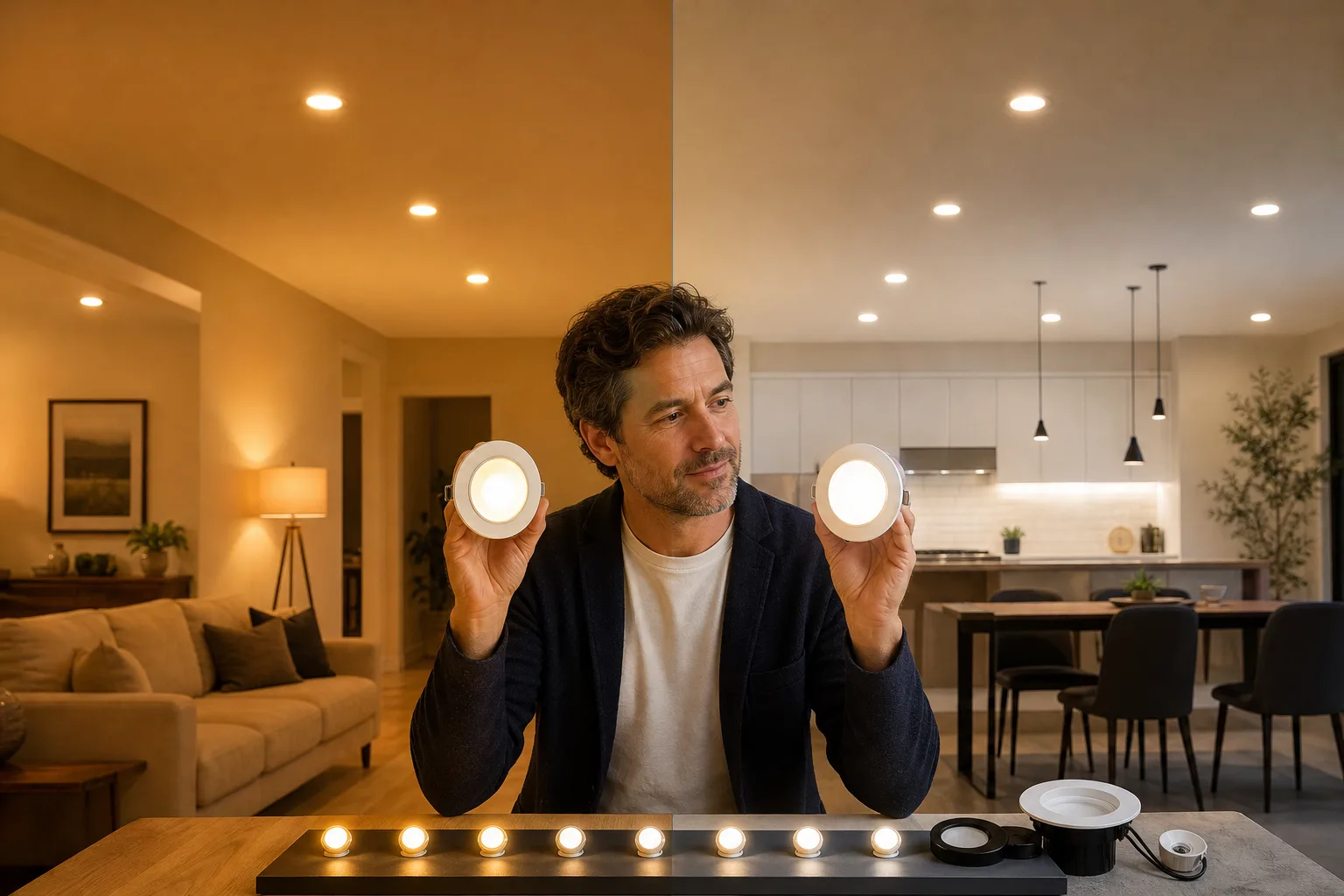
Choose 2700K when you want a soft, relaxed glow; choose 3000K when you want warm light with a cleaner, slightly crisper appearance. In many homes, that means 2700K for living rooms, bedrooms and dining areas, and 3000K for kitchens, bathrooms and home offices. Neither is universally better. Your finishes, daylight, fixture shades and other lamps can make the 300-kelvin difference look subtle or surprisingly obvious.
2700K vs 3000K at a glance
Both options belong to the warm-white part of the lighting spectrum. The U.S. Department of Energy describes 2700K as warm and personal and 3000K as warm and pleasing. Lower Kelvin values generally look more yellow, while higher values look whiter or cooler. DOE purchasing guidance also identifies homes, restaurants and hospitality spaces as common applications for both temperatures.
| Consideration | 2700K | 3000K |
|---|---|---|
| General appearance | Soft, warm and similar to a traditional incandescent lamp | Warm white, but cleaner and less yellow |
| Often suits | Relaxing rooms, traditional interiors, warm woods and evening use | Task-oriented rooms, contemporary interiors, white surfaces and mixed-use spaces |
| Possible drawback | Can make a low-light room feel more amber or subdued | Can feel comparatively stark beside 2700K lamps |
| Good starting point | Living room, bedroom, dining room and decorative lamps | Kitchen, bathroom, laundry area and home office |
| If undecided | Test both at the same lumen output, in the actual fixture, after dark and during daylight hours | |
The distinction is easier to see when two lamps are side by side. If viewed separately, either can read simply as warm white. Product-to-product differences also matter: two LEDs marked 3000K may not look identical because color consistency, spectral output and fixture materials affect the result.
What Kelvin tells you—and what it does not
Color temperature describes appearance
The K stands for kelvin. In this context, correlated color temperature, or CCT, describes whether white light appears warmer and more yellow or cooler and more bluish. It does not tell you how hot a bulb becomes. ENERGY STAR explains that lower Kelvin numbers appear warmer, while higher numbers appear whiter or bluer. Its current downlight guidance places incandescent-like products within roughly 2200K to 3000K. See ENERGY STAR downlight guidance.
Kelvin does not measure brightness
A 2700K bulb and a 3000K bulb can produce the same amount of light. Compare lumens, not color temperature, when judging brightness. Watts indicate electrical power rather than visible light output. For a fair comparison, use lamps with similar lumens, beam angles and diffuser styles.
For a rough fixture-count estimate, use:
Number of lamps = desired total lumens ÷ lumens per lamp
For example, a plan calling for 3,200 lumens using 800-lumen lamps begins with 3,200 ÷ 800 = 4 lamps. This is only a preliminary estimate. It assumes equal output and does not account for ceiling height, beam spread, dark finishes, shades or light lost inside a fixture. Use the lumens calculator for a more structured starting point.
Color rendering is a separate specification
CCT describes the shade of white; the color rendering index describes how a source renders object colors relative to a reference source of comparable CCT. Check both specifications when lighting food, artwork, clothing, wood or faces. DOE purchasing guidance notes that CRI uses a 0-to-100 scale and that higher values generally indicate less color shift. Learn how to compare products in the CRI guide.
Which color temperature works best by room?
Living rooms and bedrooms
Start with 2700K if the main goal is comfort, conversation or winding down. It tends to complement beige textiles, warm woods, brass and traditional lamp shades. In a modern living room with white walls and substantial daylight, 3000K can preserve warmth while making the space feel a little clearer. See the full living-room lighting guide for placement and layering ideas.
Kitchens and dining areas
3000K is a practical starting point for kitchen ceiling lights and under-cabinet task lighting because it provides warm light without emphasizing yellow as strongly as 2700K. However, 2700K may be preferable over a dining table or in an open-plan kitchen designed around dark timber, bronze and intimate evening lighting.
Consistency is important in an open plan. A 3000K kitchen beside a 2700K living area can work when each zone has a clear purpose, but alternating temperatures across adjacent recessed lights usually looks accidental. Keep lamps within one visual row or lighting layer at the same nominal CCT.
Bathrooms and dressing areas
Many people prefer 3000K around a bathroom mirror because it is warm but relatively clean-looking. Color rendering, glare control and light placement on both sides of the face are at least as important as the difference between 2700K and 3000K. A warm decorative pendant can be 2700K, but compare it with the mirror lights before committing to the combination.
Home offices
Between these two choices, 3000K is usually the more versatile option for a residential office. It can feel more task-oriented without moving into distinctly cool-white territory. A 2700K desk lamp may still work for evening reading, particularly if the room doubles as a den or guest room. The home-office guide explains how to balance ambient light, desk lighting and screen glare.
Plan the lighting in layers, not as one color decision
A useful room plan separates lighting into ambient, task and accent layers. Ambient lighting provides general visibility, task lighting supports activities, and accent lighting draws attention to architecture, shelves or artwork. Review the layered-lighting explainer before selecting every lamp from one package.
- Use 2700K throughout when atmosphere and visual continuity are the priorities.
- Use 3000K throughout when the room needs a warm but relatively crisp baseline.
- Mix deliberately by assigning one temperature to a distinct layer—for example, 3000K under-cabinet task lighting and 2700K pendants.
- Avoid random mixing among matching sconces, recessed lights or lamps visible at the same time.
Account for shades, finishes and daylight
Cream fabric shades and amber glass can make either source appear warmer. Clear glass exposes the lamp and makes differences more noticeable. White paint may look creamier at 2700K, while red brick and warm timber may look less rich under a comparatively cooler source. Daylight can also make 2700K appear especially yellow during the day, even if it looks balanced after sunset.
The most reliable non-laboratory test is a temporary mock-up. Buy returnable lamps from the product families you are considering, match their lumen output, and observe the actual surfaces at several times of day. This is a planning recommendation, not a substitute for photometric design in a demanding commercial, healthcare or color-critical application.
Bulbs, fixtures and controls to check before buying
Use a complete buyer checklist
- Confirm the exact CCT on the package rather than relying only on terms such as “soft white” or “warm white.”
- Match lumens so the brighter option is not mistaken for the better color temperature.
- Check CRI and any additional color-quality information supplied by the manufacturer.
- Choose the correct base, bulb shape and physical dimensions.
- Verify that an LED is approved for enclosed fixtures if it will operate behind a sealed cover. DOE notes that trapped heat can affect unsuitable LED products.
- For recessed lighting, check beam spread, trim finish, wet- or damp-location suitability and insulation-contact requirements.
- If dimming is required, confirm both that the lamp is dimmable and that the manufacturer lists the intended dimmer as compatible.
Use the LED bulb guide and lamp size and lumens checklist before ordering multiple lamps.
Understand what dimming will do
Most fixed-white LEDs stay at approximately the same CCT as they dim. A standard 3000K LED therefore does not necessarily become as warm as an incandescent lamp at low output. Dim-to-warm products intentionally lower their CCT as brightness falls; DOE describes products that may begin around 2700K to 3000K at full output and become considerably warmer when dimmed. Tunable-white products instead let users adjust brightness and color temperature, although their controls and wiring can be more complex. DOE explains these control categories.
Not every LED and dimmer combination works well. ENERGY STAR recommends checking manufacturer compatibility information, while UL Solutions identifies LED lamps as a distinct controllable load type in dimmer testing and certification. Review UL Solutions' dimmer overview, then consult the product manufacturers. The LED dimmer guide can help you organize the specifications.
Troubleshooting and final decision checklist
If new lamps look wrong, check the package before repainting or replacing fixtures. A single 3000K lamp among 2700K lamps is a common source of an uneven-looking room. Also confirm that smart bulbs have not been left at different white settings.
- The room feels too yellow: try 3000K at the same or slightly lower lumen output.
- The room feels stark: try 2700K, add dimming, reduce glare or introduce lower-level lamps.
- Colors look flat: compare CRI and color quality rather than changing CCT alone.
- Matching lamps look different: verify model numbers, manufacturing families and smart-bulb settings.
- Lights buzz, flicker or fail to dim smoothly: check lamp–dimmer compatibility and minimum-load requirements. See the guides to LED buzzing and LED flickering.
For a quick decision, choose 2700K for a softer, traditional evening atmosphere and 3000K for a cleaner warm white that supports more task-oriented rooms. If the space changes function throughout the day, consider dim-to-warm or tunable-white equipment and try the color temperature picker.
Electrical safety: changing a compatible screw-in bulb is different from altering a fixture, control or branch-circuit wiring. Turn off power in accordance with the manufacturer's instructions. Hire a licensed electrician when installing a hardwired fixture or dimmer, modifying wiring, diagnosing heat or arcing, or when the existing installation, grounding or local code requirements are uncertain.
Frequently asked questions
Is 2700K or 3000K brighter?
Neither color temperature is inherently brighter. Brightness is measured in lumens, so a 2700K lamp and a 3000K lamp with the same lumen output can provide similar quantities of light while looking different in color.
Can you mix 2700K and 3000K in the same room?
Yes, but the combination should be deliberate. Keep matching fixtures and continuous rows at one color temperature, or assign each temperature to a separate layer, such as 3000K task lights and 2700K decorative pendants.
Is 2700K too yellow for a kitchen?
Not necessarily. It can suit a traditional kitchen with warm wood and evening-focused lighting. However, 3000K is often a more versatile starting point for counters and food preparation because it appears slightly cleaner.
Does a 3000K LED become 2700K when dimmed?
Usually not. Most fixed-white LEDs primarily reduce output while retaining approximately the same color temperature. A product labeled dim-to-warm is specifically designed to become warmer as it dims.
Questions & discussion
Share a question or a useful experience about this guide. Comments appear immediately. Your name and comment are public. Email is optional and stays private; reply emails are not enabled yet. Comment privacy.