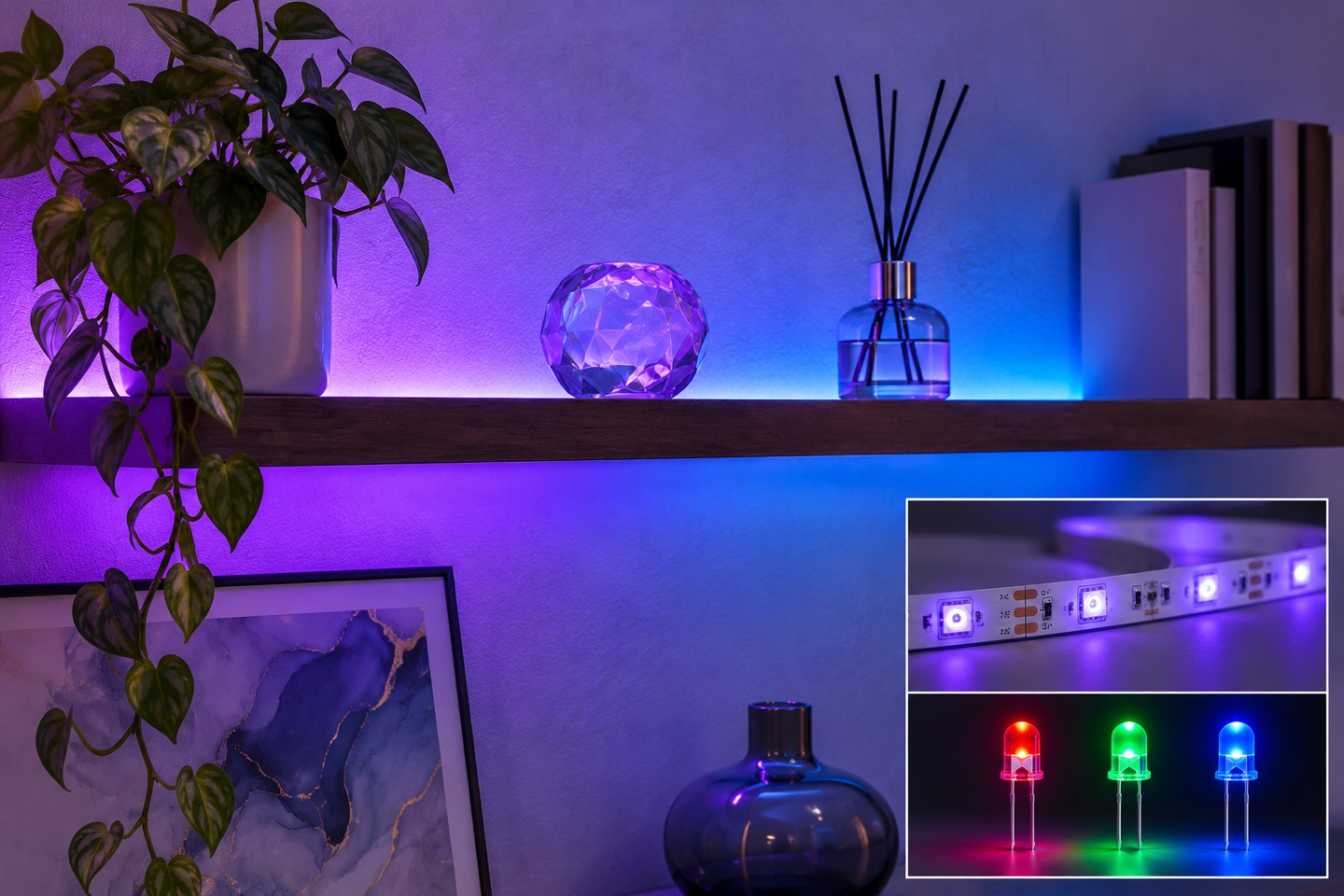
An RGB strip mixes red, green and blue light to produce colors. It’s useful behind a shelf, along a display wall or anywhere the glow is part of the room. I start by asking whether the strip will also need to provide everyday white light. That decides which kind of strip is worth looking at.
Which kind of strip do you need?
| Strip | What it controls | Where it makes sense |
|---|---|---|
| Single color | One fixed color or shade of white, with dimming where supported | A consistent light under cabinets or along a shelf |
| Tunable white | A blend of warm-white and cool-white emitters | A work surface or room where you want to change the white tone |
| RGB | A mix of red, green and blue | Colored accents, displays and reflected light |
| RGBW | RGB plus a dedicated white channel | One installation that needs both color effects and a usable white mode |
With RGB, mixed white can look tinted on a wall or countertop. With RGBW, check the dedicated white channel’s color temperature and color rendering separately. If white is your everyday mode, ask for the white-channel light output as well. A listing that says “dual color” may mean warm-to-cool white or another pair of colors. Read the channel description before ordering.
Decide whether the color moves
A conventional analog RGB strip changes the color of the connected run together. An addressable strip lets a compatible controller command individual pixels or groups, depending on how the strip is built. Addressable effects can make sense for a display, while a static accent often needs only whole-run control. Check the actual pixel grouping and controller protocol if the effect matters.
Check the entire system before ordering
Match the strip, power supply and controller by the maker’s specified voltage, load and channel arrangement. Check the controller’s overall rating and its per-channel limit. A plug that fits does not confirm the pinout or protocol. Use the LED strip power guide to work out the load from the selected strip’s specifications and include every section on the supply.
For a long run, check the maker’s maximum continuous length and feeding instructions. Confirm that the strip, joins and controller enclosure suit the location. Keep mains wiring and permanent electrical connections with a qualified electrician. See the installation guide for layout and mounting checks.
Before committing to the full run, try a sample in the actual channel or recess. Check whether you can see individual dots, how the wall color changes the glow, and what the white mode looks like on the objects you use there.