Booth lighting can flatter almost any lamp: the surroundings are bright, neighbouring displays mix colour temperatures, and a dramatic beam looks persuasive. I would not judge LED quality by “looks bright” alone. My 60-second screen asks for five things: CRI and R9, flicker warning signs, the actual dimming system, location-appropriate IP protection, and lumens rather than watts. It produces a shortlist—not a safety approval or purchase verdict.
Phase 1 of the 140th Canton Fair, including lighting, ended on October 19, 2026; Phase 2 runs through October 27 and Phase 3 through November 4. The booth-check method also applies to later phases and other trade fairs. See the official Canton Fair information.
The 140th Canton Fair takes place in Guangzhou at the China Import and Export Fair Complex (Pazhou). Phase 1 is October 15–19, 2026, includes Lighting Equipment, and opens 9:30 AM–6:00 PM. Check the official fair programme and current fair information before travelling. Here, I concentrate on the lamp at the booth, not travel preparation.
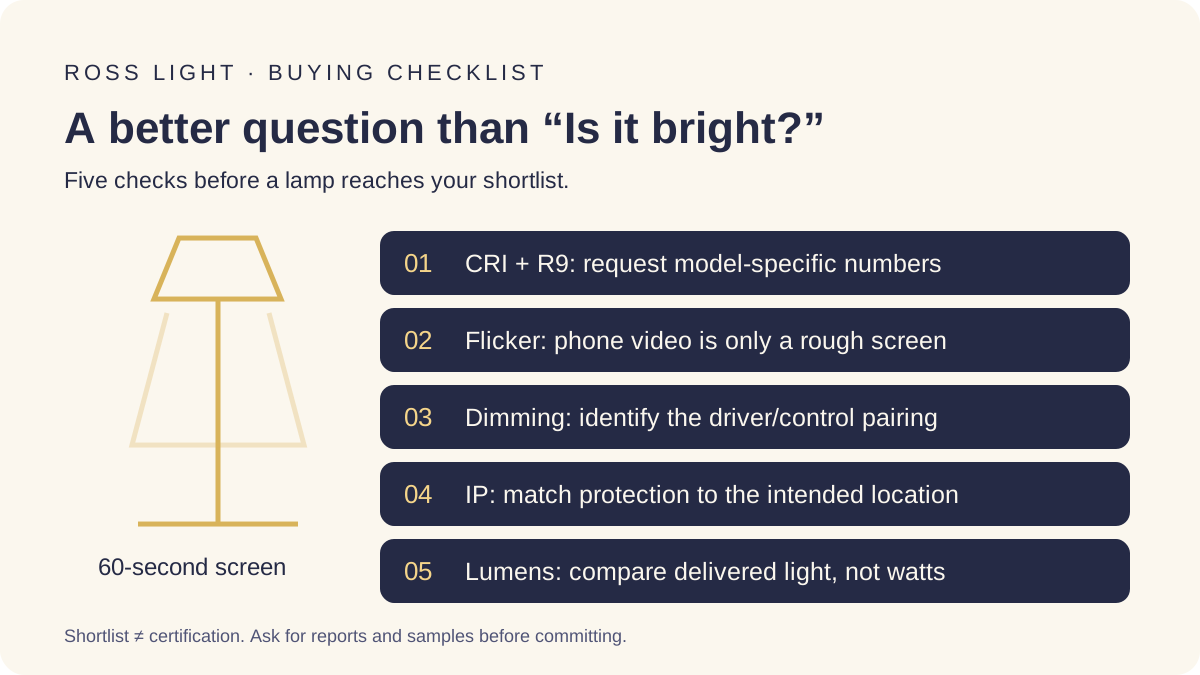
The 60-second booth checklist
Ask for the exact model number first. Photograph its label and specification sheet with permission; otherwise your notes may accidentally combine different variants. “Pass” below means worth following up, not proven compliant.
| Check | What I would do at the booth | Shortlist criterion | Red flag |
|---|---|---|---|
| CRI / R9 | Ask for numerical Ra and R9 for this model and CCT. | Traceable figures and a report to review. | Only “high CRI”; no model-specific figures. |
| Flicker | Briefly view slow-motion video at full and dimmed output, without staring into the source. | No obvious warning; measurement evidence still required. | Bands, pulsing, or refusal to demonstrate dimming. |
| Dimming | Identify TRIAC, 0–10V or DALI and ask for the compatible-control list. | Exact driver/control pairing documented. | “Works with every dimmer.” |
| IP / location | Match the complete fixture’s rating to the intended exposure. | Rating, installation restrictions and evidence available. | “Waterproof” without a defined rating. |
| Lumens / watts | Request delivered fixture lumens and total input watts. | Comparable values for the same operating conditions. | LED-chip output presented as fixture output. |
Check 1 — CRI: ask what the number leaves out
I would ask, “What are the Ra and R9 values for this exact colour-temperature version?” A generic “high CRI” sticker is an unverified claim. Ra does not include the saturated-red R9 sample, so a strong average can leave an important question about reds unanswered. The DOE explanation of LED light quality discusses this limitation.
Request the dated report and model identifier. Looking at a red object can start a conversation, but mixed booth light cannot establish a numerical score. Set project-specific requirements before ordering; no single CRI threshold guarantees a pleasing installation. My guides to CRI and R9 explain the distinction.
Check 2 — Flicker: use the phone as a warning screen
With permission, I would use phone slow-motion video to look for bands or pulsing, preferably including a surface illuminated by the lamp. Ask booth staff to demonstrate full and reduced brightness. Do not stare into a bright source or open the fixture.
This is a rough screen, not a measurement. Bands are a reason to investigate, not a calibrated failure result: exposure, camera sampling and other lamps can affect them. No visible bands do not prove flicker-free performance. PNNL’s flicker guidance treats phone video as an indicator, not a guarantee. Ask for measurement results and test conditions across the intended dimming range; see flicker basics.
Check 3 — Dimming: identify the whole pairing
“Dimmable” is not a compatibility list. I would record the driver model, supply requirements, control method and tested dimmer/controller models. Is this version phase-cut/TRIAC, analogue 0–10V, or digital DALI? Do not assume those labels are interchangeable or that one product variant supports all three.
Ask staff to show low-level behaviour: smooth reduction, restart, audible buzz and dropout. A demonstration proves only that displayed pairing, not compatibility with your installation. For claimed DALI-2 certification, verify the exact product in the DALI Alliance resources. Read my TRIAC guide and DALI guide. Leave wiring and control-system changes to qualified professionals.
Check 4 — IP: match the location, not the sales pitch
For outdoor or bathroom use, I would ask which parts of the assembled product carry the IP rating and under what installation conditions. A protected LED module does not establish protection for an exposed driver or connector. Ask for model-specific evidence and location restrictions.
The IEC IP Code classifies enclosure protection; it does not promise resistance to every environment or replace local electrical rules. Do not buy extra protection merely because the number sounds impressive, or assume any one rating makes every bathroom position acceptable. My IP guide helps frame questions; a qualified installer must confirm the actual location.
Check 5 — Lumens, not watts
I would compare delivered lumens for the complete fixture, not power consumption or an isolated LED chip’s output. Ask for total input watts, too: lumens divided by watts gives luminaire efficacy in lm/W. Compare the same CCT, output setting and stated test conditions.
Higher efficacy is not automatically better lighting. Beam shape, glare, colour quality and where the light lands still matter. Start with watts versus lumens, then use the lumens calculator for a planning estimate—not a booth-performance certificate.
What a booth visit cannot tell you
Sixty seconds cannot verify service life, batch-to-batch colour consistency or long-term lumen maintenance. I would request relevant reports, sample-order terms, driver details, warranty exclusions and written acceptance criteria. Record unanswered questions rather than converting a friendly assurance into a fact. Confirm that later samples match the quoted model and components before committing to a larger order.
Over to you
This quick self-check stays on this page: selections are not submitted or counted, and no audience results are claimed.
Next steps: Turn the shortlist into a room-specific decision with my lamp-size and lumens buying checklist. This is a desk-researched editorial checklist, not a report of a fair visit or product testing.