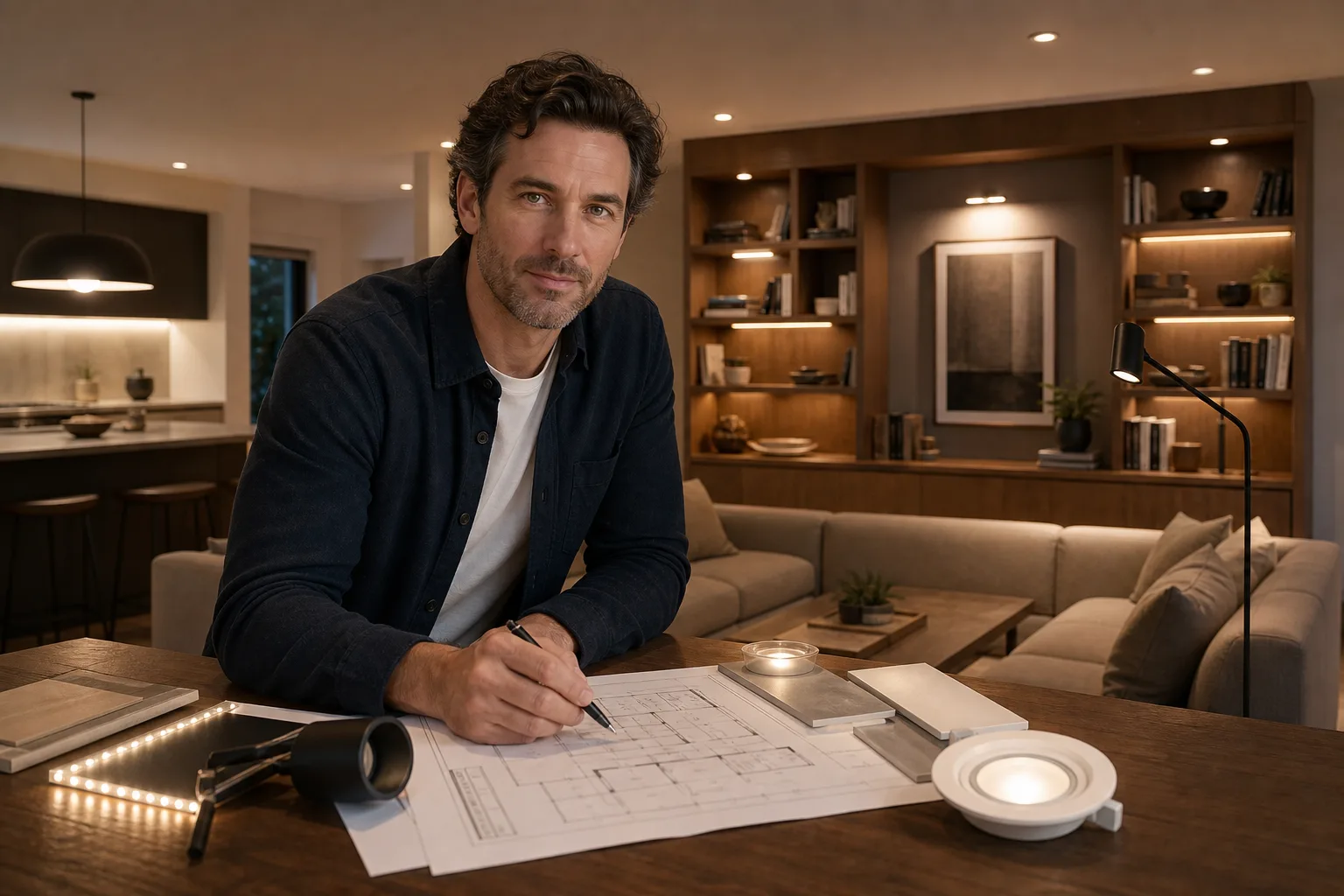
Layered lighting means using several light sources for different jobs instead of expecting one ceiling fixture to do everything. A practical plan combines ambient light for general visibility, task light for activities such as reading or food preparation, and accent light for visual emphasis. Each layer should work independently, but the room should still feel coherent when multiple layers are on.
What layered lighting does
A single bright overhead fixture can make a room technically visible while leaving work surfaces shadowed, walls dull and seating areas uncomfortable. Layering distributes light according to how the room is used. The Illuminating Engineering Society defines task-ambient lighting as a combination in which the lower general level complements light supplied at the task. [1]
The principle is not simply to add more fixtures. It is to put an appropriate amount of light in the right place and give occupants control over it. U.S. Department of Energy guidance similarly recommends matching light to the function and using task lighting where needed so that ambient levels can be lower elsewhere. [2]
Start with the room's activities, furniture and architectural features—not a fixture catalog. Mark where people walk, sit, work, read, cook, groom or display objects. Then decide which layer should serve each need. If lighting terminology is new to you, visit the lighting start-here guide before comparing products.
The three main layers
Ambient light: the general foundation
Ambient lighting provides enough broad illumination to move through a room, recognize faces and perform ordinary activities. It may come from recessed or surface-mounted ceiling fixtures, pendants, chandeliers, wall sconces, indirect coves or portable lamps. Daylight can contribute during the day, but electric ambient lighting still needs to work after dark and on overcast days.
Good ambient light is not necessarily uniform from corner to corner. Light directed onto ceilings and walls can make a room feel open because those large surfaces become visible. By contrast, rows of narrow downlights may brighten the floor while leaving walls and faces comparatively dark. Consider both horizontal surfaces and vertical surfaces when judging the result.
Task light: focused support for an activity
Task lighting places additional light where detailed work occurs. Examples include an adjustable reading lamp beside a chair, under-cabinet lighting over a kitchen counter, a desk lamp, mirror lighting at a vanity and a pendant over a worktable.
Position matters as much as output. A task light behind your head may cast your own shadow across a book. A kitchen downlight behind the person at the counter can do the same. Place the source to the side or in front of the user where practical, and use more than one direction of light when facial modeling or shadow reduction matters.
Accent light: contrast and visual direction
Accent lighting highlights artwork, textured walls, shelving, plants or architectural details. Track heads, adjustable downlights, picture lights, concealed linear lighting and narrow-beam lamps are common choices. Accent light works through contrast, so increasing the brightness of the entire room can make an accent disappear.
A decorative fixture may contribute to any of the three layers. A pendant can provide ambient light, illuminate a table or act mainly as a luminous focal point. Classify it by what its light accomplishes rather than by its shape.
| Layer | Main purpose | Typical sources | Useful control |
|---|---|---|---|
| Ambient | General visibility and circulation | Ceiling fixtures, indirect lighting, sconces, floor lamps | Dimmer or separate room zones |
| Task | Extra light at a defined activity | Desk lamps, under-cabinet lights, reading lamps, pendants | Local switch or reachable dimmer |
| Accent | Emphasis, depth and visual interest | Track heads, picture lights, adjustable downlights, linear LEDs | Separate dimmer or scene control |
How to plan output and fixture positions
Understand lumens, lux and watts
Lumens describe the total visible light produced by a lamp or fixture. Watts describe electrical power, not brightness, so compare LED products by lumens rather than relying on old incandescent watt equivalents. Department of Energy guidance makes the same distinction between light output and power consumption. [3] See watts versus lumens for a fuller explanation.
Lux measures illuminance—the amount of light arriving on a surface. One lux equals one lumen per square meter. One foot-candle equals one lumen per square foot and approximately 10.764 lux, according to NIST photometric definitions and conversions. [4]
Use a first-pass lumen estimate
For a rectangular room, calculate area first:
Area = room length × room width
The theoretical quantity of light arriving at a work plane is:
Work-plane lumens = target lux × area in square meters
Fixtures lose or redirect some output because of shades, lenses, beam distribution, mounting height, surface reflectance and aging. A preliminary source-lumen estimate can therefore be written as:
Required source lumens = target lux × area ÷ combined utilization factor
For example, a 12-by-15-foot room is 180 square feet, or about 16.7 square meters. If you choose 150 lux as an illustrative ambient target—not a universal requirement—the work plane needs about 2,505 lumens. Assuming a combined utilization factor of 0.60 gives:
150 × 16.7 ÷ 0.60 ≈ 4,175 source lumens
The 0.60 factor is a planning assumption, not a measured property of the room. Dark finishes, deep shades and poorly aimed directional fixtures may deliver less; pale surfaces and efficient distributions may deliver more. Use published photometric data for a detailed layout. The lumens calculator can help with an initial estimate.
Lay out one layer at a time
- Draw the room, including furniture, counters, art and door swings.
- Mark task locations before placing general ceiling fixtures.
- Add ambient sources to fill circulation areas and illuminate major surfaces.
- Add accent fixtures only where there is a clear focal point.
- Check sightlines so exposed lamps and bright apertures do not create unnecessary glare.
- Assign each useful layer to its own switch or control zone.
For ceiling layouts, use the fixture-spacing tool or recessed-lighting calculator as a starting point. Manufacturer spacing criteria and photometric files are more reliable than a universal rule based only on ceiling height.
Choosing bulbs, beams and fixtures
Match output and distribution to the job
A high lumen rating does not guarantee that useful light will reach the intended surface. A diffused globe sends light broadly, while a reflector lamp or adjustable spotlight concentrates it. Check the fixture's distribution, beam angle and center-beam information where available.
For a rough estimate of a symmetrical beam's diameter:
Beam diameter ≈ 2 × distance × tan(beam angle ÷ 2)
A 30-degree beam aimed at a surface eight feet away produces a theoretical beam about 4.3 feet across. Real beams have softer edges and vary by product, so treat the result as layout guidance. Learn more in the beam-angle guide or use the beam-spread calculator.
Coordinate color temperature
Correlated color temperature, stated in kelvins, describes whether white light appears warmer or cooler. Lower values appear more yellow or warm; higher values appear whiter or bluer. ENERGY STAR identifies approximately 2200–3000 K as an incandescent-like warm range, 3500–4100 K as whiter light and 5000–6500 K as bluer white. [5]
These bands are descriptions, not room rules. Many homes use 2700 K or 3000 K for ambient light, while a task source may be slightly cooler if occupants prefer it. Avoid mixing visibly different whites within one view unless the contrast is intentional. See the color-temperature guide or try the color-temperature picker.
Consider color rendering
Color rendering affects how accurately finishes, food, skin tones and artwork appear. DOE describes CRI as one measure of color fidelity and generally recommends at least 80 CRI for interior lighting; 90 or higher indicates stronger fidelity, although CRI does not describe every aspect of color quality. [6] High color quality is particularly useful at vanities, kitchen work areas, wardrobes and art displays. Read the CRI guide before treating a single number as a complete product comparison.
Controls that make the layers useful
Layered lighting depends on control. If every fixture operates from one switch, the room has multiple sources but limited flexibility. Separate ambient, task and accent circuits where practical. Portable task lamps can provide local control without rewiring, while dimmers let one layer adapt to different activities.
Useful scene patterns include:
- Cleaning: bright ambient and task lighting.
- Working: moderate ambient light with stronger local task light.
- Relaxing: reduced ambient light with selected lamps and accents.
- Viewing a screen: low, indirect light behind or beside the viewer rather than a bright source reflected in the screen.
- Night circulation: a low-output path light that avoids flooding the entire room.
Confirm that LED lamps, drivers and dimmers are compatible. A product marked dimmable may still have a limited dimming range or perform poorly with a particular control. ENERGY STAR advises checking manufacturer compatibility information and notes that incompatible combinations may require changing either the light or the dimmer. [5]
Troubleshooting and electrical safety
Check the symptom against the likely cause
| Problem | Likely causes | First checks |
|---|---|---|
| Room feels gloomy despite enough lumens | Dark walls, narrow downward beams or poor vertical illumination | Add light to walls or ceilings; review distribution rather than adding watts blindly |
| Work surface has shadows | Source is behind the user or too far from the task | Move or add a task light in front of or beside the working position |
| Accent light has little effect | Ambient layer is too bright or beam is too broad | Dim nearby ambient light or select a better-controlled beam |
| LEDs flicker, buzz or switch off | Dimmer incompatibility, minimum-load issue, loose connection or failing driver | Check the approved dimmer list; stop using equipment showing heat, odor or electrical damage |
| Colors look inconsistent | Mixed color temperatures, low color fidelity or products from different batches | Compare kelvin and CRI specifications; replace visible groups together |
| Glare causes discomfort | Exposed bright source, poor aiming or excessive contrast | Shield, reposition or dim the source; choose a wider or deeper-set optic |
The broader lighting troubleshooting section can help separate layout problems from product or control faults.
Know when to call an electrician
Replacing a compatible bulb in an undamaged fixture is different from altering building wiring. Use a licensed electrician when adding or moving hardwired fixtures, installing new circuits, replacing electrical boxes, modifying recessed housings, working in wet or damp locations, or diagnosing repeated breaker trips, damaged conductors, overheating, scorching or persistent electrical odors. Local permit and code requirements vary.
For recessed fixtures, follow the product's insulation-contact and airtight ratings. For retrofit kits, use a listed or certified kit intended for the existing luminaire and follow its instructions. UL warns that improvised or improperly installed lighting retrofits can introduce shock or fire hazards even when individual components appear suitable. [7]
Finally, evaluate the finished room in normal use. Turn layers on separately, sit and stand in the usual positions, check reflections in screens and mirrors, and confirm that controls are easy to understand. A successful layered plan is not the one with the most fixtures; it is the one that provides the right light for each activity without unnecessary glare or complexity. Explore the room lighting guides to apply this process to specific spaces.
Frequently asked questions
What are the three layers of lighting?
The three main layers are ambient lighting for general visibility, task lighting for specific activities and accent lighting for highlighting features. Decorative fixtures may contribute to any of these layers.
Does every room need ambient, task and accent lighting?
Not necessarily. Most occupied rooms need ambient light, while task and accent layers depend on activities and design goals. A hallway may need only ambient and low-level path lighting, while a kitchen usually benefits from all three.
Should task lighting be brighter than ambient lighting?
Task lighting normally provides additional illumination at the work area, but the difference should not create uncomfortable contrast. Use local controls so occupants can balance the task and ambient layers.
Can layered lighting be added without rewiring?
Yes. Floor lamps, table lamps, plug-in picture lights and some under-cabinet products can add task or accent layers. New hardwired fixtures, circuits or wall controls should be installed by a licensed electrician where required.
Questions & discussion
Share a question or a useful experience about this guide. Comments appear immediately. Your name and comment are public. Email is optional and stays private; reply emails are not enabled yet. Comment privacy.