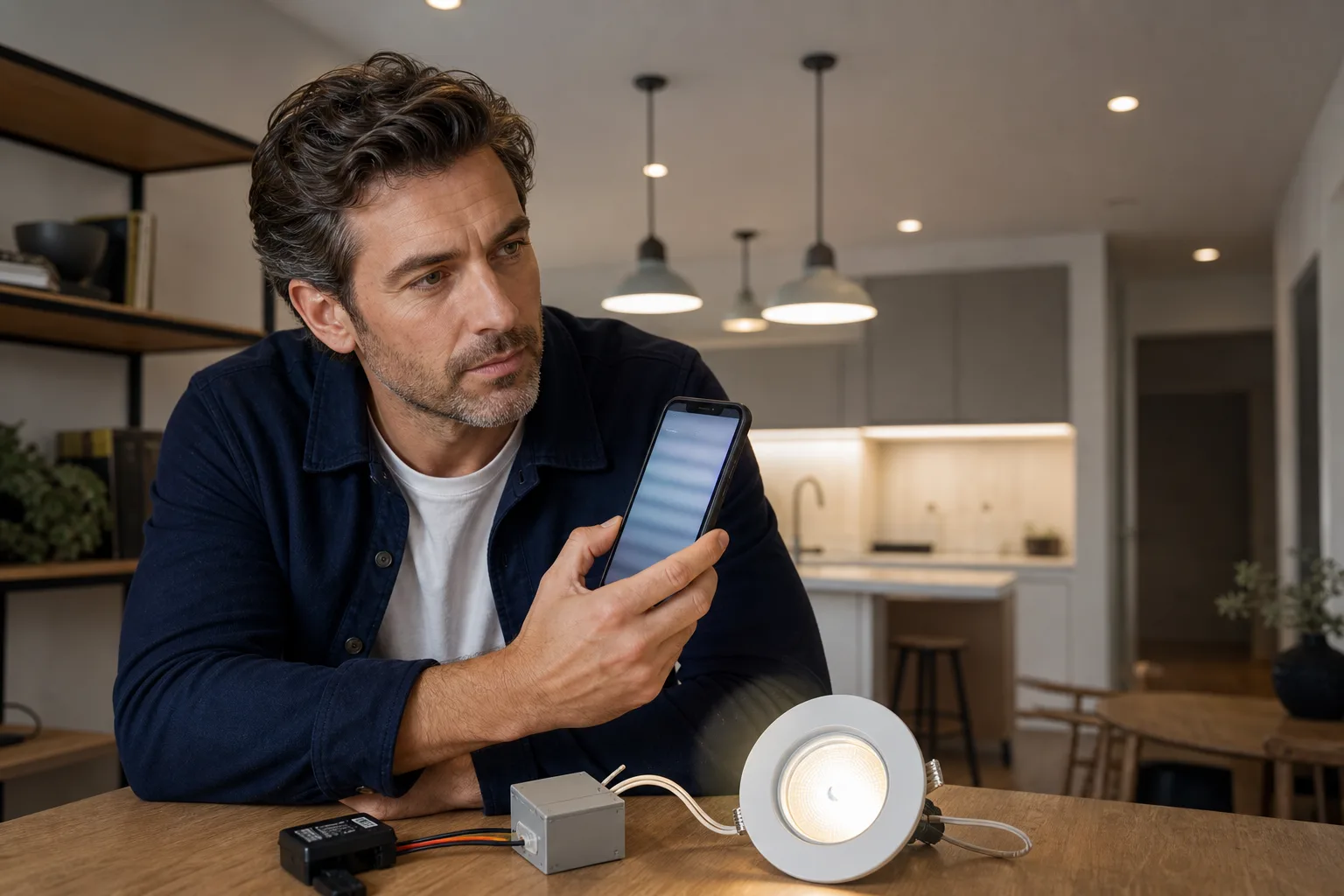
LED light flicker is a rapid variation in light output. It may appear as obvious flashing, subtle shimmer, bands in a video, or a stroboscopic effect when something moves. Common causes include an incompatible dimmer, a poorly performing or failing LED driver, a loose lamp, control-system behavior, or fluctuations in the electrical supply. Start by identifying whether the problem affects one lamp, one controlled group, one circuit or several areas of the home. Do not open a fixture, remove a switch plate or test energized wiring yourself; widespread or unexplained flickering should be assessed by a licensed electrician.
What LED flicker is—and why it is not always visible
Lighting specialists use temporal light modulation, or TLM, for measurable changes in light level or spectral distribution over time. A temporal light artifact is the visual effect that modulation produces. The CIE distinguishes direct flicker from effects involving motion, including the stroboscopic effect and phantom arrays. ([files.cie.co.at](https://files.cie.co.at/883_CIE_TN_006-2016.pdf?utm_source=openai))
Direct flicker, stroboscopic effects and camera banding
- Direct flicker: The light itself appears unsteady while the viewer and surroundings are relatively still.
- Stroboscopic effect: A moving object appears to jump, pause or break into separate positions.
- Phantom array: A rapid eye movement makes one source appear as a row of repeated images.
- Camera banding: Dark or bright stripes appear because the camera's frame rate and electronic shutter interact with changing light output. Banding can reveal modulation, but it does not by itself establish how people will perceive the light.
LEDs respond quickly to changes in current, so the driver—the electronics supplying and regulating that current—has a major influence on flicker. A well-designed driver can maintain comparatively stable output. A driver that responds poorly to supply fluctuations or to a dimmer may produce much deeper modulation. ([energy.gov](https://www.energy.gov/cmei/ssl/flicker-basics?utm_source=openai))
How flicker is described and measured
Frequency is measured in hertz (Hz), meaning cycles per second. If a repeating light waveform has a period T seconds, its frequency is:
f = 1 ÷ T
For example, a waveform repeating every 0.01 second has a frequency of 100 Hz. Frequency matters because two sources with the same change in output can produce different visual effects when they fluctuate at different rates.
Percent flicker, or percent modulation
A traditional calculation uses the maximum and minimum measured light output:
Percent modulation = 100 × (maximum − minimum) ÷ (maximum + minimum)
Assume a meter records a maximum relative output of 100 and a minimum of 20. The result is 100 × 80 ÷ 120, or about 66.7%. If output falls all the way to zero, the result is 100%.
This number is useful for describing modulation depth, but it does not account for frequency, waveform shape or duty cycle. Flicker index considers waveform shape and the proportion of output above the average, but it also omits frequency. Neither value should be treated as a universal comfort or safety score. ([energy.gov](https://www.energy.gov/eere/ssl/articles/flicker-review-temporal-light-modulation-stimulus-responses-and-measures?utm_source=openai))
What to request from a manufacturer
For a critical workspace, classroom, studio or room used by someone who reports sensitivity, look beyond an unsupported “flicker-free” label. Ask whether performance was measured at full output and at several dimmed levels, which control was used, and whether the report includes waveform frequency and modern TLM metrics. ANSI/IES TM-39-25 addresses metrics derived from measured waveforms and current practices for specifying visual responses to TLM. ([store.ies.org](https://store.ies.org/product/technical-memorandum-quantification-and-specification-of-visual-responses-to-temporal-light-modulation-a-k-a-flicker/?v=eb65bcceaa5f&utm_source=openai))
How to detect LED light flicker safely
No casual home check can certify flicker performance, but a structured screening process can help determine what happens and when. Record the lamp or fixture model, control type, dimming level, time and any appliance operating when the symptom occurs.
| Check | What to observe | What it may indicate |
|---|---|---|
| Set the dimmer to full output | Flicker stops or becomes less noticeable | Lamp-driver-dimmer compatibility or low-end adjustment |
| Change the dimming level slowly | Flashing appears only near the bottom of the range | Driver instability, insufficient load or an unsuitable low-end setting |
| Compare fixtures on the same control | Only one lamp flickers | Loose lamp, defective lamp or individual driver problem |
| Note large appliances starting | Several lights dip at the same moment | Supply fluctuation or a circuit/service issue requiring further assessment |
| Record slow-motion video | Bands or pulsing appear | Possible modulation; not a conclusive measurement |
| Use a dedicated meter | Frequency, waveform or metric values are reported | More useful evidence for comparing products or diagnosing a system |
A smartphone camera or app can be a convenient screening tool, but results depend on the camera sensor, exposure, shutter behavior and sampling rate. The Department of Energy has found that handheld and phone-based meters differ in capability and may fail to detect some frequencies reliably. Use camera results as a clue, not proof that a lamp passes or fails. ([stage.energy.gov](https://stage.energy.gov/sites/default/files/2019/04/f61/characterizing-photometric-flicker_nov2018.pdf?utm_source=openai))
If the source has a user-replaceable bulb, you may switch off power, allow the bulb to cool, confirm the correct base and rating, and compare it with a known-compatible bulb. Do not attempt this with damaged sockets, integrated LED fixtures or any installation that requires removing fixed electrical parts.
Common causes and practical fixes
An incompatible or older dimmer
Many controls originally designed for incandescent loads do not behave predictably with every LED driver. Symptoms can include shimmer, flashing, delayed start, sudden switch-off at low levels, or a lamp that remains faintly lit. Use a dimmable lamp and check the lamp or fixture manufacturer's compatibility information for the specific dimmer model. If an adjustment is provided, a qualified person can set the low-end trim so the control does not enter an unstable range.
Do not assume that combining any lamp marked “dimmable” with any LED-rated dimmer guarantees satisfactory results. The driver load, control method, number of lamps and selected output level can all affect performance. DOE research notes that driver behavior depends on loading, dimming level and the waveform supplied by the control. ([energy.gov](https://www.energy.gov/cmei/ssl/flicker-research?utm_source=openai))
A lamp, driver or fixture problem
If one lamp flickers while identical lamps on the same control remain stable, that lamp may be loose, damaged or nearing failure. With power off and only where the bulb is intended to be user-replaceable, verify that it is seated correctly. Replace it if the symptom continues.
In an integrated fixture, the LEDs and driver may not be separately replaceable. Check the fixture documentation and warranty rather than opening the housing. Repeated cycling after the fixture warms up can also point to a component or thermal problem; make sure the product is approved for its installation, such as an enclosed housing or insulated-ceiling location.
Smart controls, sensors and mixed lamps
Smart switches, occupancy sensors and illuminated controls may require particular wiring arrangements or compatible loads. Mixing lamp models on one dimmer can also produce uneven dimming because their drivers respond differently. Keeping lamps in a controlled group to the same manufacturer and model reduces one variable, although it cannot guarantee low flicker.
Supply or wiring problems
Flicker across several rooms, changes that occur without dimming, or lights that brighten while others dim should not be treated as a bulb-selection problem. Stop troubleshooting at the product level and contact a licensed electrician or the electric utility as appropriate. Electrical connections and service conductors are not safe DIY diagnostic points.
Choose bulbs, fixtures and controls with flicker in mind
Use this checklist before buying or specifying LED lighting:
- Confirm that the bulb or fixture is explicitly dimmable if it will be controlled by a dimmer.
- Match the listed voltage, base, physical size and fixture wattage limits.
- Check whether the product is suitable for enclosed, damp or wet locations where applicable.
- Look for manufacturer test data or an independently verified low-flicker claim rather than relying only on marketing language.
- Check performance at full output and at the dimmed levels you expect to use; low-level behavior may differ substantially from full-output behavior.
- Use a manufacturer-listed compatible control when possible.
- For integrated fixtures, investigate driver replaceability, warranty terms and control protocol before purchase.
- For video, detailed visual work or moving machinery, ask a lighting professional to evaluate the application rather than selecting by percent modulation alone.
Third-party verification can support a specific low-flicker marketing claim when the tested product, operating conditions and dimming levels are identified. It should not be assumed to cover untested controls or every possible installation. ([ul.com](https://www.ul.com/news/light-flicker-where-hertz-matters?utm_source=openai))
Plan the room so deep dimming is not the only option
Flicker control starts with product quality, but room planning can reduce dependence on the lowest and sometimes least stable part of a dimming range. Estimate the required light output in lumens, then use the lumens calculator as a planning aid. Its result is an estimate: room reflectance, fixture distribution, mounting height, shade losses and task location all affect the delivered light.
A layered lighting plan separates ambient, task and accent light. For example, a room can use moderate ambient light with a dedicated desk or counter light instead of oversizing one central fixture and routinely dimming it near minimum output. Independent layers also make it easier to isolate a troublesome bulb, fixture or control.
Give extra attention to spaces with prolonged visual tasks, cameras or fast movement. In kitchens, workshops and home offices, assess the actual fixture-control combination at normal operating levels. Room brightness, source visibility, surrounding daylight, motion and individual sensitivity can all change whether modulation is noticed, so a satisfactory sample or mock-up is more informative than a single specification number.
When flickering lights need an electrician
Call a licensed electrician promptly if flicker affects multiple lights or circuits, begins suddenly without a lamp or control change, or is accompanied by buzzing, crackling, sparks, repeated breaker trips, shocks, a burning or rubber-like smell, discoloration, or a warm switch or receptacle. Turn off the affected circuit if it can be done safely, and follow emergency guidance if there is smoke or fire.
The National Fire Protection Association specifically advises contacting a qualified electrician or landlord for flickering or dimming lights and for other warning signs such as warm or discolored outlets, sparks and recurring breaker problems. ([content.nfpa.org](https://content.nfpa.org/-/media/project/storefront/catalog/files/home-fire-safety/electrical/electrical_safety_checklist.pdf?rev=03d8fdf4ae13431986d3701244787223&utm_source=openai))
A licensed electrician should also handle dimmer replacement where fixed wiring is involved, loose socket or fixture wiring, integrated-driver diagnosis, unexplained voltage changes, and suspected service or neutral problems. Product swapping is reasonable only when it involves a normal user-replaceable bulb in an undamaged fixture with power off. When the cause is uncertain, treat flicker as an electrical symptom first and a lighting-quality issue second.
Frequently asked questions
Why do my LED lights flicker only when dimmed?
The lamp's driver and the dimmer may not operate reliably together, especially near the bottom of the dimming range. Confirm that the lamp is dimmable, check the manufacturer's compatible-control information and test whether the problem disappears at full output. A licensed electrician should replace or adjust a hardwired dimmer.
Can a phone camera accurately test LED flicker?
A camera can reveal possible modulation through moving bands or pulsing, but it is not a definitive test. Results depend on shutter speed, frame rate, exposure and sensor behavior. Reliable comparison requires a suitable optical meter and clearly stated measurement conditions.
Does a high percent flicker number always mean a light will look worse?
No. Percent flicker describes the difference between maximum and minimum output but omits frequency and waveform shape. Two lights can have the same percentage and produce different visual effects, so frequency and other metrics are also needed.
When is LED flicker an electrical safety concern?
Contact a licensed electrician when flicker affects several lights or circuits, occurs without a dimmer, or accompanies heat, discoloration, burning smells, buzzing, crackling, sparks, shocks or repeated breaker trips. Do not open switches, fixtures or energized electrical equipment to investigate.
Questions & discussion
Share a question or a useful experience about this guide. Comments appear immediately. Your name and comment are public. Email is optional and stays private; reply emails are not enabled yet. Comment privacy.