The editorial guide behind Ross Light
I’m Ross.
Let’s make sense of light.
I turn lighting specifications, room needs and safety limits into calm, checkable planning steps for everyday readers.

Why Ross Light exists
Good lighting advice should make the room clearer—not the subject harder.
Lighting information often arrives as a wall of numbers: lumens, lux, CCT, CRI and beam angle. Each number can be useful, but none of them can describe a room on its own. Ross Light exists to connect those specifications to the ordinary things people are trying to do—cook safely, read comfortably, work without glare or make an evening room feel settled.
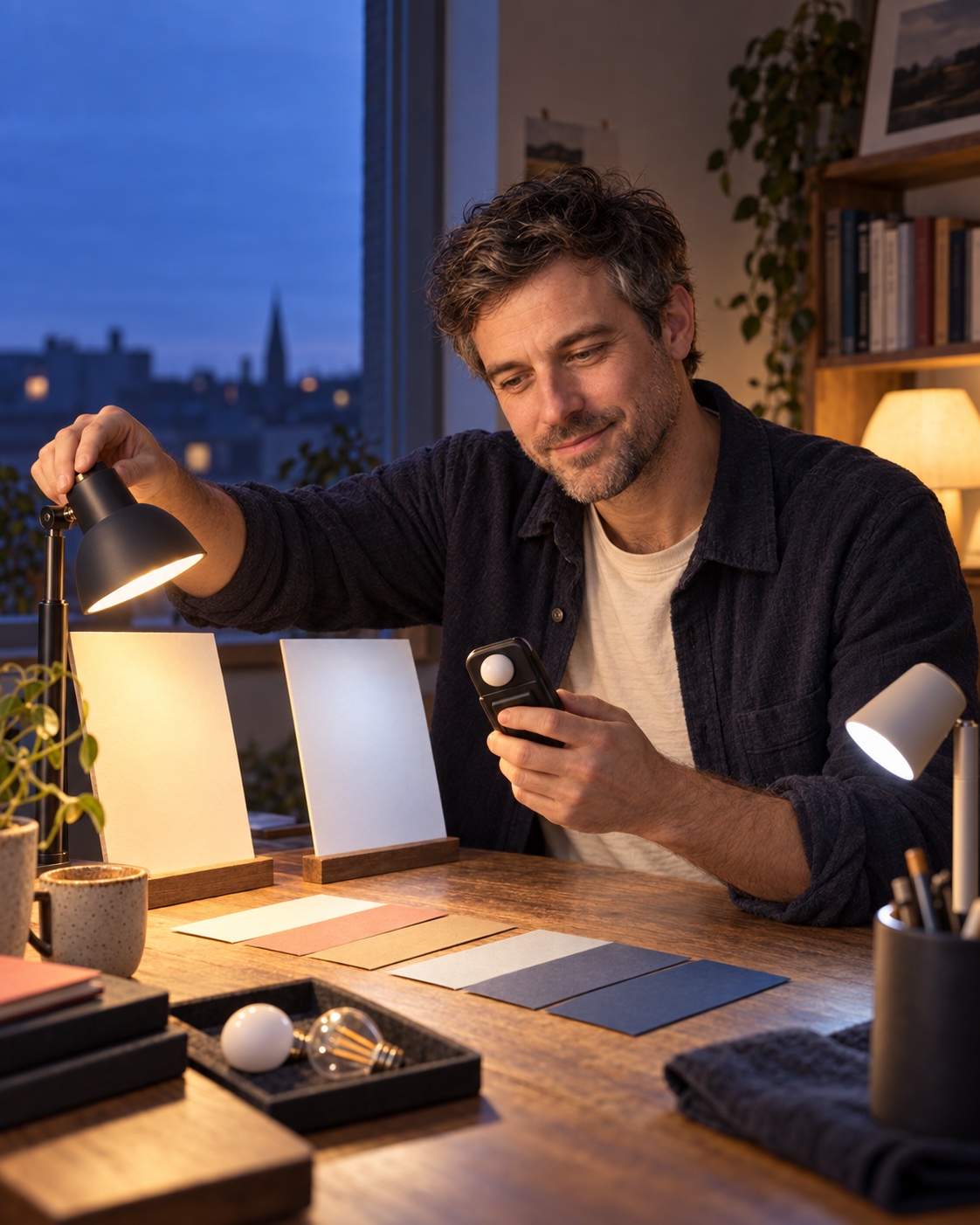
Ross is the original editorial character at the center of the site: curious enough to check the small print, practical enough to begin with the room, and cautious about turning a planning estimate into a promise.
“A useful answer should show where the number came from—and where it stops being useful.”— Ross’s note
What I can help you understand
From a specification sheet to a workable starting point.
Use these paths to turn lighting terms into decisions you can check in your own room.
Read the numbers
Understand what lumens, lux, color temperature, CRI and beam angle can—and cannot—tell you.
See the method →Plan around the room
Begin with dimensions, surfaces and the activity, then estimate a useful amount of light.
Try the room planner →Compare choices
Look beyond wattage and packaging claims when choosing bulbs, fixtures and controls.
Check how claims are handled →Spot common problems
Make sense of glare, flicker, buzzing and rooms that feel too bright, too dark or uneven.
Know the boundary →Use estimates well
Treat calculators as planning tools with visible formulas, assumptions and limits.
Open the calculator →Know when to stop
Recognize the point where a lighting question becomes electrical work for a local professional.
Read the safety line →The Ross Light method
Observe. Measure. Explain. Adjust.
The character of Ross grew from a simple habit: keep a notebook beside the lamp, write down what changed and resist changing three things at once. That patient, research-minded rhythm now shapes every guide.
- 01Observe the room and the task.Start with what someone needs to see, where they sit or stand, and what is already uncomfortable.
- 02Measure what can be measured.Use dimensions and published specifications carefully; do not pretend they capture every surface or fixture optic.
- 03Make the assumptions visible.Show the formula, inputs, evidence and uncertainty behind a recommendation or estimate.
- 04Adjust one variable and review.Change brightness, placement, shielding or color deliberately, then judge the result in the actual room.

How trust works here
Clear labels are more useful than borrowed authority.
Ross is an original editorial character and the consistent voice of Ross Light. Trust in the site should come from evidence you can follow, not from a biography you cannot verify.
Source facts
Definitions and technical claims should lead back to standards bodies, government publications, universities or established technical references.
Planning estimates
Calculator results are starting points. The formula, inputs and main limitations should remain visible beside the result.
Editorial judgment
When a guide interprets evidence or suggests a practical sequence, it should say so rather than presenting judgment as a universal rule.
Corrections
Material errors are checked against the strongest available source and reflected in the page’s updated date. Report something that needs review.
The professional boundary
Planning is useful. Some work belongs with a licensed professional.
Ross Light provides education and planning references. A lumen-method estimate can help you begin a conversation or compare options, but it is not a construction specification.
Permanent wiring, load calculations, code compliance, wet-location work and uncertain faults should be handled by a suitably licensed local professional. Requirements vary by location, so local rules always take precedence.